
What is the Kinematics JEE 2018 projectile-and-bounce question?
The rebound height in this kinematics JEE 2018 question is 30 m, not 60 m, because both the total kinetic energy and its vertical fraction decrease. The question is from JEE Advanced 2018, Paper 2, Physics. It is a numerical-answer question, not a JEE Main MCQ.
A ball leaves level ground at 45 degrees to the horizontal, reaches a maximum height of 120 m and returns to the ground. At its first impact, it loses half its kinetic energy and rebounds at 30 degrees to the horizontal. Find its next maximum height in metres.
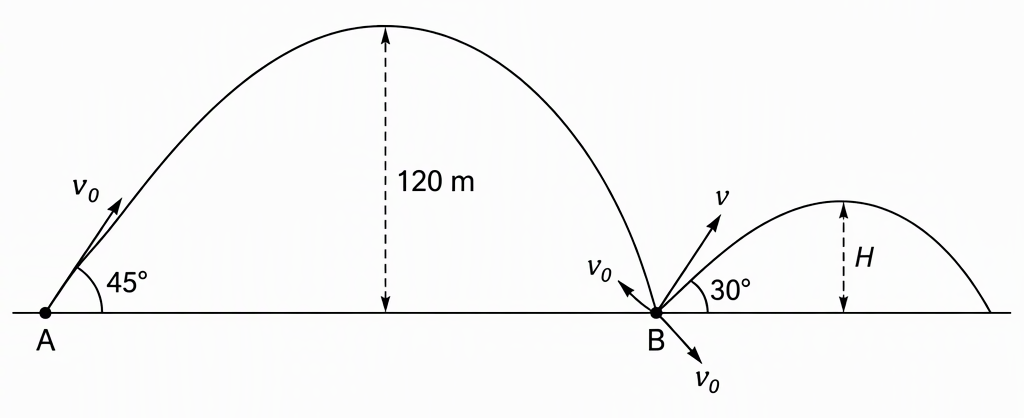
Keep three stages separate: first flight, collision and second flight. Apply energy loss only at the collision, then use the new angle for the rebound.
How does the first flight give the initial speed?
The first height gives the ratio of launch speed squared to gravitational acceleration; calculating the speed numerically is unnecessary. The official method retains this relation for the final substitution. Define the initial speed, gravitational acceleration and first maximum height as:
At the first apex, the vertical velocity is zero. The vertical-motion equation gives:
Rearranging, then using the launch angle:
Neglecting air resistance, the ball returns to its launch elevation with its initial kinetic energy restored. Its speed immediately before impact therefore equals its initial speed.
Equal speed does not mean equal velocity. The horizontal component is unchanged during flight, but the vertical component now points downward.
How does losing half the kinetic energy change the rebound speed?
The rebound speed is the incoming speed divided by the square root of two, not divided by two. Kinetic energy depends on speed squared, so apply the stated loss to energy first. Define the speed immediately after the bounce and the ball’s mass as:
Losing half means retaining half. Substitute the kinetic-energy expressions:
Cancel the common factor:
Halving speed would leave only one-quarter of the original kinetic energy, not half. Half the energy does not mean half the speed.
Do not assume conservation of horizontal velocity across the impact or introduce a coefficient of restitution. The supplied total-energy loss fixes the rebound speed, and the supplied rebound angle fixes its direction.
How do you calculate the rebound height as 30.00 m?
Use the rebound’s vertical speed in the maximum-height equation. The result is one-quarter of the first height: the collision reduces speed squared, while the lower rebound angle reduces the fraction of kinetic energy in vertical motion. Resolve the rebound velocity vertically:
At the rebound apex, the vertical velocity is zero:
Substitute the vertical component:
Now apply the collision result:
Compare this with the retained first-flight relation:
The numerical answer to enter is:
As a check, separate the energy and angle factors:
No numerical value of gravitational acceleration is needed because the same gravity appears in both height relations. Keep that shared factor symbolic rather than calculating the launch speed.
Why is halving 120 m to get 60 m wrong?
Direct halving ignores the changed launch angle. Height scales with total kinetic energy only when the launch angle is unchanged, for the same ball under the same gravity. This is a numerical-answer question: 60 m is an illustrative incorrect result, not a supplied wrong option.
The faulty reasoning is: “Half the total kinetic energy remains, so the height must halve.”
But maximum height depends on vertical kinetic energy, not all the kinetic energy:
The vertical fractions for the first launch and rebound are:
The retained energy contributes one factor of one-half. The changed vertical fraction contributes another factor of one-half, producing 30 m. Horizontal motion still carries energy at the apex; reaching maximum height does not mean the ball has stopped.
How do rebound angle and energy loss change the answer in practice questions?
An unchanged rebound angle makes direct halving valid; losing more energy at the same rebound angle reduces the height further. These two questions are original practice variations, not additional verified JEE PYQs. Attempt each question before reading its short solution.
Question 1: Keep the original 45-degree launch and 120 m first height. The ball loses half its kinetic energy at impact but now rebounds at 45 degrees. Find its next maximum height.
Solution: The angle is unchanged, so the vertical fraction is unchanged. Direct halving works here because only the total energy changes:
Question 2: Keep the original first flight and 30-degree rebound angle, but let the ball lose three-quarters of its kinetic energy at impact. Find its next maximum height.
Solution: The retained fraction is one-quarter. Apply that fraction to speed squared:
Using the 30-degree rebound height relation:
Before substituting in either variation, write down the retained energy fraction and the rebound angle separately. Use both to calculate the rebound height.
Next step: photograph a doubt on JEEnius and photograph any question you are stuck on and get a step-by-step solution, with a free-body diagram when the question needs one (20 free).
Read next: How to Study Magnetism JEE: Order, Equations and Practice.
Frequently asked questions
What is the answer to the JEE Advanced 2018 projectile bounce question?
The rebound height is 30 m, so the numerical answer is 30.00. The ball retains half its kinetic energy, while the change from a 45-degree launch to a 30-degree rebound halves the vertical energy fraction, giving one-quarter of the original 120 m height.
Why is the rebound height 30 m and not 60 m?
Maximum height depends on vertical kinetic energy, not total kinetic energy. Halving 120 m ignores the smaller rebound angle, which introduces another factor of one-half. Direct halving would give the correct height only if the rebound angle remained 45 degrees.
Does losing half the kinetic energy halve the speed?
No: kinetic energy is proportional to speed squared, so retaining half the energy reduces the speed to the incoming speed divided by the square root of two. Halving the speed would leave only one-quarter of the original kinetic energy.
Do I need a value of g to solve the JEE 2018 rebound question?
No numerical value of gravitational acceleration is needed. The first flight gives v₀²/(4g) = 120 m, and the rebound height is v₀²/(16g), so comparing the two expressions directly gives 30 m.