
What is the answer to the JEE Advanced 2017 Paper 2 electrochemistry question?
Option B is correct for the JEE Advanced 2017 electrochemistry question: the tenfold concentration ratio lowers the cell potential and adds a positive correction to Gibbs free energy. This is a Chemistry single-correct question from JEE Advanced 2017, Paper 2, not JEE Main.
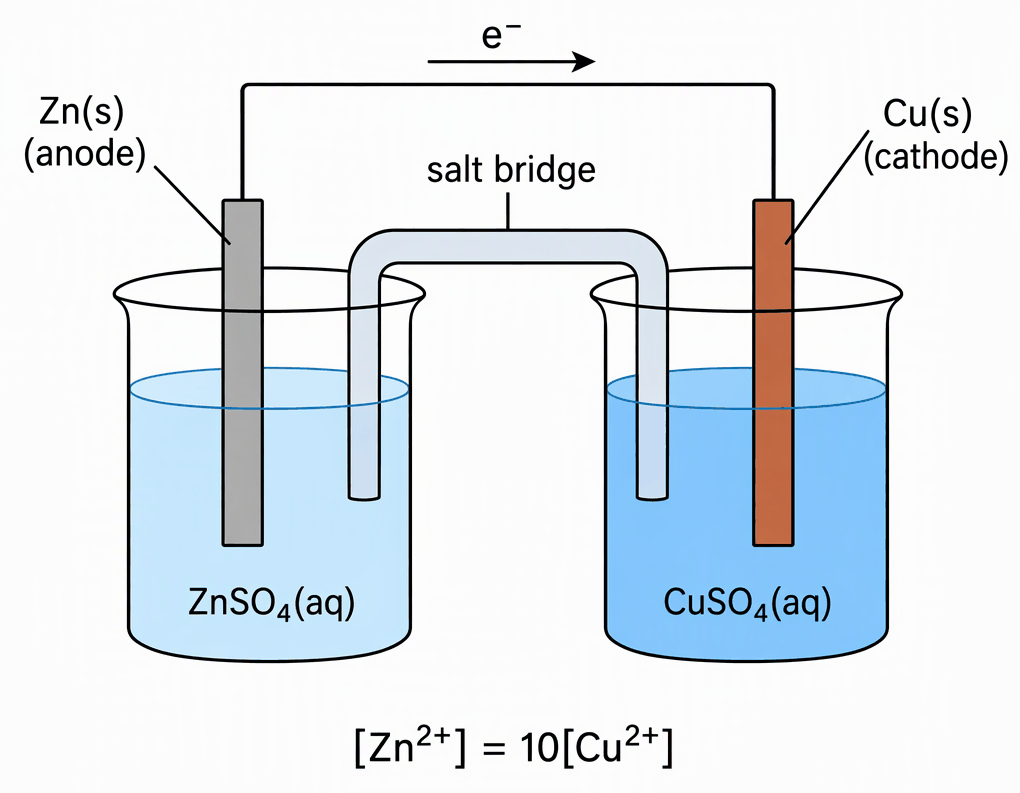
A zinc electrode in aqueous zinc sulphate is coupled to a copper electrode in aqueous copper sulphate. The zinc-ion concentration is ten times the copper-ion concentration.
The given standard cell potential is:
Find the Gibbs free energy change for the cell reaction, in joules per mole, at the given temperature. The symbols mean:
The four supplied options are:
- A
- B
- C
- D
The question bank tags this as medium difficulty and gives an expected solving time of 90 seconds. These are bank estimates, not an official exam standard.
How do you find the electron count and reaction quotient?
Two electrons are transferred, and the reaction quotient is ten. Follow the official solution’s half-reaction method: write oxidation and reduction first to fix the electron count and identify which ion belongs in the numerator.
At the anode, zinc undergoes oxidation:
At the cathode, copper ions undergo reduction:
Add these and cancel the electrons:
The two electrons released are the same two electrons accepted. Do not add them to obtain four:
Pure solid zinc and copper have unit activity, so neither appears in the reaction quotient. Using the concentration convention of the supplied solution:
The common copper-ion concentration cancels. No individual ion concentrations are required.
How do you apply the Nernst equation without assuming room temperature?
Subtract the concentration correction from the standard potential and keep temperature symbolic. The reaction quotient exceeds one, so the cell potential must be smaller than its standard value. Use this direction check to catch a reversed ratio.
Start with the Nernst equation:
Substitute the given potential, electron count and concentration ratio:
The logarithm is:
Therefore, with potential expressed in volts:
The factor 2.303 accompanies the base-10 logarithm; it converts from the natural-log form. The question does not specify 298 kelvin, so using a room-temperature numerical coefficient would introduce an unstated assumption.
How do you convert the cell potential into Gibbs free energy?
Multiply the non-standard cell potential by minus twice the Faraday constant. The concentration correction becomes positive because a negative multiplier acts on a negative term. Keep the bracket until you have written both products.
The required relation is:
Substitution gives:
Evaluate the two products separately:
The double negative gives the plus sign, and twice the Faraday constant cancels between numerator and denominator. Hence:
The correct answer is B. The first product is the standard contribution; the stated concentration ratio adds the positive correction shown in the second product.
For the units check, the Faraday constant multiplied by volts gives joules per mole. The gas constant multiplied by absolute temperature gives the same units:
Why does using the standard potential give option D?
Option D comes from calculating the standard Gibbs free energy instead of the value at the given concentrations. The exact mistake is substituting the standard potential where the non-standard potential is required.
The incorrect route is:
What that multiplication actually gives is:
The Nernst correction vanishes only when:
Here, the quotient is ten, not one. Use this diagnostic before selecting an option: Did the tenfold concentration ratio enter the calculation? If not, you have discarded a condition that changes the answer.
How can you practise three related concentration-ratio questions?
Change only the concentration ratio and repeat the Nernst-then-Gibbs sequence. These are original practice variations of the solved question, not additional PYQs. For all three, retain the same zinc-oxidation reaction direction, two-electron transfer and symbolic absolute temperature:
- Question 1: Find the Gibbs free energy when the two ion concentrations are equal.
First evaluate the quotient and logarithm, then calculate potential:
Now convert potential into Gibbs free energy:
- Question 2: Find the Gibbs free energy when the copper-ion concentration is ten times the zinc-ion concentration.
The quotient is still zinc-ion concentration divided by copper-ion concentration. Do not reverse its definition:
- Question 3: Find the Gibbs free energy when the zinc-ion concentration is one hundred times the copper-ion concentration.
A hundredfold ratio contributes two base-10 logarithmic units, not one hundred:
For this reaction at fixed temperature, each tenfold increase in the reaction quotient lowers the potential by:
It raises the Gibbs free energy by:
Cover the worked answers and redo all three. Check the ratio, logarithm sign and final multiplication before comparing your answers.
Next step: the past-paper archive on JEEnius and search every JEE Main paper from 2002 and every Advanced paper from 2007, by year, subject or chapter, each with a worked solution (free).
If that step was the hard part, work through Kinematics JEE 2018: Projectile Rebound Height of 30 m.
Frequently asked questions
What is the answer to the JEE Advanced 2017 Paper 2 electrochemistry question?
Option B is correct: ΔG = 2.303RT − 2.2F J mol⁻¹. The zinc-ion concentration is ten times the copper-ion concentration, so Q = 10. Applying the Nernst equation and then ΔG = −nFE gives the positive concentration correction.
Why are n = 2 and Q = 10 in the 2017 Daniell cell question?
Zinc releases two electrons, and copper ions accept those same two electrons, so n = 2, not 4. For Zn(s) + Cu²⁺(aq) → Zn²⁺(aq) + Cu(s), Q = [Zn²⁺]/[Cu²⁺] = 10. Pure solids have unit activity and do not appear in the quotient.
Why is option D wrong in the JEE Advanced 2017 electrochemistry question?
Option D, −2.2F, gives the standard Gibbs free energy calculated from E° = 1.1 V. The stated concentrations give Q = 10, so the Nernst correction is nonzero. Including it gives ΔG = 2.303RT − 2.2F J mol⁻¹.
Can I use the 298 K Nernst equation in this question?
No, the question does not specify 298 K, so keep temperature symbolic. Use E = E° − (2.303RT/nF) log₁₀Q rather than substituting a room-temperature numerical coefficient.