
Should I start metallurgy practice with PYQs or a worked drill?
If metallurgy is in your target-exam syllabus and your basics are secure, start with official-paper PYQs. If you still confuse extraction steps, attempt the free worked drill below first. For metallurgy practice questions JEE students can trust, compare two sources: questions located in official past papers and original chapter-practice questions with worked explanations.
An old JEE question establishes historical exam relevance, not inclusion in the current syllabus. Check your target year’s official JEE Main syllabus at jeemain.nta.nic.in and the JEE Advanced syllabus on the official JEE Advanced website separately. Coverage in one exam does not establish coverage in the other.
This recommendation concerns practice method, not whether metallurgy is currently included or excluded. Check syllabus relevance before allocating revision time.
What do official PYQs and original chapter drills actually give you?
Official-paper PYQs test your handling of an actual past exam question; worked drills help repair a specific concept. Official papers and final answer keys establish the question and accepted answer, but a key alone does not explain the chemistry.
- Provenance: Official-paper PYQs come from an identifiable exam paper; original worked chapter drills should be labelled as newly written practice.
- Answer verification: PYQ answers can be checked against the final official key; drill answers need explanations whose assumptions and chemistry can be checked.
- Concept targeting: PYQs may combine several ideas; drills can isolate one misconception, such as confusing electrolyte function with reduction.
- Explanation depth: An official key supplies the accepted answer, not worked reasoning; a worked drill should explain the answer and the tempting mistake.
- Exam-format fidelity: PYQs preserve their original format. Advanced PYQs preserve that particular paper’s format, not a fixed future pattern; drills use their author’s chosen format.
- Syllabus filtering: Both require checking against your target syllabus. A chapter label or an old exam appearance is insufficient.
- Best use: Choose PYQs to test readiness; choose drills to diagnose and repair weak reasoning.
Finding a chapter question manually in a full paper takes more effort than using a chapter-wise collection. A third-party collection saves sorting time but still needs source checking. An original drill can isolate a misconception, but cannot establish past question frequency or future exam weightage.
Which source should I choose for my stage of preparation?
Choose by what you can explain, not by your class label alone. If you remember an extraction sequence but cannot explain its conditions, choose concept repair. If you can defend each step, apply that knowledge to relevant official questions.
- Class 11, first exposure: Study the relevant extraction concepts, then attempt the worked drill. Do not accumulate difficult PYQs before understanding why concentration, conversion and reduction are separate operations.
- Class 12, processes remembered but reasons weak: Attempt the drill without looking at the solutions. Move to PYQs for concepts you answer correctly with sound reasoning; repair the others first.
- Dropper, familiar PYQ options: Use the original drill to check reasoning. Recognising an answer from a previous attempt is not the same as deriving it from the question’s conditions.
- Advanced aspirant, secure basics: Prioritise applicable Advanced PYQs. Read each paper’s question-specific marking instructions rather than carrying assumptions from another paper.
- Main-only student, little time: Confirm target-year syllabus relevance before allocating a metallurgy practice block. Assess overlapping thermodynamics or redox content under its own syllabus heading.
For students and parents, an explained correction followed by a successful retry is evidence of progress. The number of PDFs collected is not. Keep a short error record naming the mistaken idea and showing the corrected reasoning.
Can I try free metallurgy questions before choosing my next set?
Attempt these four questions without viewing the answers, and write one sentence explaining each choice. They are original editorial practice, not PYQs or a verified JEEnius question-bank offering. This diagnostic checks selected concepts only; it is neither a complete chapter test nor a predictor of JEE marks.
Each question has one correct option. Finish all four before moving to the answer section.
Question 1: Which processes are shown?
Zinc carbonate is heated in the absence or limited supply of air. Zinc sulphide is heated with an adequate supply of air:
Which classification is correct?
- A. Both are roasting because both involve heating.
- B. The first is calcination; the second is roasting.
- C. The first is roasting; the second is calcination.
- D. Both are calcination because both produce an oxide.
Question 2: What establishes thermodynamic feasibility?
Consider the following reduction at a specified temperature, with gas pressures and solid phases fixed. Judge the forward reaction under those conditions.
Which criterion establishes thermodynamic favourability?
- A. The overall reaction releases heat.
- B. Formation of zinc oxide has a negative Gibbs free-energy change.
- C. Carbon monoxide contains carbon, so reduction must occur.
- D. The overall coupled reaction has a negative Gibbs free-energy change.
Question 3: Why is cryolite used in aluminium extraction?
Why is alumina dissolved in molten cryolite instead of simply electrolysing pure molten alumina?
- A. The mixture allows a lower operating temperature and improves electrolyte conductivity.
- B. Cryolite supplies electrons and chemically reduces alumina without electrolysis.
- C. Cryolite makes aluminium deposit at the anode instead of the cathode.
- D. Cryolite prevents ions from moving, reducing unwanted current.
Question 4: What happens during copper electrorefining?
Which description correctly identifies the electrodes and copper deposition?
- A. Pure copper is the anode; impure copper is the cathode; copper deposits at the cathode.
- B. Impure copper is the anode; pure copper is the cathode; copper deposits at the anode.
- C. Impure copper is the anode; pure copper is the cathode; copper deposits at the cathode.
- D. Impure copper is the cathode; pure copper is the anode; copper deposits at the anode.
What are the correct answers, and why are the other choices tempting?
The answers are 1-B, 2-D, 3-A and 4-C. A correct option without a valid explanation is still a reason to revise. Compare your written reasoning with the explanations below, especially where an option uses a familiar term in the wrong role.
1. B: Check the role of air, not just the ore name.
The first reaction is thermal decomposition of the carbonate under absent or limited air, so it is calcination. The second consumes oxygen to convert the sulphide into oxide and sulphur dioxide, so it is roasting.
Heating occurs in both processes, making A tempting but wrong. Producing an oxide also does not identify the process by itself. Repair: process conditions, especially whether oxygen participates in the reaction.
2. D: Evaluate the complete coupled reaction.
Use the Gibbs free-energy change for the overall reaction under the specified conditions, including gas pressures. The criterion is:
Zinc oxide reduction must be considered together with carbon monoxide oxidation, not by inspecting oxide formation alone. Option A confuses heat release with Gibbs free-energy change; entropy also matters.
Negative Gibbs free-energy change establishes thermodynamic favourability, not speed. Activation barriers or limited contact between phases may slow the reaction. Repair: coupled-reaction thermodynamics.
3. A: Cryolite changes the electrolyte’s working conditions.
Pure alumina requires a very high temperature to melt. Dissolving it in molten cryolite allows operation at a lower temperature and improves electrolyte conductivity.
Option B wrongly assigns cryolite the role of a reducing agent. Electrical energy drives the reduction of aluminium species at the cathode; cryolite does not replace electrolysis. Repair: electrolyte function.
4. C: Copper dissolves at the anode and deposits at the cathode.
Impure copper is the anode, where copper is oxidised into solution. A pure copper starter sheet is the cathode, where copper ions gain electrons and deposit.
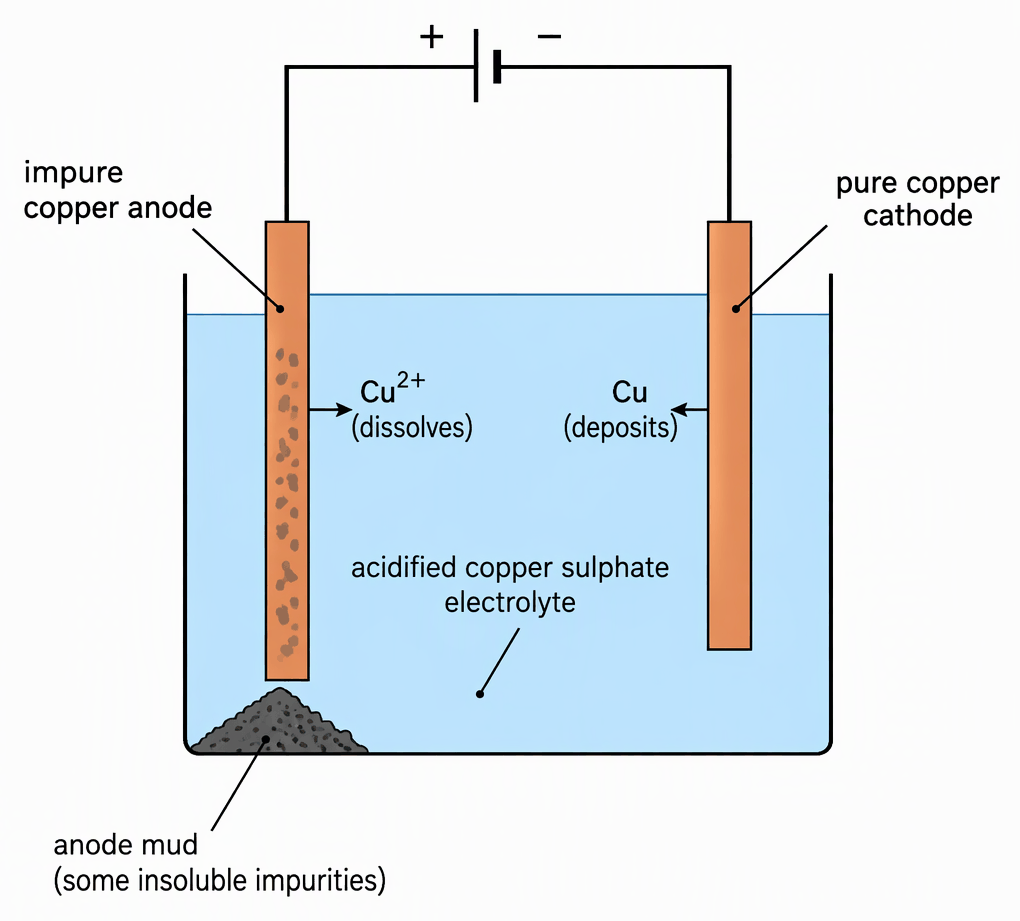
Option B reverses the location of deposition. Impurity behaviour varies: some impurities dissolve and remain in solution, while some form anode mud. Not every impurity becomes mud. Repair: electrode reactions, including where oxidation and reduction occur.
How do I turn a metallurgy PYQ into useful practice?
Identify its source, check syllabus relevance, attempt it, verify the final official key and explain the chemistry. The key establishes the accepted answer for that paper. Your practice is incomplete until you can explain the result and reject the strongest alternative.
- Identify the exam and paper. Record the year, paper or shift, and question identifier when available. If the source cannot be established, call it a practice question, not a PYQ.
- Check syllabus relevance. Match the tested concept to your target year’s official syllabus before adding it to your revision queue.
- Attempt independently. Keep the solution hidden. Write the relevant process condition, reaction or thermodynamic argument before choosing an option.
- Verify against the final official key. If a chapter-wise compilation disagrees, check the original wording, conditions, options and question status, including whether it was dropped, before accepting the compilation’s answer.
- Explain and retry. Correct the reasoning, revise the weak concept, then retry with the solution hidden. State why the tempting alternative fails.
Separate an incorrect fact from an incorrect inference. Confusing roasting with calcination calls for revising process conditions; choosing a reducing agent from an incomplete free-energy argument calls for rebuilding the coupled reaction.
A small collection cannot establish chapter weightage. Do not turn its question count into a promised number per paper.
When should I stop chapter drills and take a full mock?
Take a full mock when pacing or switching between chapters and subjects is the problem, not when an extraction concept remains unclear. A long paper is an inefficient substitute for repairing one misunderstood electrode reaction.
- Wrong concept, weak explanation or guessed answer: Revise that idea and attempt another targeted drill.
- Correct answer with sound reasoning: Move to applicable official-paper PYQs.
- Sound chemistry but poor paper management: Practise a full paper and examine how you allocate time across subjects.
For that last need, JEEnius offers full-length mock tests, including free tests: a 75-question, 300-mark, 180-minute paper with a scored per-subject breakdown. These figures describe the JEE Main full-paper format, not a metallurgy test or an Advanced pattern.
Attempt the diagnostic, explain each error, and choose your next source from that evidence.
Next step: full-length mock tests on JEEnius and sit a full 75-question, 300-mark, 180-minute paper and get a scored per-subject breakdown (free tests included).
Keep going with Units and Measurements JEE 2017: Well-Depth Error.
Frequently asked questions
Should I start metallurgy practice with PYQs or chapter drills?
Start with official-paper PYQs if the tested concepts are in your target-year syllabus and your basics are secure. If you confuse extraction steps or cannot explain process conditions, attempt a worked drill first. Choose by the quality of your reasoning, not your class or the number of questions completed.
Does an old metallurgy PYQ mean the topic is in the current JEE syllabus?
No. An old PYQ establishes historical exam relevance, not current syllabus inclusion. Check your target year’s official JEE Main and JEE Advanced syllabuses separately before allocating revision time.
Where can I practise free metallurgy questions with solutions?
This article includes four free original questions with worked explanations on calcination and roasting, reduction thermodynamics, cryolite and copper electrorefining. They are editorial practice questions, not PYQs. Use them to diagnose selected misconceptions, not as a complete chapter test or a predictor of JEE marks.
How do I verify the answer to a metallurgy PYQ?
Identify the exam year, paper or shift, and question identifier when available, then check the final official answer key. If a compilation disagrees, inspect the original wording, conditions, options and question status, including whether it was dropped. After verification, explain the chemistry and retry with the solution hidden.
When should I move from metallurgy drills to full mocks?
Use targeted drills while concepts remain unclear or correct answers depend on guessing. Move to syllabus-relevant official PYQs when you can answer with sound reasoning. Take a full mock when pacing or switching between chapters and subjects is the main problem.