
Which free matrices practice should I choose for JEE?
For free matrices practice questions for JEE, choose targeted drills if multiplication, powers or invertibility cause errors. Choose matrices PYQs when operations are secure but unfamiliar applications are difficult. Choose full-length mocks for question selection and whole-paper execution, not to repair a concept from scratch.
Six original questions with worked solutions start in the fourth section below. They are not previous-year questions.
How do chapter drills, PYQs and full-length mocks compare?
Drills isolate a rule, PYQs test its use in authentic exam wording, and mocks test decisions across a paper. Pick the format that exposes your current mistake, rather than choosing by the size of a question collection.
- Best use
- Targeted chapter drills: Repair a specific gap, such as multiplication order or legal cancellation.
- Previous-year questions: Apply known rules when the method is not announced.
- Full-length mocks: Test selection, accuracy and time allocation across subjects.
- Question context
- Targeted chapter drills: Narrow topic focus isolates mistakes.
- Previous-year questions: Authentic exam wording and combinations of ideas.
- Full-length mocks: Whole-paper context, with competing demands on attention.
- Feedback to seek
- Targeted chapter drills: The first incorrect algebraic step.
- Previous-year questions: Why the solution works and where your approach failed.
- Full-length mocks: Avoidable errors, poor selections and accessible questions left unfinished.
- Main versus Advanced relevance
- Targeted chapter drills: Foundations for both; depth depends on the questions.
- Previous-year questions: Choose authentic questions from your target exam.
- Full-length mocks: A 75-question, 300-mark, 180-minute format corresponds to JEE Main, not a fixed JEE Advanced pattern.
- Principal limitation
- Targeted chapter drills: The topic label can make the required method too obvious.
- Previous-year questions: Remembering a solution can disguise a weakness.
- Full-length mocks: There may be too few matrices questions to diagnose the chapter.
- Free-access checks
- Targeted chapter drills: Check that questions, answer keys and worked explanations are free.
- Previous-year questions: Check those three items and the original paper identity.
- Full-length mocks: Check free access to questions, answer keys and explanations, as well as scoring.
Do not assume “free questions” means free solutions. An answer key confirms a result; an explanation should justify the steps.
What should Class 11, Class 12 students and droppers choose?
Choose by the error, not your class or attempt number. A dropper can need basic drills, while a Class 12 student may need whole-paper practice. Solving and explaining an unfamiliar question is better evidence than time spent studying the chapter.
- Class 11, studying matrices ahead of school: Start with dimensions and operations. Do not jump into mixed-paper timing while multiplication is uncertain.
- Class 12, chapter completed but matrix equations are hard to set up: Use targeted equation drills, then fresh chapter PYQs. Form the equations yourself before reading solutions.
- Dropper, familiar with old PYQs: Solve unseen variants without opening solutions. Recognition is not mastery.
- Any stage, chapter work correct but accessible mathematics unfinished: Prioritise full-paper practice and review. Check question selection and time spent on stalled attempts.
- Advanced aspirant: Use reasoning-focused practice and authentic Advanced PYQs. A Main-format mock cannot substitute for Advanced practice.
For parents: Ask the student to correct and explain an error, then solve a fresh variant. Downloaded practice files do not show what they can do independently.
Can I try six free matrices practice questions for JEE now?
Attempt these six original questions before reading the solutions. They are not official PYQs or a prediction of chapter weightage. Write a short justification beside every answer so that a lucky selection does not pass as understanding.
This set checks selected foundations, not the entire chapter. It does not establish Advanced readiness.
Q1. Single-correct MCQ
The matrices have orders:
Choose the ordered pair of product orders:
Q2. Numerical answer
Find the entry in row 1, column 2 of the cube:
Q3. Numerical answer
Find the parameter that makes this matrix singular:
Q4. Numerical answer
Use the matrix equation to find the requested sum:
Q5. Single-correct MCQ
For square matrices of the same order, which condition guarantees this implication?
Q6. Single-correct MCQ
A square matrix satisfies the following relation, where the identity matrix has the same order:
Find its inverse:
Stop here until you have written your reasoning. For an uncertain answer, record the exact step you could not justify rather than guessing.
How do I solve these matrices questions correctly?
The answers are Q1 (a), Q2 6, Q3 4, Q4 3, Q5 (b) and Q6 (c). Compare the rules below with your working, not just your final answers. Find the first step where your reasoning breaks.
Q1: Match inner dimensions; retain outer dimensions.
A product exists when the first matrix’s column count matches the second matrix’s row count:
Therefore:
Both products exist, but they cannot be equal because their orders differ. Even when reversed products have the same order, equality is not automatic.
Q2: The off-diagonal entry is 6.
Separate the identity matrix from the remaining part:
The identity commutes with every matrix of the same order. Hence:
Direct multiplication confirms it:
Cubing each entry separately is not matrix cubing.
Q3: The parameter is 4.
A square matrix is singular precisely when its determinant is zero:
At this value, the matrix is not invertible. A matrix containing nonzero entries can still be singular.
Q4: The requested sum is 3.
Multiply each row by the column vector to obtain two scalar equations:
The first row already gives the requested sum. Solving both equations checks that you translated the matrix equation correctly.
Q5: Invertibility permits left cancellation.
Multiply both sides on the left by the inverse, preserving order:
Nonzero alone is insufficient. Consider:
Then:
Both right-hand factors are invertible:
Thus the same example defeats options (a), (c) and (d). Scalar-style cancellation and treating every nonzero matrix as invertible are invalid.
Q6: Construct the inverse before claiming it exists.
Rearrange the given polynomial relation:
Both multiplication orders give:
Therefore:
This proves invertibility without assuming it in advance. Watch for sign errors and the missing factor of one-half; retain the identity matrix rather than replacing it with a scalar.
What should I practise next based on my mistakes?
Use the type of error, not a total score, to choose your next format. A correct option without an explanation needs another attempt. A sign error needs a different repair from an invalid cancellation rule.
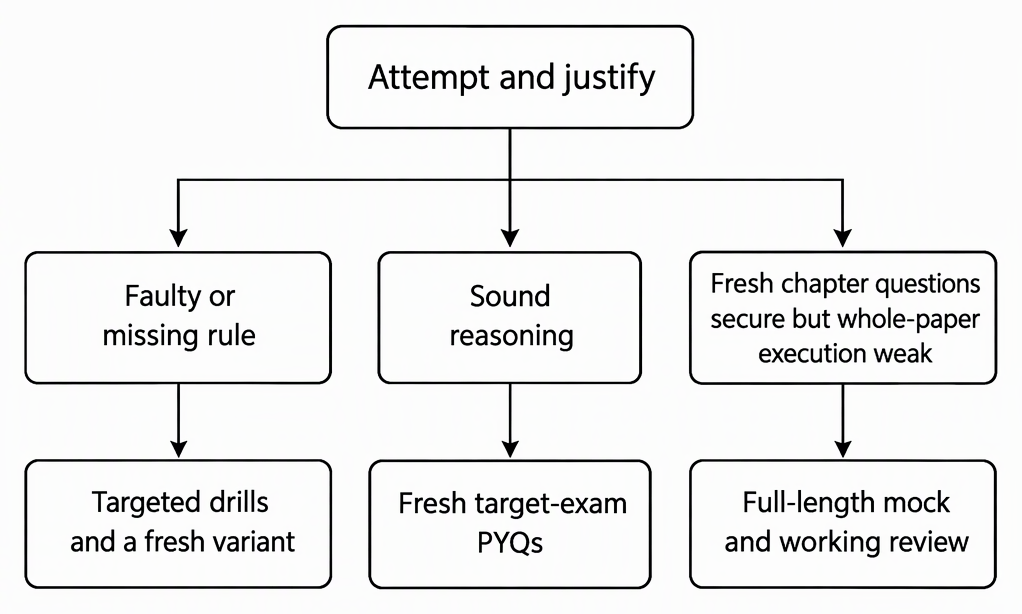
- Errors in Q1 or Q4: Return to order compatibility, multiplication and translating matrix equations before starting a full mock.
- Errors in Q2 or Q6: Practise identities, powers and polynomial relations. Write the identity matrix explicitly wherever required.
- Errors in Q3 or Q5: Repair singularity, invertibility and legal cancellation before tackling harder inverse problems.
- Correct answers without explanations: Reattempt with written reasoning before progressing.
- Correct answers with sound reasoning: Move to fresh matrices PYQs from your target exam. This set alone does not prove complete chapter mastery.
For PYQs, verify the original paper identity and answer key. Do not assign an invented year or shift to an unverified question.
Keep an error log with four columns: question, incorrect step, corrected rule, fresh variant to solve. For example:
- Question: Q5.
- Incorrect step: Cancelled a nonzero left factor.
- Corrected rule: General left cancellation requires an invertible left factor.
- Fresh variant: Check cancellation using a different singular matrix.
When should I take a free JEEnius mock?
Take a mock once you can solve fresh chapter questions independently and need to test whole-paper performance. JEEnius includes free full-length mock tests with 75 questions, 300 marks, 180 minutes and a scored per-subject breakdown. This is a Main-format next step, not an Advanced practice substitute.
A per-subject score is not a matrices-level diagnosis. Inspect the relevant questions and your working separately, including questions you skipped despite knowing the method.
For Main-style review, use:
Blind guessing risks losing marks under this scheme without showing what you understand. Review a mistaken calculation separately from a poor decision to attempt an unfamiliar question.
Attempt the diagnostic, review the first faulty step and select the practice format that addresses it.
Next step: full-length mock tests on JEEnius and sit a full 75-question, 300-mark, 180-minute paper and get a scored per-subject breakdown (free tests included).
Keep going with Probability Theory JEE 2024: Integer-Product Solution.
Frequently asked questions
Are these free matrices questions official JEE PYQs?
No. These are six original questions with worked solutions, not official previous-year questions. They check selected foundations and do not establish complete chapter mastery or JEE Advanced readiness.
Should I practise matrices drills, PYQs or full-length mocks?
Use targeted drills when rules such as multiplication order, powers or cancellation are uncertain. Move to fresh target-exam PYQs when you can solve and explain chapter questions independently. Use full-length mocks to test question selection, accuracy and time allocation across the paper.
Can I cancel A from AB = AC if A is nonzero?
A nonzero matrix cannot always be cancelled. For square matrices of the same order, invertibility of A guarantees that AB = AC implies B = C. Multiply both sides on the left by the inverse of A, preserving multiplication order.
When should I take a free JEEnius mock for JEE?
Take a mock once you can solve fresh chapter questions independently and need to assess whole-paper performance. JEEnius offers free full-length mocks with 75 questions, 300 marks, 180 minutes and a scored per-subject breakdown. This is a JEE Main-format next step, not a substitute for JEE Advanced practice or a matrices-level diagnosis.