
What is the Units and Measurements JEE 2017 well-depth question?
The correct answer is B, 1%: apply the timing uncertainty to the combined fall-and-sound interval. This Units and Measurements JEE 2017 question is a single-correct question from JEE Advanced 2017, Paper 2, Physics, on error propagation in an indirect measurement.
A person releases a stone from rest at the mouth of a well. They time the interval from release until the sound of its impact at the bottom reaches them at the mouth.
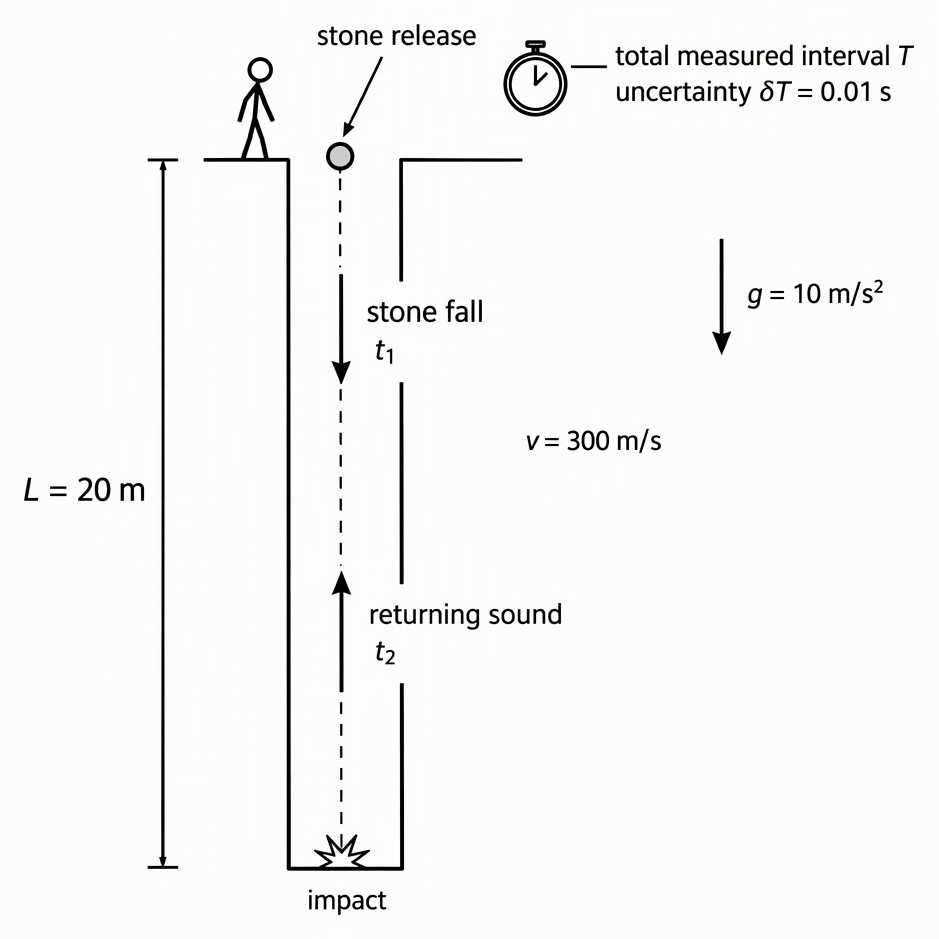
The measured depth is 20 m, and the timing uncertainty is 0.01 s. Take gravitational acceleration as 10 m/s² and sound speed as 300 m/s.
Which option is closest to the fractional depth uncertainty expressed as a percentage?
The difficulty is medium on the question bank’s scale, with 120 seconds as its suggested solving time.
How do you write the two parts of the measured time?
Add the stone’s fall time and the returning sound’s travel time. The stopwatch does not stop at impact: the observer must wait for the sound. Both journeys cover the well’s depth, but the stone accelerates while sound travels at the supplied constant speed.
Define the fall time, upward sound-travel time and depth as:
For release from rest:
For the returning sound:
Therefore, the measured interval is:
At the stated depth:
How do you differentiate time to find the depth uncertainty?
Differentiate the complete time–depth relation, then divide the timing uncertainty by that derivative. Treat gravitational acceleration and sound speed as fixed because the question supplies uncertainty only in the measured time. The derivative tells us how much the measured interval changes for a small change in depth.
For the fall-time term, apply the chain rule:
For the sound-travel term:
Combining the two derivatives gives:
For a small uncertainty, the first-order relation is:
The derivative is positive here: increasing the depth increases both travel times. Rearranging gives the absolute depth uncertainty:
Check the units before substituting. The derivative has units of seconds per metre, so dividing the timing uncertainty by it produces metres:
How does the calculation give option B?
The first-order percentage uncertainty is 0.9375%, closest to 1%, so the correct option is B. Keep the calculation in three stages: absolute error, fractional error and percentage error. Stopping after the first stage gives a length uncertainty, not the quantity requested.
First evaluate the square-root term:
Hence:
Within the first-order approximation, the absolute error is:
Divide by the measured depth to obtain the dimensionless fractional error:
Convert that fraction to a percentage:
Keep the three results separate:
- Absolute error: 0.1875 m.
- Fractional error: 0.009375.
- Percentage error: 0.9375%.
How can confusing absolute and percentage error lead to option A?
Option A can result from relabelling an absolute error as a percentage. One possible incorrect route is to calculate the depth uncertainty correctly, drop its unit, attach a percent sign and round to the listed option:
A length uncertainty cannot become a percentage merely by changing its label. The missing operation is division by the measured depth, followed by multiplication by 100:
Retain the metre unit until the division. Its cancellation shows exactly where the answer becomes dimensionless; only then should you convert the fraction to a percentage.
Which two original questions practise the same error rules?
Use a direct-power question and a quotient question to practise converting measurement uncertainty to percentage uncertainty. Both questions below are original chapter practice, not verified past-paper questions. Try each before reading its worked answer.
Question 1: An indirectly measured quantity follows the relation below, with the constant exact. Find its percentage uncertainty.
Differentiate, multiply by the timing uncertainty, then divide by the original quantity:
Question 2: Density is calculated from the following measurements. Find its maximum first-order percentage uncertainty.
For a quotient, add the magnitudes of the fractional uncertainties to obtain the maximum:
Question 1 uses a direct power relation. Question 2 asks for maximum uncertainty, so use addition of magnitudes, not statistical quadrature.
Before selecting any percentage-error option, check that you have divided the absolute uncertainty by the measured quantity and cancelled the units.
Next step: the past-paper archive on JEEnius and search every JEE Main paper from 2002 and every Advanced paper from 2007, by year, subject or chapter, each with a worked solution (free).
For a worked example of the same idea, see Integral Calculus JEE 2024: Tangent Slopes and Errors.
Frequently asked questions
What is the answer to the JEE Advanced 2017 well-depth question?
The correct answer is option B, 1%. The first-order absolute depth uncertainty is 0.1875 m; dividing by the 20 m depth and multiplying by 100 gives 0.9375%, closest to 1%.
Why do we add sound-travel time in the well-depth question?
The measured interval ends when the observer hears the impact, not when the stone reaches the bottom. It therefore includes both the stone's fall time and the sound's return time: T = √(2L/g) + L/v.
How do you calculate depth uncertainty from timing uncertainty?
Treat gravitational acceleration g and sound speed v as fixed, then differentiate T = √(2L/g) + L/v to obtain dT/dL = 1/√(2gL) + 1/v. The first-order depth uncertainty is δL ≈ δT / |dT/dL|. For L = 20 m, g = 10 m/s², v = 300 m/s and δT = 0.01 s, this gives δL ≈ 0.1875 m.
Why is 0.2% wrong for the JEE 2017 well-depth question?
The calculated 0.1875 m is an absolute depth uncertainty, not a percentage. Relabelling it as 0.1875% and rounding to 0.2% skips division by the measured depth. The correct conversion is (0.1875/20) × 100% = 0.9375%.