
Which Alcohols, Phenols and Ethers practice questions should I start with for JEE?
Start with concept questions if reactions still confuse you, chapter PYQs after theory, and full-length mocks for execution across the syllabus. For free Alcohols, Phenols and Ethers practice questions for JEE, attempt the original diagnostic below: six questions with worked explanations, available directly on this page.
No single format does all three jobs well. A chapter exercise can expose a misunderstood reagent, but it cannot test how you handle Chemistry after a difficult Mathematics section. Repair the reaction rule first, check it against actual JEE questions second, and test pacing last.
How do NCERT exercises, this diagnostic, PYQs and free mocks compare?
NCERT checks foundations, this diagnostic tests selected reaction rules, PYQs check exam application, and mocks test whole-paper execution. Choose by the error you need to uncover, not the advertised question count.
- Purpose: NCERT chapter exercises: foundation check. On-page diagnostic: identify selected reaction-rule errors. Official JEE PYQs: apply knowledge to questions actually asked. Free full-length mocks: practise whole-paper decisions and pacing.
- Before theory is complete: NCERT: use alongside the corresponding theory. Diagnostic: attempt reactions already studied. PYQs: use selectively for learning, not as a timed judgement. Mocks: poor tools for learning an unfinished chapter.
- Chapter targeting: NCERT: chapter-specific. Diagnostic: six checks, not exhaustive coverage. PYQs: select from official papers or verify a chapterwise collection’s sources. Mocks: cover the syllabus, with no guarantee of a particular chapter’s questions.
- Explanation availability: NCERT: worked examples support learning; exercises are not a worked-solution bank. Diagnostic: every answer is explained below. PYQs: an official answer key gives answers, not necessarily reasoning. Mocks: solution access depends on the offer; a score breakdown is not a worked explanation.
- Exam-interface practice: NCERT: none. Diagnostic: none. PYQs: reading a paper does not reproduce a computer-based interface. Mocks: online tests provide screen-based practice, though interfaces differ.
- Main limitation: NCERT: not a substitute for unfamiliar JEE applications. Diagnostic: narrow coverage. PYQs: remembered answers can disguise weak reasoning. Mocks: a total score cannot diagnose a specific reaction misconception.
For chapterwise PYQ collections, check the stated exam, year and paper against the original question. “JEE level” does not mean JEE PYQ. For official JEE Main material, use jeemain.nta.nic.in.
JEEnius includes free tests among its 75-question, 300-mark, 180-minute full-length mocks, with a scored per-subject breakdown. These dimensions describe JEE Main, not JEE Advanced; they do not establish a free chapter-specific question bank.
Which option fits a Class 11 student, Class 12 student or dropper?
Choose by present understanding, not class or attempt number. A dropper may need basic reaction practice, while a first-time learner may reason well through a particular topic. For parents, choose by the student’s errors, not the largest advertised question count.
- First encounter with the chapter: use NCERT examples and exercises alongside basic reaction practice. This applies to a Class 11 student studying ahead as much as any first-time learner. Learn the relevant reactions before treating PYQs as a timed test.
- Class 12 student who remembers reactions but picks wrong products: start with the diagnostic below. Check whether you missed the medium, substrate or reaction condition.
- Dropper who recognises PYQ answers: explain unfamiliar variants before checking solutions. Recognition is not proof that you can derive the answer.
- JEE Main aspirant solving chapter questions independently: move to mixed Chemistry practice, then full-length mocks to check topic switching and pacing.
- JEE Advanced aspirant: use Main questions as a foundation check, then actual Advanced PYQs for deeper reasoning. Advanced has no fixed question-type or marking pattern.
Can I try free Alcohols, Phenols and Ethers questions now?
Attempt these six original authored questions before reading the answers in the next section. They are not attributed JEE PYQs, an exhaustive chapter test or a replica of an Advanced paper. Questions 1–4 are single-correct MCQs; Questions 5–6 require short explanations.
For each response, write the condition or structural feature that decided your answer. This helps distinguish reasoning from a guess.
1. Which option gives increasing acidity with the correct explanation?
Each sequence runs from least acidic to most acidic.
- A: Phenol, ethanol, para-nitrophenol; ethanol’s ethyl group stabilises its conjugate base.
- B: Ethanol, phenol, para-nitrophenol; phenoxide is resonance-stabilised, and the para nitro group further stabilises the conjugate base.
- C: Ethanol, para-nitrophenol, phenol; the nitro group donates electrons by resonance.
- D: Para-nitrophenol, phenol, ethanol; resonance makes phenoxide less stable than ethoxide.
2. What is the principal organic product when ethanol is oxidised with PCC in anhydrous dichloromethane?
- A: Ethanoic acid.
- B: Ethene.
- C: Ethanal.
- D: Ethoxyethane.
3. What is the major organic product when 2-methylpropan-2-ol is heated with concentrated sulfuric acid under acid-catalysed dehydration conditions?
- A: 2-methylpropene.
- B: 2-methylpropanal.
- C: But-1-ene.
- D: 2-methylpropan-2-yl hydrogen sulfate as the final major product.
4. What is the principal organic product when phenol is treated with excess bromine water at room temperature?
- A: Only 2-bromophenol.
- B: Only 4-bromophenol.
- C: Bromobenzene.
- D: 2,4,6-tribromophenol.
5. Which route prepares anisole under ordinary Williamson ether synthesis conditions? Explain why the other fails.
- Route A: sodium phenoxide with methyl iodide.
- Route B: sodium methoxide with bromobenzene.
Assume ordinary substitution conditions without a specialised coupling catalyst. Identify the nucleophile, electrophile and carbon where substitution must occur.
6. Anisole is heated with excess concentrated hydroiodic acid. What organic products form, and which carbon–oxygen bond breaks?
State whether cleavage occurs between oxygen and the methyl carbon or between oxygen and the aromatic ring carbon. Explain the choice rather than listing products alone.
What are the answers, and which reaction rule does each test?
The key is 1: B, 2: C, 3: A, 4: D; 5: Route A; 6: phenol and methyl iodide. Check your reasoning against each explanation. A correct option supported by the wrong rule still needs attention.
Why is para-nitrophenol more acidic than phenol and ethanol?
1. Error label: acidity. The nitro group stabilises the conjugate base, making para-nitrophenol the most acidic. The increasing acidity order is:
Phenoxide spreads negative charge through resonance; ethoxide lacks that stabilisation, and its ethyl group is electron-releasing. The para nitro group withdraws electrons through inductive and resonance effects, further stabilising the conjugate base. Compare conjugate bases rather than relying on “phenols are acidic”.
What does PCC in anhydrous dichloromethane do to ethanol?
2. Error label: oxidation conditions. The product is ethanal. Under these specified conditions, the primary alcohol becomes an aldehyde without continuing to the carboxylic acid.
Excess acidified dichromate under aqueous reflux can instead oxidise ethanol to ethanoic acid. If you selected the acid, rewrite both transformations with their conditions.
Why does dehydration of 2-methylpropan-2-ol give 2-methylpropene?
3. Error label: elimination. Acid protonates the hydroxyl group, allowing water to leave; removal of a hydrogen from an adjacent carbon then forms 2-methylpropene.
The tested transformation is dehydration, meaning loss of water, not substitution. The starting alcohol has three equivalent methyl groups, so choosing among them does not produce different alkene structures.
Why does phenol give 2,4,6-tribromophenol with bromine water?
4. Error label: aromatic substitution conditions. Excess bromine water gives 2,4,6-tribromophenol, typically as a white precipitate. The hydroxyl group strongly activates the ring and directs substitution towards the ortho and para positions.
Controlled bromination in a nonpolar solvent can instead give monobrominated ortho and para products. Omitting the medium makes a product question unreliable because “phenol plus bromine” does not specify the same outcome in every setting.
Which Williamson route works for anisole?
5. Error label: synthesis planning. Route A works: phenoxide is the nucleophile, methyl iodide is the electrophile, and substitution occurs at its methyl carbon. Oxygen attacks that carbon as iodide leaves, forming anisole.
Route B fails under ordinary Williamson conditions: bromobenzene cannot undergo the required ordinary bimolecular nucleophilic substitution at its aryl carbon. Aryl carbon geometry and bonding differ from those of a methyl or primary alkyl halide.
Identify the attacked carbon before choosing which fragment becomes the alkoxide. Having the correct two fragments is not enough.
Which bond breaks when anisole reacts with HI?
6. Error label: ether cleavage. Anisole gives phenol and methyl iodide. Oxygen is protonated first, then iodide attacks the methyl carbon, breaking the methyl–oxygen bond.
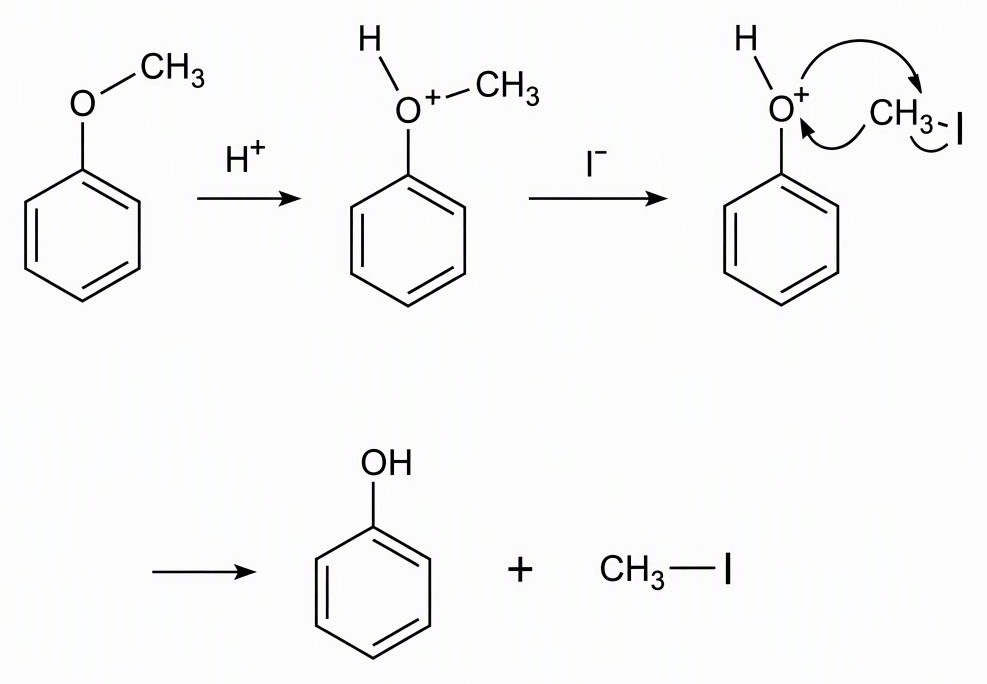
The aromatic carbon does not undergo the required ordinary backside substitution, so cleavage does not produce iodobenzene and methanol. This is the same structural restriction that blocks Route B in Question 5.
What should I practise after finding an error?
Repair the missed rule, attempt a changed version, then return to exam questions. Do not use a score cutoff from this small set to declare yourself ready. Choose the next task by your error type, not simply the number of correct answers.
- Reagent-condition error: rewrite the transformation with substrate, reagent, medium and product. Then attempt a changed-substrate version under the same conditions.
- Acidity or mechanism error: explain the conjugate base or relevant intermediate before solving another question. State where charge is stabilised and why.
- Synthesis-planning error: identify the nucleophile, electrophile and attacked carbon. Check whether substitution can occur there.
- PYQ practice: attempt independently before checking the official key. Seek a worked explanation if the key does not resolve your reasoning.
- Execution practice: once chapter questions are independently solvable, try mixed Chemistry and then a full-length mock. Review topic switching and time spent, not just the score.
A full-length mock checks broader application, not mastery of this particular chapter: its questions span the syllabus. Keep targeted chapter practice separate rather than relying on a mock to include the reaction you need to test.
What else should I check before choosing free chapter practice?
Check what is actually free: questions, explanations or a full test. This page includes the diagnostic and worked explanations without an external question bank or download. For other resources, check access terms before starting.
Are these actual JEE PYQs?
No. These are original authored practice questions, not questions attributed to any JEE paper.
Are NCERT exercises enough for JEE?
They build the foundation but do not replace application practice. Follow them with JEE questions that use reactions in unfamiliar settings.
How many chapter questions should I complete?
There is no defensible universal target. Explaining unfamiliar questions independently matters more than repeatedly recognising answers.
Does a free full-length mock include free chapter-specific practice?
No. These are different offers; access to a full-length test does not establish access to a chapter bank.
When you can solve chapter questions independently, use a JEEnius free full-length mock and its scored per-subject breakdown as your next whole-paper check. Then return to the exact reaction rule behind each Chemistry error.
Next step: full-length mock tests on JEEnius and sit a full 75-question, 300-mark, 180-minute paper and get a scored per-subject breakdown (free tests included).
For a worked example of the same idea, see Three Dimensional Geometry JEE 2025: Skew Lines and Ellipse.
Frequently asked questions
Which Alcohols, Phenols and Ethers questions should I practise first for JEE?
Start with NCERT exercises and basic reaction questions if the theory is still unclear. Use chapter PYQs to check application after theory, then mixed Chemistry practice and full-length mocks to test pacing and topic switching.
Are these free Alcohols, Phenols and Ethers questions actual JEE PYQs?
No. These six questions are original authored practice questions, with worked explanations available directly on the page. They test selected reaction rules, not exhaustive chapter coverage.
Are NCERT exercises enough for Alcohols, Phenols and Ethers in JEE?
NCERT exercises build the foundation but do not replace unfamiliar JEE applications. Follow them with verified JEE PYQs, attempting each independently before checking the answer.
How many Alcohols, Phenols and Ethers questions should I solve?
There is no universal question-count target. Judge progress by whether you can explain unfamiliar questions independently, not by how many answers you recognise. After an error, repair the reaction rule and attempt a changed version before returning to exam questions.