
What is the answer to the Three Dimensional Geometry JEE 2025 skew-lines question?
Option B is correct: the full latus-rectum length is two-thirds. In this Three Dimensional Geometry JEE 2025 question from JEE Main, April 2025, Shift 1, two spatial lines have a prescribed shortest separation. The two permissible parameter values become the ordered semi-axis parameters of an ellipse.
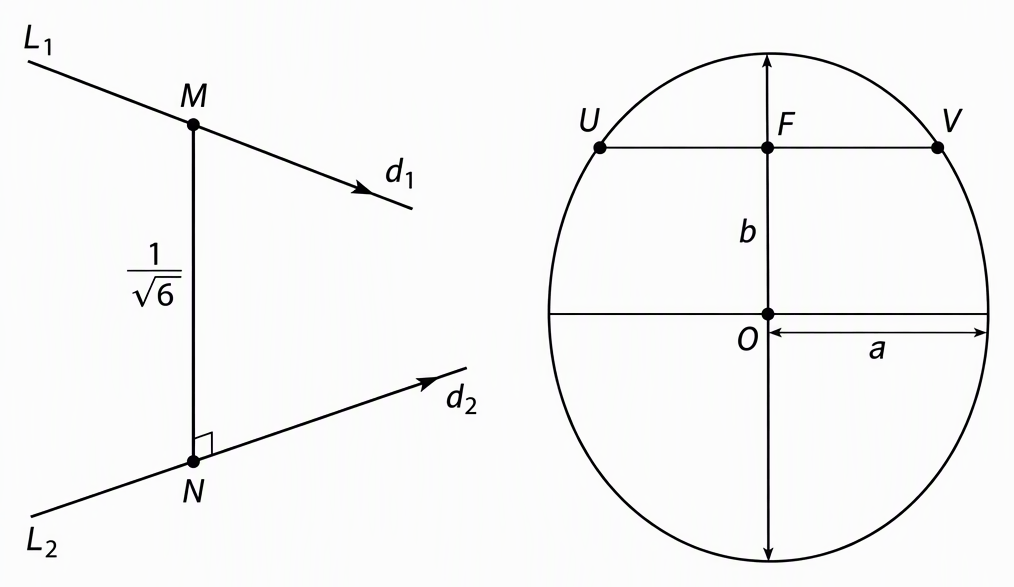
The lines and their shortest distance are:
Name the two permissible parameter values in increasing order:
Find the full latus-rectum length of the ellipse:
The four options are:
The question bank tags this problem hard, with a 180-second benchmark. The solution needs two decisions: retain both distance roots, then identify the ellipse’s major axis from its actual lengths.
How do you extract the points and direction vectors?
Set the common ratio in the first line to a parameter. The numerator containing “plus one” gives a selected point with x-coordinate negative one, not positive one. Following the official scalar-triple-product method, separate each line’s point from its direction vector:
Choose the points and directions:
Capital letters label points; the lowercase letters label ellipse parameters. Subtract the first point from the second:
The shortest-distance formula is:
The cross product is perpendicular to both lines. The formula projects the connecting vector onto that perpendicular direction, giving the shortest separation rather than the distance between the selected points.
How do you calculate both values of the parameter?
The distance condition gives two roots, one and three. Neither may be discarded: the modulus represents a distance, so opposite signs of the scalar triple product can give the same positive separation. Calculate the cross product first, then retain both branches of the distance equation.
Expand component by component:
Its magnitude is:
The nonzero cross product confirms that the directions are not parallel. Evaluate the scalar triple product:
Apply the prescribed distance:
Write the branches separately:
The question orders the roots, so their assignment is fixed:
Check both in the original distance expression:
Both satisfy the prescribed separation. Keeping only the positive branch would lose one of the two parameters needed to define the ellipse.
Which axis is major, and what is the latus-rectum length?
The vertical axis is the major axis: its semi-axis length is three, while the horizontal semi-axis length is one. The full latus-rectum length is therefore two-thirds. The letter used for an axis does not decide its role; the question’s ordering takes priority over the familiar textbook convention.
Substitute the ordered roots:
The denominators are squared semi-axis lengths, not the lengths themselves:
Here the larger parameter belongs to the vertical axis:
Use the notation-independent rule:
The latus rectum passes through a focus and is perpendicular to the major axis. Since the major axis is vertical, this chord is horizontal.
In this question’s notation:
The factor of two is needed because the question asks for the full chord, not its half-length. The distance roots supply the semi-axis lengths; comparing those lengths determines where each belongs in the formula.
Answer: option B.
Why does the wrong method give option D, 18?
Option D comes from using the correct roots in the wrong axis convention. Start with the correctly calculated values:
Blindly applying the familiar expression gives:
This expression assumes that the parameter named “a” is the semi-major axis and “b” is the semi-minor axis. That assumption is false here. The shortest-distance calculation is correct; the error occurs entirely at the ellipse stage.
Use this routine before substituting:
- Compare the actual semi-axis lengths, not their letters.
- Identify the major-axis direction.
- Put the smaller length squared in the numerator and the larger length in the denominator, with the factor of two.
How do you solve two related three-dimensional geometry checks?
Retain both modulus branches when the prescribed distance changes; check for intersection when the distance becomes zero. These original practice variations based on the solved problem use the same two lines. They are not additional verified PYQs.
Question 1: Find every parameter value when the shortest distance is:
Reuse the calculated expression:
This checks whether you preserve both modulus branches.
Question 2: Determine whether the lines intersect, and find the intersection, when:
The distance becomes zero while the directions remain nonparallel, so the lines intersect. Write their coordinates:
Equate the second and third coordinates:
Substitute from the first equation into the second:
Verify the first coordinate before accepting the result:
Nonparallel does not automatically mean skew: nonparallel lines can intersect. Before calling two lines skew, check that their shortest distance is positive.
Next step: the past-paper archive on JEEnius and search every JEE Main paper from 2002 and every Advanced paper from 2007, by year, subject or chapter, each with a worked solution (free).
If that step was the hard part, work through Biomolecules JEE 2024: Polymer U Mass Calculation.
Frequently asked questions
What is the answer to the JEE 2025 skew-lines and ellipse question?
Option B is correct: the full latus-rectum length is 2/3. The shortest-distance condition gives p = 1 and p = 3, so the ordered ellipse parameters are a = 1 and b = 3.
How do you find the shortest distance between two skew lines?
For points A and B on the two lines and direction vectors d1 and d2, use D = |(B − A) · (d1 × d2)| / |d1 × d2|. In this problem, d1 × d2 = (1, −2, 1), so D = |p − 2|/√6.
Why are there two values of p in the distance equation?
The prescribed distance gives |p − 2| = 1, which has two branches: p − 2 = 1 and p − 2 = −1. Thus p = 3 and p = 1 both satisfy the same positive shortest distance, and both are needed to define the ellipse.
Why is the latus rectum 2/3 and not 18?
The ellipse x²/1 + y²/9 = 1 has semi-minor axis 1 and semi-major axis 3. Its full latus-rectum length is twice the square of the semi-minor axis divided by the semi-major axis, giving 2/3. The result 18 comes from incorrectly treating a = 1 as the semi-major axis.