
What is the Ray Optics JEE 2022 two-lens matching question?
In this Ray Optics JEE 2022 question, measure object distance afresh from each lens. Light travels from left to right: the object is 20 cm left of lens 1, and lens 2 is 5 cm right of lens 1 in every combination.
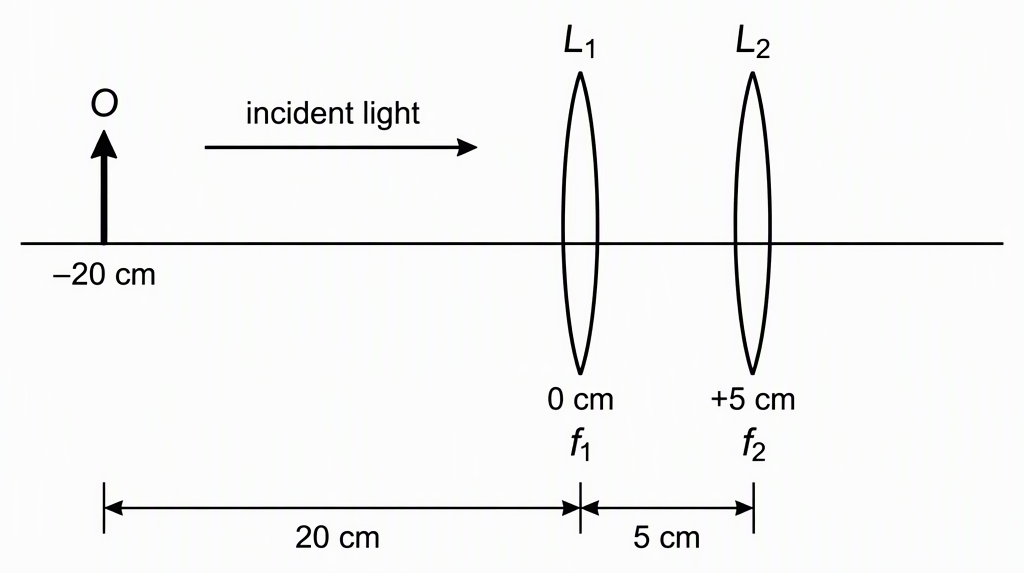
The source is JEE Advanced 2022, Paper 1, Physics. This is a match-list question on image formation by thin lenses; “medium” is the question bank’s difficulty classification, not an official exam rating.
Match each combination in List I to its final-image position in List II. The focal-length pairs are ordered as lens 1, lens 2, with all values in cm.
- I:
- II:
- III:
- IV:
List II, measured from lens 2:
- P: 7.5 cm right.
- Q: 60.0 cm right.
- R: 30.0 cm left.
- S: 6.0 cm right.
- T: 30.0 cm right.
Choose the correct complete matching:
How do you assign the object-distance sign at lens 2?
For cases I–III, lens 2 has a positive object distance of 15 cm. Follow the official sequential-lens method: solve lens 1, shift the origin to lens 2, then solve lens 2. Under the Cartesian convention, rightward distances are positive and leftward distances negative, measured from the lens currently being used.
The thin-lens equation and initial object distance are:
For I–III, the first focal length is positive 10 cm:
This is where lens 1 alone would focus the rays. Lens 2 intercepts them before they reach that point.
Shift the origin explicitly:
The point lies 15 cm right of lens 2. It is a virtual object for lens 2 because incident rays converge towards it, rather than diverge from it.
Why do cases I–III give different final images?
The incoming beam is identical, but lens 2 changes its convergence by different amounts. Keep every distance signed until you translate it into a List II position.
- Case I: Lens 2 adds convergence.
- Case II: Lens 2 reverses convergence into divergence.
- Case III: Lens 2 reduces convergence without reversing it.
Case I:
The final image is 7.5 cm right of lens 2. I matches P.
Case II:
The final image is 30 cm left of lens 2. II matches R.
Case III:
The final image is 60 cm right of lens 2. III matches Q.
Both second lenses in II and III are diverging. The negative 20 cm lens has weaker diverging power than the negative 10 cm lens, so it leaves the incoming beam convergent. A diverging lens does not always produce a virtual image: its incident beam matters.
How does case IV complete the matching to option A?
Case IV gives a final image 30 cm right of lens 2, matching T. Recalculate the first image because lens 1 is now diverging; carrying over the first three cases’ intermediate image would be a method error.
For lens 1:
Transfer the origin:
The intermediate image lies 15 cm left of lens 2. Rays reaching lens 2 diverge as though from this point, so it acts as its real object.
IV matches T. Audit all four results below; each tuple lists first image distance, second object distance and final image distance, in cm:
- I, match P:
- II, match R:
- III, match Q:
- IV, match T:
The complete matching is I–P, II–R, III–Q, IV–T. Correct option: A.
How can dropping one sign lead to option C?
Discarding the negative sign in case II can lead to choosing C prematurely. After correctly finding I–P, only A and C remain compatible with that first match. The correct second calculation gives:
Matching only its magnitude incorrectly gives II–T. Among the remaining choices, that incorrect second match points to C.
This explains selecting C prematurely, not deriving all four entries printed in C. The mistake is treating image distance as an unsigned length when List II explicitly distinguishes left from right.
Repair it by writing the position before selecting the letter:
Then verify every pair in the chosen option, not just the first two.
How can I practise the two-lens sign convention?
Use these original practice variations, not additional verified JEE PYQs, to check the origin transfer. Both retain the object 20 cm left of lens 1 and the 5 cm lens separation. Find each final image position relative to lens 2.
Question 1: Use the following focal lengths:
Answer check:
The final image is 10 cm right of lens 2.
Question 2: Keep the same geometry but use:
Answer check:
The final image is 6 cm left of lens 2.
Cover the checks and solve both. Write the second lens’s object distance, including its sign, before calculating either final image.
Next step: the past-paper archive on JEEnius and search every JEE Main paper from 2002 and every Advanced paper from 2007, by year, subject or chapter, each with a worked solution (free).
Related on JEEnius: Conic Sections JEE 2025: April Hyperbola Solution.
Frequently asked questions
What is the answer to the JEE Advanced 2022 two-lens matching question?
The correct option is A: I–P, II–R, III–Q, IV–T. Measured from lens 2, the final images are respectively 7.5 cm right, 30 cm left, 60 cm right and 30 cm right.
How do I find the object distance for the second lens?
First calculate the image distance v1 from lens 1, then shift the origin to lens 2. With light travelling left to right and lens separation d, the signed object distance is u2 = v1 − d. Here d = 5 cm, so u2 is +15 cm in cases I–III and −15 cm in case IV.
Why is the object distance positive for lens 2 in cases I–III?
Lens 1 alone would focus the rays 20 cm to its right, while lens 2 sits only 5 cm to its right. The incoming rays therefore converge towards a point 15 cm right of lens 2, which acts as a virtual object. Under the Cartesian convention used here, this gives u2 = +15 cm.
Can a diverging lens form a real image?
Yes, a diverging lens can form a real image when the incident beam is already converging and the lens does not reverse that convergence. In case III, lens 2 has focal length −20 cm and object distance +15 cm, giving a real image 60 cm to its right. In case II, the stronger diverging lens produces a virtual image 30 cm to its left.