
What is the distance between skew lines JEE 2025 question?
Two lines in three-dimensional space have a prescribed shortest separation, and a parameter in the second line’s direction must be determined. In this distance between skew lines JEE 2025 question, the sum of all admissible values is minus three, option D.
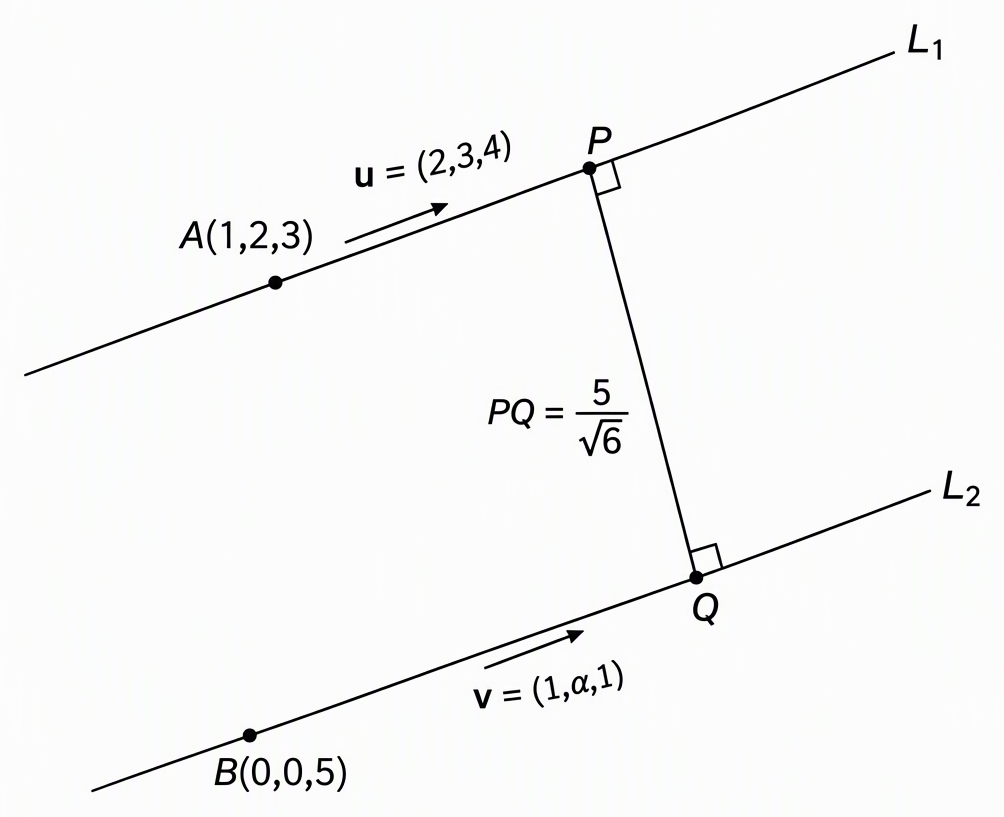
The source is JEE Main, April 2025, Shift-1, Mathematics, Three Dimensional Geometry. The question bank classifies it as hard and gives an expected solve time of 120 seconds, not a measured student-performance figure.
The two lines are:
Find the sum of all admissible parameter values when their shortest distance is:
The choices are:
How do you extract the points and direction vectors?
The constants subtracted from the coordinates identify a point on each line; the symmetric-form denominators give direction ratios. Following the official solution, write:
The connecting vector is:
Use the scalar-triple-product formula:
The cross product is perpendicular to both lines. The formula projects the connecting vector onto this common-normal direction, giving the length of the marked shortest segment.
The connecting vector itself need not be the shortest segment. Its length measures the distance between the chosen points, not necessarily between the lines.
How do you calculate the numerator and denominator without sign errors?
Take the absolute value of the scalar triple product for the numerator and the cross-product magnitude for the denominator. The cross product’s middle component is always two, so the directions are never parallel and the denominator cannot vanish.
First calculate:
The middle component uses the first vector’s third component times the second vector’s first, minus the reverse pairing:
Now take the dot product:
Distance cannot be negative, so retain the modulus:
For the denominator:
Therefore:
How do you form the quadratic and check every valid value?
Equating the calculated distance to the given distance produces a quadratic whose root sum is minus three. Use Vieta directly when only the sum is asked; finding individual roots is unnecessary. The optional check below confirms that both roots are real and satisfy the original distance equation.
Set:
Both sides are nonnegative, and the denominator is strictly positive because the cross product never vanishes. Squaring is therefore reversible here: it introduces no extra solutions.
Squaring and cross-multiplying gives:
Expand both sides:
Move everything to the right:
Divide by four:
Apply Vieta:
Hence option D, matching the official worked solution. For an optional validity check, factorise:
Thus there are two distinct real possibilities:
Substitute each into the original distance expression:
Both satisfy the prescribed positive separation. Neither can be discarded from the sum.
How does a Vieta sign mistake produce option A?
Using the coefficient ratio without Vieta’s minus sign produces option A, even from the correct quadratic. Start from:
The incorrect calculation is:
This error produces option A. To recover the sign rather than guess it, expand the root form:
Comparing coefficients gives:
The absolute value makes the distance nonnegative. It does not make the parameter values, or their sum, positive.
Which two related questions should you practise next?
Practise one fixed-direction distance calculation and one intersection check. These are original practice variations, not additional JEE 2025 questions. They test the same cross-product calculation and the meaning of a zero numerator.
Question 1: Find the shortest distance between these lines.
Vector form handles the zero direction component without division by zero. The worked check is:
Question 2: For the original lines, find the parameter value giving intersection and the intersection point.
Set the already-derived numerator to zero:
The lines are never parallel, so zero separation means intersection. Verify it using:
Rework these two variations without looking at the checks, then continue with Three Dimensional Geometry JEE 2025: Skew Lines and Ellipse.
Frequently asked questions
What is the formula for the shortest distance between skew lines?
For lines through points a₁ and a₂ with direction vectors u and v, the shortest distance is d = |(a₂ - a₁) · (u × v)| / |u × v|. The cross product gives a direction perpendicular to both lines, and the formula projects the connecting vector onto it. This formula requires nonparallel direction vectors.
What is the answer to the distance between skew lines JEE 2025 question?
For the problem with prescribed shortest distance 5/√6, the admissible parameter values are α = -4 and α = 1. Their sum is -3, so option D is correct.
How can I use Vieta to find the sum without solving for alpha?
The distance equation simplifies to 29α² + 87α - 116 = 0. By Vieta’s formula, the sum of its roots is -b/a = -87/29 = -3. Using b/a instead incorrectly gives 3, which is option A.
Does squaring the distance equation introduce extra roots?
Not in this problem: both sides of the distance equation are nonnegative, and the denominator is strictly positive. The cross product is (3 - 4α, 2, 2α - 3), so its magnitude never vanishes. Squaring is therefore reversible, and both α = -4 and α = 1 satisfy the original equation.