
Should I start with chapter questions, PYQs or a full mock?
Start with focused chapter questions if you cannot reliably choose the reaction. For aldehydes and ketones practice questions for JEE, choose chapter drills for reaction-selection errors, authentic previous-year questions (PYQs) when fundamentals are stable, and full-length mocks when the remaining problem is applying chemistry under whole-paper pressure.
This page contains six original practice questions with worked explanations, free to read here. They are author-created questions, not questions attributed to any JEE paper. Record your chemical reasons, not just option letters, to identify what needs attention.
What do chapter drills, authentic PYQs and full-length mocks actually test?
Chapter drills isolate chemistry errors, PYQs test interpretation of authentic exam questions, and mocks test whole-paper execution. A student who confuses aldol with Cannizzaro needs a different task from one who understands both but loses time switching between Physics, Chemistry and Mathematics.
Each comparison below follows this order: original chapter drills; authentic JEE PYQs; full-length mocks.
- Prerequisite knowledge: Drills require the relevant reaction basics; PYQs require enough chapter knowledge to identify the route independently; mocks require preparation across subjects for meaningful whole-paper review.
- Chapter focus: Drills stay tightly focused; chapterwise PYQs focus on carbonyl chemistry but may combine concepts; mocks spread questions across the syllabus.
- Exam authenticity: Original drills are teaching questions; authentic PYQs preserve actual exam wording; mocks simulate an exam but are not past papers.
- Timing realism: Drills isolate solving time; timed PYQ sets add local pressure; full mocks test subject switching and paper management.
- Reaction-error diagnosis: Drills help isolate a misconception; PYQs expose gaps in interpreting unfamiliar substrates; mock errors need separation into chemistry, reading and time-allocation problems.
- Main limitation: Narrow drills can give away the reaction family; recognising a remembered PYQ answer is not independent solving; a mock does not guarantee coverage of every aldehyde–ketone reaction.
- Access: The original drills are on this page; no particular free PYQ repository is verified here; for whole-paper practice, JEEnius includes free full-length mocks: a 75-question, 300-mark, 180-minute full-length paper with a scored per-subject breakdown.
That specification fits the JEE Main format. Do not apply it to JEE Advanced, whose question types and marking vary.
Which practice format fits my current mistakes?
Choose by what fails during solving, not by your class or attempt number. If you know a reagent but cannot explain why the substrate reacts, choose focused drills. If you can explain standard transformations but struggle with unfamiliar wording, choose authentic chapterwise PYQs rather than repeating elementary questions.
- Class 11, chapter not yet studied: Establish carbonyl polarity, resonance and acid–base reasoning first. Do not treat a JEE question score as meaningful before those foundations are in place.
- Class 12, aldol and Cannizzaro keep getting mixed up: Choose focused drills. Explicitly mark alpha hydrogens before selecting a pathway, then read the base concentration and temperature.
- Standard transformations are secure, unfamiliar wording is not: Move to authentic chapterwise PYQs. Check the relevant official answer key, and explain how the wording constrains the answer.
- Dropper who recognises familiar PYQs: Where practical, solve without looking at the options. Explain rejected alternatives, then use fresh original questions to check whether the reasoning transfers.
- Chapter questions go well, whole papers do not: Use full-length mocks. Review time allocation and subject switching alongside conceptual errors.
Can I solve six free aldehydes and ketones questions now?
Solve the complete set below before reading the key. These questions target reaction selection, substrate structure and work-up. Record one chemical reason beside every option letter, especially when an answer feels familiar.
Original chapter diagnostic, not PYQs or a complete JEE-level benchmark. The size and composition are editorial choices, not exam statistics. Each question has exactly one correct option.
Question 1. For the usual comparison of nucleophilic addition to simple carbonyl compounds under comparable conditions, which order lists the compounds from most reactive to least reactive?
- A: Propanone, ethanal, methanal.
- B: Ethanal, methanal, propanone.
- C: Methanal, ethanal, propanone.
- D: Methanal, propanone, ethanal.
Question 2. Which reagent distinguishes benzaldehyde from acetophenone by a positive qualitative-test result for one and a negative result for the other under standard test conditions?
- A: Fresh Tollens’ reagent, with gentle warming.
- B: Acidified 2,4-dinitrophenylhydrazine solution.
- C: Fehling’s solution, with warming.
- D: Aqueous sodium hydrogen carbonate.
Question 3. Propanal undergoes self-aldol addition with dilute aqueous sodium hydroxide at low temperature. The reaction is stopped before dehydration. Which condensed structure represents the aldol-addition product? Stereochemistry is not being tested.
A:
B:
C:
D:
Question 4. Benzaldehyde is treated with concentrated aqueous sodium hydroxide under Cannizzaro conditions. Which pair of organic products is present before any acid work-up?
- A: Benzyl alcohol and benzoic acid.
- B: Benzyl alcohol and sodium benzoate.
- C: Benzene and sodium benzoate.
- D: Benzyl alcohol and acetophenone.
Question 5. Which compound gives a positive iodoform test when warmed with iodine in aqueous sodium hydroxide?
- A: Benzophenone.
- B: Benzaldehyde.
- C: Propanal.
- D: Acetophenone.
Question 6. Two separate samples of acetophenone are treated as follows: the first with sodium borohydride in ethanol followed by aqueous work-up, and the second with zinc amalgam and concentrated hydrochloric acid under Clemmensen reduction conditions. Which pair gives the respective organic products?
- A: Ethylbenzene; 1-phenylethanol.
- B: Benzyl alcohol; toluene.
- C: 1-Phenylethanol; ethylbenzene.
- D: 1-Phenylethanol; styrene.
Why is each answer correct, and which wrong route should I reject?
The key is 1 C, 2 A, 3 B, 4 B, 5 D, 6 C. A correct letter with an incorrect reason still needs review. Compare your reason with the structural feature or condition that decides each answer.
1. C: Methanal reacts most readily. Mistake label: steric/electronic effect.
Methanal has no alkyl groups attached to its carbonyl carbon, ethanal has one, and propanone has two. Increasing alkyl donation reduces the electrophilic character of the carbonyl carbon, while increasing steric hindrance makes nucleophilic approach harder.
Counting only steric crowding misses the electronic effect. This is the usual order for these simple compounds, not a universal ranking for every substituted carbonyl compound.
2. A: Tollens’ reagent distinguishes this pair. Mistake label: test selectivity.
Benzaldehyde reduces Tollens’ reagent to metallic silver and is oxidised to benzoate in the basic medium. Acetophenone does not give that positive result under standard conditions.
Both compounds give a carbonyl derivative with 2,4-dinitrophenylhydrazine, so both test positive. Neither gives the usual positive Fehling’s result or liberates carbon dioxide with sodium hydrogen carbonate. Keep the claim substrate-specific: “every ketone is negative in every qualitative test” is false.
3. B: The product is 3-hydroxy-2-methylpentanal. Mistake label: alpha hydrogen/connectivity.
Base removes an alpha hydrogen from one propanal molecule, producing the enolate donor. Its alpha carbon attacks the carbonyl carbon of a second propanal molecule, the acceptor.
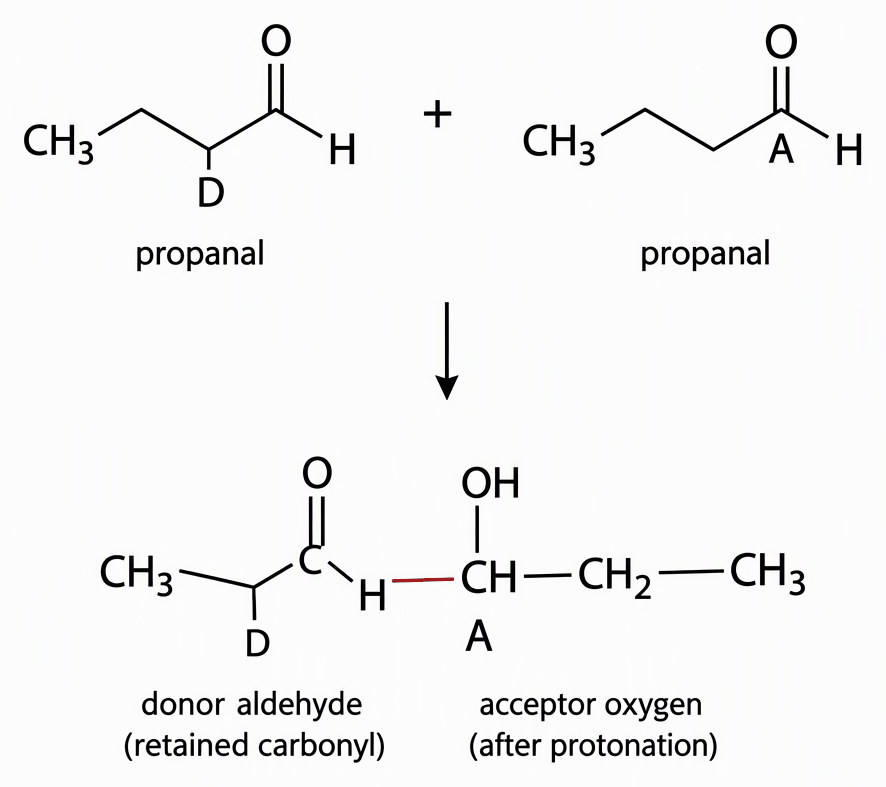
The donor retains its aldehyde group, while the acceptor carbonyl becomes an alcohol after protonation. Tracing those two carbons gives:
Option C is the dehydrated product. The question specifies low-temperature addition and stopping before dehydration, so do not replace the beta-hydroxy aldehyde with an alkene.
4. B: The products are benzyl alcohol and sodium benzoate. Mistake label: alpha hydrogen/work-up.
Benzaldehyde has no alpha hydrogen available for ordinary aldol chemistry. Under concentrated aqueous base, Cannizzaro disproportionation reduces one molecule to benzyl alcohol and oxidises another to benzoate.
The basic solution contains the carboxylate salt, sodium benzoate. Benzoic acid is obtained after acidification, which the question excludes. Option A catches students who remember the transformation but ignore work-up.
5. D: Acetophenone gives the positive result. Mistake label: substrate-specific test.
Acetophenone contains the methyl-ketone unit shown below. Under iodine and aqueous sodium hydroxide, it gives yellow iodoform.
Benzophenone lacks the required methyl group, while benzaldehyde and propanal do not satisfy the relevant structural requirement. This explains the given option set, not every positive iodoform test: ethanal and suitable alcohols can also respond.
6. C: The products are 1-phenylethanol and ethylbenzene. Mistake label: reagent outcome.
Sodium borohydride reduces the ketone carbonyl to a secondary alcohol, giving 1-phenylethanol after work-up. Clemmensen reduction replaces the carbonyl oxygen with two hydrogens, giving ethylbenzene.
Both reactions preserve the carbon skeleton here. Benzyl alcohol and toluene each have one fewer carbon than the required products, while styrene incorrectly substitutes alkene formation for reduction.
How should I choose my next practice from these mistakes?
Use the chemical reason for each error, not your total score, to choose the next task. This short set diagnoses selected fundamentals. It neither exhausts aldehydes and ketones nor establishes readiness for JEE Advanced, and six editorially chosen questions cannot justify a diagnostic pass mark.
- Nucleophilic-addition error: Revise carbonyl polarity, alkyl donation and steric effects before another focused drill.
- Aldol or Cannizzaro error: Mark alpha hydrogens first, then check concentration, temperature and work-up.
- Qualitative-test error: Write substrate-specific test rules rather than treating all aldehydes or all ketones alike.
- Reduction error: Distinguish carbonyl-to-alcohol conversion from carbonyl-to-methylene conversion.
Make each error-log entry contain substrate feature, reagent and conditions, predicted product, and why the original answer failed. “Forgot the reaction” is too vague to guide your next attempt.
If the answers and explanations are secure, move to authentic PYQs. Require identifiable paper provenance and check the relevant official key rather than trusting an unattributed answer list.
Connect carbonyl reduction with alcohol oxidation through Alcohols, Phenols and Ethers Practice Questions: 6 Solved. Practise both directions and explain the functional-group change, not just the reagent name.
If whole-paper execution is the remaining issue, use a full-length mock. JEEnius includes free full-length mocks with per-subject scores. After the paper, separate chemistry errors from time-allocation errors before deciding what to practise next.
Frequently asked questions
Should I start aldehydes and ketones practice with chapter questions or PYQs?
Start with focused chapter questions if you cannot reliably select the reaction or explain why the substrate reacts. Move to authentic chapterwise PYQs once standard transformations are secure. Use full-length mocks when your main difficulty is time allocation or switching between subjects.
Are these aldehydes and ketones questions free JEE PYQs?
All six questions and their worked explanations are free to read, but they are original teaching questions, not JEE PYQs. They diagnose selected fundamentals rather than establish readiness for JEE Advanced.
How do I avoid confusing aldol and Cannizzaro reactions?
Mark the alpha hydrogens before choosing a reaction, then check base concentration, temperature and work-up. Propanal undergoes aldol addition with dilute aqueous sodium hydroxide at low temperature. Benzaldehyde lacks alpha hydrogens and undergoes Cannizzaro disproportionation under concentrated aqueous sodium hydroxide, giving benzyl alcohol and sodium benzoate before acidification.
What is the difference between NaBH4 and Clemmensen reduction of acetophenone?
Sodium borohydride in ethanol reduces acetophenone to 1-phenylethanol after aqueous work-up. Clemmensen reduction with zinc amalgam and concentrated hydrochloric acid gives ethylbenzene. Both preserve the carbon skeleton in this case.