
What is the gravity-change question from Motion in a Plane JEE 2022?
The answer to this Motion in a Plane JEE 2022 question is 0.95: the gravity change shortens only the descent distance, leaving the ascent unchanged. This is from JEE Advanced 2022, Paper 1, Physics. It is a numerical-answer question, not an MCQ.
A projectile leaves horizontal ground with a given speed and projection angle. Its reference range is the ground-to-ground distance under unchanged gravity. At the apex, gravity becomes the original value divided by 0.81 and stays at that value until the projectile returns to ground level. Find the new range as a multiple of the reference range.
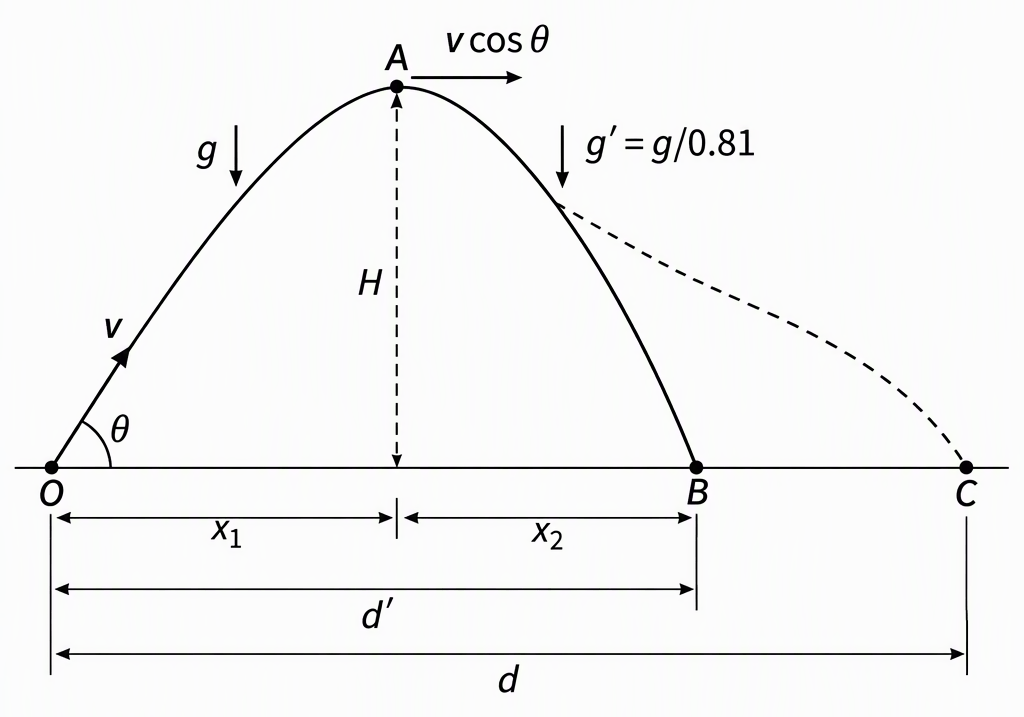
Using the question’s notation:
The question bank classifies this as medium, with an expected solving time of 120 seconds. That is the bank’s practice target, not an official exam time limit.
What remains unchanged before the projectile reaches the apex?
The official method starts with the original range under unchanged gravity:
The ascent occurs entirely under the original gravity, so its duration, horizontal distance and maximum height remain unchanged. Split the flight at the apex, where the acceleration changes.
The horizontal distance to the apex is half the original range:
At the highest point, only the vertical velocity is zero. The projectile is not at rest:
Use vertical motion during ascent to calculate the height:
The gravity change introduces no instantaneous velocity jump. It changes the acceleration after the apex, not the velocity at that instant. There is also no horizontal acceleration, so the horizontal speed stays constant throughout the flight.
How do you calculate the descent time under the new gravity?
Treat the descent as a fall from the height already reached, with zero initial vertical velocity. Use the new gravity only for this stage, carrying forward the height calculated from the original ascent.
Measure elapsed descent time from the apex:
Taking downward displacement as positive:
Substitute the height from the ascent calculation:
Horizontal distance equals unchanged horizontal speed multiplied by this descent time:
Compare the descent distance with the ascent distance:
The square root appears because the falling height is fixed by the ascent. Fall time therefore varies as:
It does not vary inversely with gravity itself. The horizontal descent distance follows the same square-root dependence because horizontal speed remains unchanged.
Why is the numerical answer 0.95?
The new descent covers 90% of the original descent distance, while the ascent distance stays unchanged. Adding those unequal parts gives 95% of the original range. The changed trajectory is not symmetric about the apex.
Substitute the given gravity:
Therefore:
Comparing with the required form gives the numerical entry:
Sanity check: the new gravity is stronger, so the descent is shorter while the ascent is unchanged. Reducing only the original second half by 10% reduces the total range by 5%.
If gravity does not change, the descent distance equals the ascent distance. The total range returns to its original value:
Why does replacing gravity in the range formula give the wrong answer?
Replacing gravity throughout the standard range formula incorrectly changes both stages of flight. That formula requires the same constant gravitational acceleration from launch to landing. Here, the acceleration changes midway, so the formula cannot describe the whole flight.
The invalid calculation is:
This substitution retroactively changes the ascent time and maximum height. But the projectile reached the apex under the original gravity; neither quantity can be altered by what happens afterward.
0.81 is an illustrative incorrect numerical result, not a supplied wrong option. The verified question has no listed options.
The repair is to preserve the original ascent distance and apex height, then calculate only the descent using the changed gravity. Choose each equation by the interval over which its assumptions hold.
How do you solve two related changed-gravity questions?
Keep the ascent unchanged in both cases and scale only the descent distance. These are original practice questions based on the same concept, not additional verified PYQs. Both retain horizontal ground, an apex-only gravity change and no horizontal acceleration.
Question 1: Keep the same launch and original range, but make gravity four times its original value at the apex. Find the new range as a multiple of the original.
Question 2: Keep the same launch and original range, but make gravity one-quarter of its original value at the apex. Find the new range as a multiple of the original.
Stronger post-apex gravity shortens only the descent distance; weaker post-apex gravity lengthens it. Cover these solutions and redo both variants, writing the preserved ascent distance and apex height before using the new gravity.
Next step: photograph a doubt on JEEnius and photograph any question you are stuck on and get a step-by-step solution, with a free-body diagram when the question needs one (20 free).
Keep going with Aldehydes Ketones Practice Questions JEE: 6 Solved.
Frequently asked questions
What is the answer to the JEE Advanced 2022 gravity-change projectile question?
The numerical answer is 0.95, meaning the new range is 95% of the original range. When gravity becomes g/0.81 at the apex, the horizontal descent distance becomes 90% of its original value, while the ascent remains unchanged. The total range ratio is therefore (1 + 0.9)/2 = 0.95.
Why can't I replace g with g/0.81 in the projectile range formula?
The standard ground-to-ground range formula assumes the same constant gravity throughout the flight. Replacing g throughout incorrectly changes the ascent as well as the descent, giving 0.81 instead of 0.95. Preserve the original ascent distance and maximum height, then use the new gravity only for the descent.
Does the projectile stop at the highest point?
Only its vertical velocity is zero at the highest point; its horizontal velocity remains v cos θ. The gravity change alters acceleration without causing an instantaneous velocity jump. With no horizontal acceleration, horizontal speed stays constant throughout the flight.
What happens to the range if gravity becomes four times larger at the apex?
For a projectile returning to horizontal ground, the new range is 0.75 times the original range. The ascent still covers half the original range, while the descent distance becomes half of its original value because it scales as the square root of g/g'. Adding these distances gives d/2 + d/4 = 3d/4.