Which chromium compound makes the borax bead green in JEE Advanced 2019?
Chromium(III) metaborate produces the green bead, so option D is correct. The “redox reactions and electrochemistry JEE 2019” archive entry is a JEE Advanced 2019, Paper 1, Chemistry single-correct MCQ. Its medium difficulty is the question bank’s classification, not an official exam rating.
The task is to identify the compound responsible for the green colour when a chromium(III) salt is heated in the borax-bead test. The distinction is between the oxide entering the reaction and the chromium compound formed in the bead.
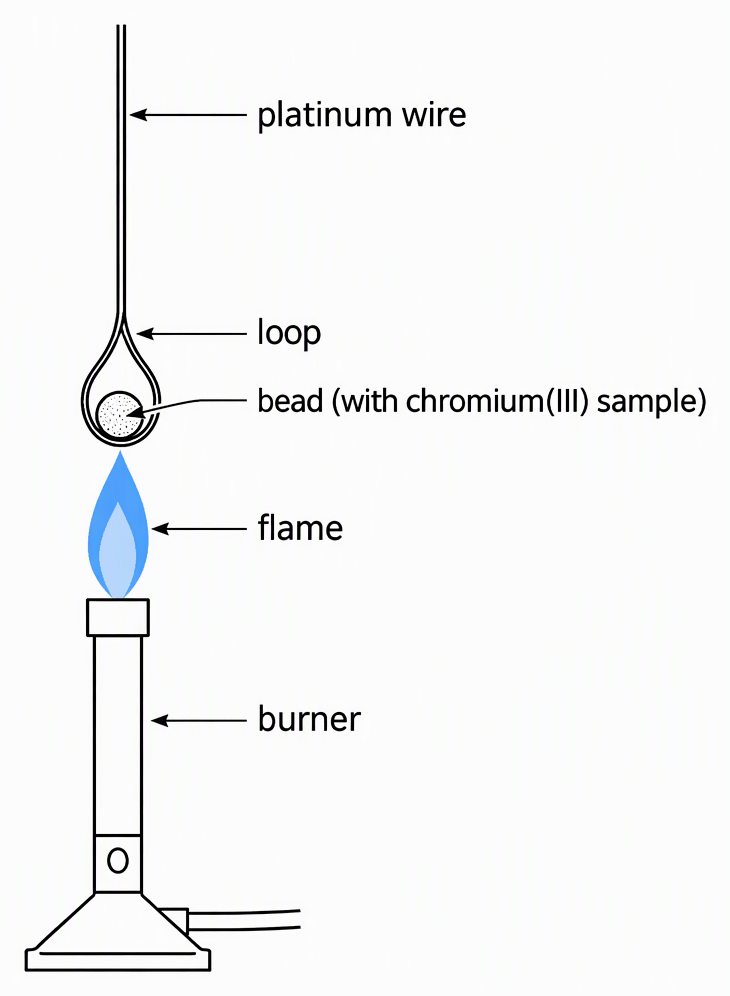
For laboratory context, a small borax bead is heated on a platinum-wire loop with the sample. This setup explains the test; it is not additional wording from the original question.
The supplied options are:
What happens when borax first loses its water of crystallisation?
Heating first converts hydrated borax into anhydrous sodium tetraborate. This dehydration step does not produce the chromium-green colour.
Borax is sodium tetraborate decahydrate:
Its balanced dehydration equation is:
Explicitly writing the released water completes the official solution’s abbreviated dehydration equation without changing its method. Each formula unit loses ten water molecules; the sodium tetraborate remains.
Keep the names separate: hydrated borax contains water of crystallisation, while anhydrous sodium tetraborate does not. The anhydrous salt is the starting material for the next heating step, not the chromium-containing compound the question asks you to identify.
How does further heating produce the acidic oxide?
Further heating forms sodium metaborate and boric anhydride. Boric anhydride behaves as the acidic oxide in the official solution: it reacts with the metal oxide supplied by the sample.
The first product is sodium metaborate; the second is boric anhydride. Check the atom counts:
- Sodium: 2 atoms on each side.
- Boron: 4 atoms on the left; 2 in sodium metaborate and 2 in boric anhydride.
- Oxygen: 7 atoms on the left; 4 in sodium metaborate and 3 in boric anhydride.
Sodium metaborate is not chromium(III) metaborate. It contains no chromium and must not be confused with the green product formed in the next step.
How does the final reaction establish option D?
Chromium(III) oxide reacts with boric anhydride to form chromium(III) metaborate, which produces the characteristic green bead colour. For a chromium(III) salt, the corresponding oxide in the official method is chromium(III) oxide. Since the salt is unspecified, do not invent a salt-decomposition equation.
The coefficients follow directly from the product formula:
- Chromium: 2 atoms in the oxide require 2 product units.
- Boron: those product units contain 6 boron atoms, requiring 3 units of boric anhydride.
- Oxygen: the reactants contain 3 plus 9 oxygen atoms; the products contain 12. The totals match.
As a separate formula check, one chromium(III) ion needs three singly charged metaborate units:
This charge check confirms the formula; it does not replace the heating-reaction sequence. That sequence identifies chromium(III) metaborate as the final chromium-containing product.
Final answer:
Chromium remains at oxidation state plus three during this oxide-to-metaborate conversion. The archive chapter label does not require an electron-transfer calculation when the reaction contains no oxidation-state change.
Why is chromium(III) oxide, option B, not the answer?
Option B stops the reaction sequence one step too early. If you recognise chromium(III) oxide as green and stop there, you would select B. That reasoning identifies a green chromium compound, but not the compound responsible for the colour after reaction in the borax bead.
In the final displayed equation, chromium(III) oxide is a reactant. Chromium(III) metaborate is its chromium-containing product. The question asks about the bead produced by the test, not the colour of the oxide in isolation.
Use this correction: identify the stage the question asks about, follow the sequence to that stage, then match the option. A familiar property of an intermediate cannot establish the identity of the final product.
How can you practise oxidation states and electron balancing from this question?
Use the three questions below to check oxidation states, balance electron transfer and calculate a mole ratio. They are original chapter practice, not additional verified PYQs from the redox reactions and electrochemistry JEE 2019 archive.
What is chromium’s oxidation state in the oxide and metaborate?
Chromium is at plus three in both compounds, so their conversion is not redox. Let its oxidation state be the unknown in each charge-balance equation.
For chromium(III) oxide:
For chromium(III) metaborate, each metaborate unit carries one negative charge:
Chromium’s oxidation state does not change. Neither do those of boron, oxygen or sodium in the bead sequence.
How do you balance dichromate reduction in acidic solution?
One dichromate ion takes six electrons to form two chromium(III) ions. Balance atoms first, then charge.
- Balance chromium by placing two chromium(III) ions on the right.
- Balance the seven oxygen atoms with seven water molecules on the right.
- Balance hydrogen with fourteen hydrogen ions on the left.
- The left charge is now plus twelve, while the right is plus six. Add six electrons on the left.
How many moles of iron(II) react with one mole of dichromate?
Six moles of iron(II) are required. Each iron(II) ion supplies one electron:
Multiply by six:
Combine and cancel electrons:
These last two reactions reduce chromium(VI) to chromium(III), unlike the chromium(III)-to-chromium(III) bead reaction. Before balancing electrons in your next question, write the element’s oxidation state on both sides.
Next step: the past-paper archive on JEEnius and search every JEE Main paper from 2002 and every Advanced paper from 2007, by year, subject or chapter, each with a worked solution (free).
Keep going with Ray Optics JEE 2023: Focal-Length Error Explained.
Frequently asked questions
Which chromium compound gives a green borax bead in JEE Advanced 2019?
Chromium(III) metaborate, Cr(BO₂)₃, produces the green bead, so option D is correct. It forms when chromium(III) oxide reacts with boric anhydride during the test.
Why is chromium(III) oxide not the answer to the green borax-bead question?
Chromium(III) oxide is a reactant in the final bead-forming reaction, not the chromium-containing product. Although the oxide is green, the question asks which compound produces the colour in the bead. Following the reaction to completion gives chromium(III) metaborate.
What happens when borax is heated in the borax-bead test?
Borax first loses its ten water molecules of crystallisation to form anhydrous sodium tetraborate. Further heating produces sodium metaborate and boric anhydride. Boric anhydride then reacts with chromium(III) oxide to form the green chromium(III) metaborate.
Is the chromium borax-bead reaction a redox reaction?
No: chromium remains at oxidation state +3 when chromium(III) oxide becomes chromium(III) metaborate. The other elements also retain their oxidation states in the displayed bead sequence. The archive chapter label does not make an electron-transfer calculation necessary.