
How should I revise JEE Maths in the last month?
Recovering familiar-but-unreliable questions should come before starting several untouched chapters. This JEE Maths revision strategy is primarily for JEE Main: use three Maths hours within an illustrative six-hour net revision day, leaving ninety minutes each for Physics and Chemistry. Every day, recall methods without notes, solve timed previous-year questions and reattempt errors. Aim for reliable solutions, not syllabus completion.
All study-hour allocations below are proposed schedules, not official requirements or guaranteed routes to a score. Adjust them to your commitments and test evidence.
What six-hour revision timetable can I follow?
Use these seven blocks to give Maths three hours while retaining daily Physics and Chemistry practice. The schedule counts only net study minutes; breaks, lunch and recovery are separate. On constrained days or mock days, use the replacements below rather than adding work to the evening.
Daily schedule: clock time, subject, task, net study minutes
- 08:00–09:15, Maths, closed-book recall and chapter PYQs, 75 minutes.
- 09:30–10:30, Physics, recall and targeted question practice, 60 minutes.
- 10:45–11:45, Chemistry, active revision and question practice, 60 minutes.
- 13:00–14:15, Maths, timed practice and review, 75 minutes.
- 14:30–15:00, Physics, error repair, 30 minutes.
- 15:00–15:30, Chemistry, closed-book recall, 30 minutes.
- 16:00–16:30, Maths, mistake reattempts, 30 minutes.
The gaps at 09:15–09:30, 10:30–10:45 and 14:15–14:30 are breaks. Keep 11:45–13:00 for lunch and recovery, and 15:30–16:00 for another recovery break. None counts as study.
This sample assumes six hours are available outside compulsory commitments. Shift the clock times around school or coaching rather than sacrifice sleep or skip school.
On a four-hour constrained day:
- Maths: 120 minutes, retain recall, timed questions and error reattempts; reduce new-question volume.
- Physics: 60 minutes, combine practice with correction.
- Chemistry: 60 minutes, combine recall with targeted questions.
A workable Maths split is 15 minutes recall, 45 minutes solving, 30 minutes review and 30 minutes reattempts. Cut the question count before cutting correction.
On a mock day, replace the normal timetable:
- Full-paper mock: three hours, under exam-like conditions.
- Analysis: two hours, initially 60 minutes Maths and 30 minutes each for Physics and Chemistry.
- Targeted repair: one hour, directed at the most recoverable errors.
Adjust analysis time to the errors actually found. A mock is not an extra three-hour task on top of a six-hour day.
Why should Maths get half my revision time?
Give Maths half the revision day when it needs repair and Physics and Chemistry are reasonably stable. This is a starting allocation, not a permanent entitlement. JEE Main Paper 1 gives each subject 100 marks, so rescuing Maths by neglecting two equally weighted subjects is a poor trade.
Maths repair needs a complete sequence: select a method, execute it, check restrictions and correct the failed step. Use the protected block to finish that sequence instead of merely reading the answer.
Choose the allocation from your test evidence:
- Maths needs the most repair: three hours Maths, ninety minutes Physics and ninety minutes Chemistry.
- Maths is strongest and another subject has more recoverable errors: two hours per subject.
- Full-paper mock day: use the replacement timetable, then direct repair time toward the clearest opportunities.
Review the split after each full mock using wrong answers, solvable questions left unattempted and correct answers that took excessive time. Do not rebuild the timetable because of one unpleasant practice session.
Three hours of Maths revision does not mean spending half the actual paper on Maths. Rehearse your exam-time allocation in full-paper mocks.
Keep Chemistry work specific with JEE Chemistry Revision Strategy: A 30-Day Main Plan. Its ninety minutes should have named tasks, not whatever is left after Maths.
What mistakes can make this revision plan fail?
The main failures are passive revision, unreviewed tests and backlogs that exceed the daily budget. Keep analysis and reattempts inside the six-hour boundary. If a task does not fit, reduce new-question volume or postpone lower-priority work instead of treating correction as invisible extra work at night.
- Passive revision: recognising a formula or following a video is not recall. Close the source and solve a fresh or previously missed question unaided.
- Resource hopping: use one PYQ source, existing notes and one error queue. Do not spend the final month sorting a new stack of books.
- Backlog optimism: a nearly mastered chapter and an untouched chapter with substantial prerequisites should not receive equal repair time. Estimate the missing work before adding either to tomorrow’s queue.
- Mock accumulation: analyse the previous test before taking another. Taking more tests without correction records recurring errors rather than fixing them.
- Timetable inflation: review and reattempts belong inside the six hours. Do not move them to bedtime after counting six hours of lectures and questions.
- Missed-day compensation: resume the current day and carry forward only the most recoverable unfinished task. Do not double tomorrow’s hours or shift the entire month forward.
- Desk-hour tracking: parents should track completed practice and corrected mistakes, not only how long the student sat.
At the evening check, name one method recalled unaided, one error repaired and the next unresolved task. “Studied Maths” is too vague to guide tomorrow.
Which Maths chapters should I prioritise?
Prioritise chapters where you recognise the approach but cannot yet produce a reliable solution. Build the queue from a recent mock, not a universal chapter ranking. If you lack a useful test, spend 45 minutes on a mixed Maths diagnostic inside the existing budget, then start repair that day.
Sort chapters into three working buckets:
- Retain: you can solve representative questions unaided. Maintain these through mixed sets.
- Repair: recall, execution or speed breaks an otherwise familiar method. Put these first in chapter practice.
- Postpone: you cannot start without learning substantial prerequisites. Admit a topic only when its scope and prerequisites make a short repair realistic.
For each chapter, record a small sample of outcomes, the exact failure and the next task. A small sample is a starting signal, not a definitive mastery rating.
Use specific records:
- Logarithms: rule recognised, domain restriction missed; next task, state validity conditions before solving related questions.
- Circles: wrong representation chosen; next task, compare the available forms and identify what each given condition suggests.
- Circles: representation correct, arithmetic failed; next task, redo the expansion and verification, not the entire chapter theory.
Forgetting a logarithm’s domain restriction is different from not understanding logarithms. Choosing the wrong circle representation is different from making an arithmetic slip; assign different repairs.
Use this worked circle problem only if your diagnostic exposes that method gap. It is not evidence that everyone should prioritise circles.
Reject unsupported chapter-wise weightage, “guaranteed questions” and universal easy-chapter lists. Your own question outcomes are the basis for this revision queue.
How should I divide the thirty days?
Repair first, then increase mixed practice, then taper. Define D-30 as thirty days before your actual exam date and D-1 as the day before it. These are relative dates, not an exam-date announcement. Keep the daily budget fixed while changing the tasks inside its blocks.
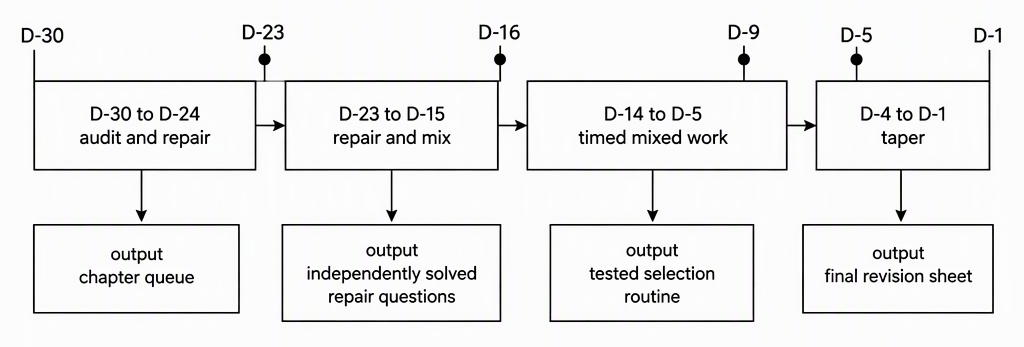
Month plan: phase, main task, observable output
- D-30 to D-24: audit and repair the first priority gaps. Output: a chapter queue with named failures and next actions.
- D-23 to D-15: continue repair and introduce regular mixed sets. Output: repair questions solved independently after a delay, not just understood during review.
- D-14 to D-5: emphasise mixed timed work and mock-derived fixes. Output: a tested question-selection routine and subject order.
- D-4 to D-1: taper volume and consolidate familiar methods. Output: a compact final revision sheet.
The second Maths block can contain a small mixed set from the start. Across the middle phases, include more of the topics you have studied rather than repeatedly selecting comfortable chapters.
Use D-23, D-16, D-9 and D-5 as four manageable sample full-paper mock slots, not a universally optimal frequency. Count coaching full-paper tests toward them instead of adding duplicates.
During the final four days, avoid large untouched chapters and confidence-damaging marathons. Keep short recall and familiar problem-solving sessions, with a lighter D-1 rather than an attempt to recover the whole backlog.
What exactly should I do during the three Maths hours?
Use the three blocks for recall, timed solving and delayed correction, in that order. Record answers produced without notes, classify errors and solve missed questions again. On a diagnostic day, substitute the 45-minute diagnostic for a practice segment rather than adding another session to the timetable.
First block, 75 minutes:
- 15 minutes: closed-book recall of formulas, conditions and method triggers for the repair topic.
- 45 minutes: chapter PYQs attempted independently before checking solutions.
- 15 minutes: check answers, classify failures and assign repair tasks.
Second block, 75 minutes:
- 45 minutes: timed mixed practice, including retained and recently repaired topics.
- 30 minutes: review wrong, skipped and unusually slow questions.
Final block, 30 minutes: reattempt due errors without looking at the solution. Return a failed reattempt to the queue with a more precise diagnosis.
Attach an action to every error category:
- Concept: revisit the exact definition or result, then solve a basic application.
- Method selection: identify the clue you missed and practise choosing an approach.
- Algebra or arithmetic: locate the faulty line, redo it and verify the result.
- Reading or domain restriction: state the condition before manipulating the expression.
- Time management: identify where progress stopped and practise leaving the question for a later pass.
An error-log entry might record a solution lost by dividing by an expression that could be zero. Consider:
Dividing by the first factor immediately loses an admissible solution. Check the zero case before division:
Then solve the remaining case:
Finish by solving a related question unaided. Copying “do not divide by zero” is not enough.
Keep the revision sheet to formulas with conditions, method triggers and recurring personal traps, not copied derivations. Turn each review into a specific task for tomorrow, such as checking excluded cases before cancellation.
For fresh topic work, JEEnius practice mode offers sets that skip questions already seen, with free sets included. Unseen practice tests transfer; delayed error reattempts test whether the repair lasted. You need both.
How should mocks change my plan, and what changes for Advanced?
Use comparable mock results to select the next repair tasks, not to rewrite the month after every score. Track correct, wrong and solvable-but-unattempted questions, recurring errors and Maths time used. For Advanced, retain repair and retesting but change the practice questions and follow that paper’s marking instructions.
Record these indicators after each full-paper mock:
- Maths correct answers: look for independently repeatable methods.
- Maths wrong answers: distinguish knowledge gaps from avoidable execution errors.
- Solvable questions left unattempted: identify selection or time-use failures.
- Recurring error types: check whether earlier repairs survived.
- Maths time used: interpret it alongside outcomes, without imposing a universal minutes-per-question limit.
Main awards 4 marks for a correct answer, deducts 1 for a wrong answer and gives 0 for an unattempted question. Its 25-question Maths section has no optional question selection in the paper structure. That does not mean you should guess every answer.
Use a flexible two-pass approach: first take questions with a clear route, then return to longer or uncertain ones. Rehearse the subject order and Maths time allowance in full-paper mocks.
After analysis, select the three most actionable Maths fixes for the next sessions. Repeated-question familiarity can inflate apparent progress, so check repairs through unseen mixed questions as well as delayed reattempts.
Advanced aspirants should use appropriate Advanced PYQs, multi-concept work and practice reading the actual marking instructions. JEE Advanced has two compulsory three-hour papers and no fixed question-type or marking pattern. Never transfer Main’s 25-question Maths structure or marking scheme to it.
For the error queue, the JEEnius mistake notebook automatically saves every wrong question and returns it at 1, 3, 7 and 14 days until you answer it correctly three times; it is free and unlimited. Errors first made near the exam cannot complete a fourteen-day return cycle beforehand, so prioritise unresolved ones in the remaining review blocks.
Audit your last test, select tomorrow’s repair topic and write the next day’s actual study blocks, including correction time.
Next step: practice mode on JEEnius and practise a topic in sets that skip questions you have already seen (free sets included).
Frequently asked questions
How should I revise JEE Maths in the last month?
Repair familiar but unreliable methods before starting several untouched chapters. Use closed-book recall, timed previous-year questions and delayed error reattempts each day. Increase mixed practice through the month, then reduce volume and consolidate familiar methods in the final four days.
How many hours should I spend on JEE Maths revision daily?
Three Maths hours within a six-hour net revision day is a proposed starting point when Maths needs the most repair and Physics and Chemistry are reasonably stable. Leave ninety minutes each for Physics and Chemistry, and include correction within the budget. If Maths is strongest and another subject needs more repair, consider two hours per subject instead.
Which Maths chapters should I revise first for JEE Main?
Start with chapters where you recognise the approach but cannot yet solve representative questions reliably. Use a recent mock to sort chapters into retain, repair and postpone buckets, putting repair topics first. If you lack useful test evidence, use a 45-minute mixed diagnostic within your existing study budget.
How should I fit full mocks into my JEE revision timetable?
Replace the normal six-hour revision day with a three-hour full-paper mock, two hours of analysis and one hour of targeted repair. Analyse wrong, skipped and unusually slow questions, then choose the three most actionable Maths fixes. Count coaching full-paper tests toward your mock schedule rather than adding duplicates.
Can I use this Maths revision plan for JEE Advanced?
Keep the repair-and-retest approach, but use Advanced PYQs and multi-concept practice. JEE Advanced has two compulsory three-hour papers and no fixed question-type or marking pattern, so practise reading each paper's marking instructions. Do not transfer JEE Main's question structure or marking scheme to Advanced.