
What is the best JEE Chemistry revision strategy for the last month?
Daily closed-book recall, syllabus-aligned NCERT or notes checks, timed questions and correction of previous mistakes should drive your JEE Chemistry revision strategy, not another complete lecture cycle. This is primarily a final-month JEE Main plan for students who have already studied a substantial part of Chemistry. It repairs forgotten or unreliable knowledge; it is not a plan for learning the entire syllabus from scratch.
Start with a sample allocation of 3 Chemistry hours within an 8-hour net self-study day, not a universal requirement. Build the month around diagnosis and repair, then mixed practice, then consolidation. Advanced preparation can retain the recall-and-error loop, but needs different questions and a different full-mock format.
What daily timetable should I follow for Chemistry revision?
Use this ordinary-day schedule if Chemistry needs repair and you have no substantial school or coaching commitments. It protects Physics and Mathematics while separating Chemistry repair, timed work and retrieval. Copy the tasks and outputs; move the clock slots to fit your day rather than sacrificing sleep.
- 07:00–08:30; Chemistry priority-topic repair; 90 minutes. Required output: a closed-book attempt, checked gaps and independently solved representative questions.
- 09:00–11:30; Mathematics; 150 minutes. Required output: planned topic practice with wrong and stuck questions reviewed.
- 12:30–15:00; Physics; 150 minutes. Required output: concept or numerical practice, followed by corrected solutions.
- 16:00–17:00; Chemistry timed practice and review; 60 minutes. Required output: a timed answer record and a reason for each error.
- 20:00–20:30; Chemistry retrieval and due mistake retries; 30 minutes. Required output: recalled formulas or reactions and closed-book re-solutions.
Split the morning Chemistry block into 15 minutes of closed-book retrieval, 30 minutes of targeted source checking and 45 minutes of worked practice. Attempt each solution yourself before consulting a worked example. Split the afternoon block into 30 minutes of timed questions and 30 minutes of analysis.
Chemistry gets 180 minutes, Physics 150 minutes and Mathematics 150 minutes. That totals 480 minutes, or 8 net hours. Meals, rest and the gaps between blocks are not counted as study.
For a 4-hour net-study day, use Chemistry 90 minutes, Physics 75 minutes and Mathematics 75 minutes. Reduce topic and question coverage, not the entire correction step.
A full mock replaces ordinary study blocks. It does not add another three hours on top of this schedule; its review must also fit inside the available day.
How should I divide time between subjects and Chemistry’s three branches?
Keep all three subjects active, then give extra time to gaps you can repair. JEE Main assigns 100 marks each to Physics, Chemistry and Mathematics, but equal marks do not require identical preparation time. The sample allocation of 3 Chemistry hours and 2.5 hours each for Physics and Mathematics is a temporary response to identifiable Chemistry gaps.
It is not proof that Chemistry is inherently easier or more scoring. If recent work shows that Physics has the larger repairable gap, move time there instead. Protect a regular Physics block using JEE Physics preparation: daily study plan and practice, rather than treating Physics as whatever fits after Chemistry.
Within the 180 Chemistry minutes, start with these daily totals. They need not be uninterrupted blocks; the morning repair topic may take most of its branch’s allocation.
- Physical Chemistry: 60 minutes. Include formula retrieval, numerical work and correction.
- Organic Chemistry: 60 minutes. Include reaction retrieval, reasoning and mixed questions.
- Inorganic Chemistry: 60 minutes. Include NCERT checks, closed-book prompts and retries.
When one branch has a clearly larger repairable gap, use 75 minutes for that branch, 60 for the next priority and 45 for maintenance of the strongest branch. Choose using closed-book recall, error reasons, time taken and missing prerequisites, not comfort.
Review the split after every 3 study days. Shift time when fresh practice and delayed retries show improvement; do not permanently starve a branch because of one poor test.
What mistakes can make this revision timetable fail?
The timetable fails when you complete the hours but miss the required outputs. Reading for 90 minutes is not equivalent to repairing a topic, and attempting questions is not equivalent to learning from them. Apply these corrective rules before increasing study time.
- Passive familiarity: Recognising a highlighted NCERT line is not retrieval. Close the book and write or explain the answer before checking, including the condition or exception that makes the statement precise.
- Lecture substitution: Use a short explanation for a named gap, such as choosing the correct equilibrium expression. Do not restart a full course because a few questions felt difficult.
- Question-count inflation: Count reviewed questions and successful delayed retries. Questions merely opened, guessed or attempted without analysis are not completed revision.
- Resource switching: Keep one primary theory source, relevant NCERT material and one reliable question source. Do not create a new stack of books in the final month.
- Backlog snowballing: Leave a repair slot within each phase. Carry forward only the highest-priority unfinished task, not every task missed since Monday.
- Chemistry tunnel vision: Preserve Physics and Mathematics practice. Extra Chemistry time must come from a planned reallocation, not from cutting sleep.
- Invented certainty: Reject guaranteed scores, unsupported chapter-weightage forecasts and claims that a named chapter list will definitely appear. Select topics by syllabus relevance, current gaps and repair cost.
If the plan repeatedly overruns, shrink the task. “Repair concentration-unit conversion and solve a fresh question” is usable; “finish Physical Chemistry” is not.
How should I organise the 30-day Chemistry revision calendar?
Use phases with evidence-based exit rules rather than assigning one chapter to every day. Chapters differ in size, prerequisites and how much you remember. Day 30 means the day before your actual exam: count backwards from that date, checking official information at jeemain.nta.nic.in, rather than using an estimated future exam date.
- Days 1–3; diagnose. Audit the current official syllabus and recent practice. Use closed-book recall and a small diagnostic set to produce a ready, repair or first-learning topic list. Move on once priorities are identified; the small set is triage, not a reliable mastery score. Keep the final repair slot for checking uncertain classifications.
- Days 4–14; repair. Prioritise previously learned topics with specific gaps, while keeping ready topics on short retrieval cycles. Produce corrected solutions and recall prompts. Reserve Day 14 for a mixed checkpoint plus unfinished priority repairs; promote topics only after a delayed mixed check.
- Days 15–23; mix. Move towards mixed timed Chemistry sets and full-paper practice while continuing targeted corrections. Produce time records and an updated recurring-error list. Reserve Day 23 for a checkpoint and repair slot, then carry forward the highest-priority error rather than automatically adding another chapter.
- Days 24–27; rehearse. Use reviewed mocks to practise execution and address recurring mistakes. Produce an attempt-order plan and specific checking habits. Keep repair time after review; restrict new learning to small, clearly bounded gaps.
- Days 28–30; consolidate. Use familiar notes, formulas, reaction prompts, NCERT checks and selected retries. Produce a short list of remaining traps. Use repair time for those traps, with no new resource or full-syllabus restart.
Ready means you can explain the essentials and handle representative questions independently. Repair means you learned the material before but can name the gaps. First learning means essential concepts or prerequisites are missing.
For first-learning work, assess the prerequisites before committing. Give a bounded topic one study block, then check whether you can solve a fresh representative question independently. Park a sprawling unfamiliar chapter if it would displace several repairable topics, not because it is unimportant.
How should I revise Physical, Organic and Inorganic Chemistry differently?
Give each branch a different output: Physical needs reconstructed formulas and correct numerical setups, Organic needs connected reaction reasoning, and Inorganic needs precise retrieval checked against the source. Reading should answer a gap exposed by recall or questions, not occupy the whole session.
How should I revise Physical Chemistry formulas and numericals?
Reconstruct formulas from memory with their conditions, units and assumptions, then solve representative numerical questions without notes. A remembered expression is not enough if you cannot decide when it applies. After choosing a gas-law relation, check whether the question’s pressure, volume and temperature units match the form you are using.
- Conceptual error: You chose a relation that does not apply. Recheck the governing idea and its conditions.
- Setup error: The idea was right, but quantities or equations were assigned incorrectly. Rewrite the setup before calculating.
- Unit error: Convert units explicitly and inspect the final unit.
- Arithmetic error: Mark the exact faulty step and adopt a targeted calculation check.
The output is a compact formula-and-conditions sheet plus a corrected solution showing exactly where the original setup failed. Prefer this to copying ten correct solutions: it identifies what needs repair.
How should I revise Organic Chemistry reactions without forgetting them?
Retrieve the transformation from the substrate, reagent and conditions, then explain the expected functional-group change and selectivity. Connect the product to reaction reasoning rather than memorising disconnected reagent lists. When related reactions compete, identify the feature in the substrate or conditions that changes the outcome.
Your output is a small reaction map reconstructed from memory and checked against the primary source, followed by mixed product or reagent questions. Include changed substrates so that recalling the previous answer is not enough. Record a missing condition separately from a missing mechanism idea; they require different repairs.
How should I revise Inorganic Chemistry from NCERT?
Read syllabus-aligned NCERT passages, then close the book and answer prompts on trends, structures, reactions and exceptions. After an error, return to the exact passage rather than rereading the entire chapter. Your output should be a short list of failed recall prompts with chapter, subsection or page references, not a newly copied chapter.
Use interhalogen hydrolysis practice as a narrowly focused worked example when relevant to your syllabus. It is not evidence of chapter weightage or predicted exam frequency.
Across all three branches, require a delayed mixed check before moving a repaired topic to ready. Getting the answer immediately after reading its solution is not sufficient evidence.
How should tests and mistake retries decide tomorrow’s work?
Make tomorrow’s priority the most useful repair exposed by today’s reviewed work. As a sample schedule, take one full Main mock in each of Days 1–7, 8–14, 15–21 and 22–27. This spaces mocks to leave room for repair and review; it is not an official requirement or a frequency proved optimal by data. Replace ordinary blocks and protect review time.
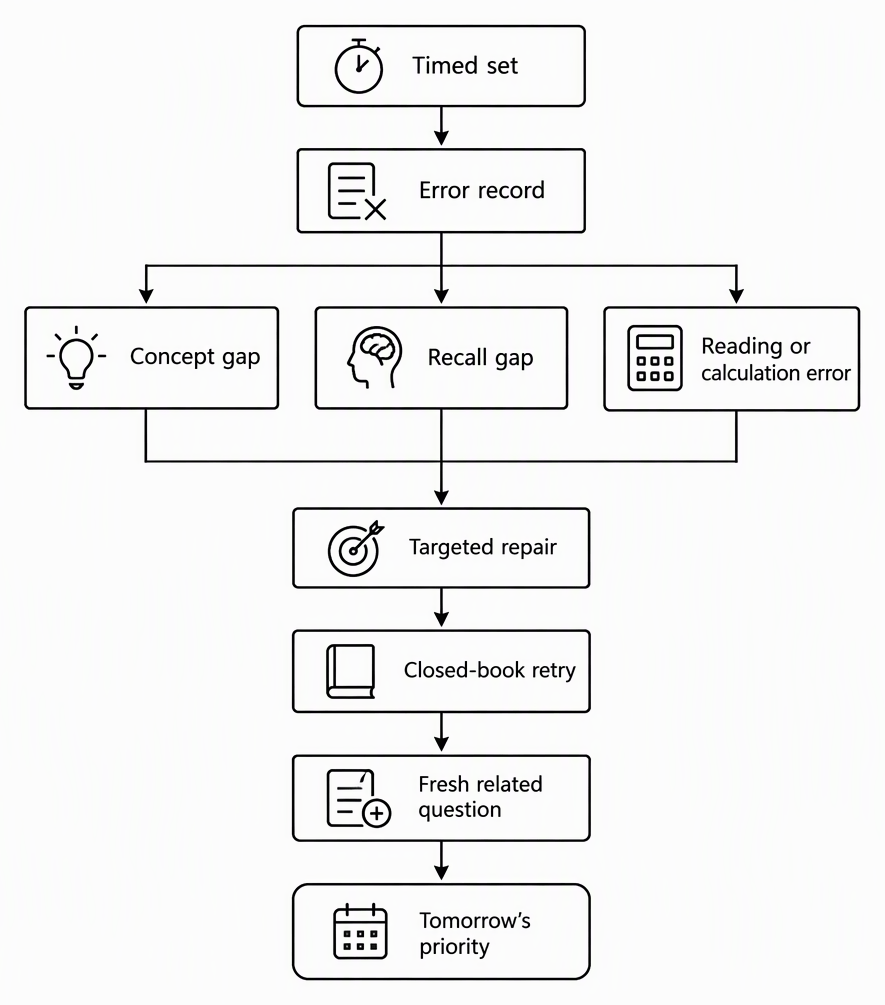
A full Main mock lasts 180 minutes; Chemistry contains 25 questions worth 100 marks. Your 30-minute Chemistry drill is a training choice, not an official sectional time limit. Record correct, wrong and unattempted answers, actual time used and the reason for each error.
- Concept gap: Use a targeted explanation, then solve a fresh question.
- Recall gap: Write a retrieval prompt and answer it without notes.
- Reading or calculation error: Adopt a specific check, such as circling the requested quantity or checking unit conversion before substitution.
Re-solve missed questions without seeing the answer, then include a fresh related question to test transfer rather than memorisation. Use that evidence to change tomorrow’s repair task, not to rewrite the whole calendar after every bad session.
For Advanced, retain the recall-and-error loop but use Advanced questions and their stated marking instructions. Full rehearsal involves two compulsory three-hour papers; question types and marking vary by year. Do not transfer Main’s fixed pattern to Advanced.
For scheduled retries, JEEnius’s free, unlimited mistake notebook automatically saves every wrong question and returns it at 1, 3, 7 and 14 days until you get it right three times. Late-month errors may have retry dates beyond the exam; prioritise those falling before your actual exam without assuming the product schedule changes. Tonight, select tomorrow’s first repair from an error you can name, not a chapter you merely fear.
Next step: the mistake notebook on JEEnius and every question you get wrong is saved automatically and returned to you at 1, 3, 7 and 14 days until you get it right three times (free, unlimited).
Frequently asked questions
How many hours should I revise Chemistry daily for JEE Main?
A sample allocation is 3 Chemistry hours within an 8-hour net self-study day, leaving 2.5 hours each for Physics and Mathematics. Split Chemistry into 90 minutes of topic repair, 60 minutes of timed practice and review, and 30 minutes of retrieval and mistake retries. For a 4-hour day, use 90 minutes for Chemistry and 75 minutes each for the other subjects, reducing coverage rather than dropping correction.
How should I plan JEE Chemistry revision for the last 30 days?
Use Days 1–3 to diagnose gaps, Days 4–14 to repair previously learned topics, Days 15–23 for mixed practice, Days 24–27 for rehearsal, and Days 28–30 for consolidation. Count backwards from your actual exam so Day 30 is the day before it. This plan suits students who have already studied a substantial part of Chemistry; it is not a full-syllabus first-learning plan.
How should I revise Physical, Organic and Inorganic Chemistry differently?
For Physical Chemistry, reconstruct formulas with their conditions and units, then solve numericals independently. For Organic Chemistry, retrieve reactions from substrates, reagents and conditions, and test your reasoning with changed substrates. For Inorganic Chemistry, use closed-book prompts checked against syllabus-aligned NCERT passages, returning to the exact source after an error. Require a delayed mixed check before treating a repaired topic as ready.
How many JEE Main mocks should I take in the last month?
The sample plan uses one full Main mock in each of Days 1–7, 8–14, 15–21 and 22–27, leaving time for review and repair. This is a planning example, not an official requirement or a proven optimal frequency. Each 180-minute mock replaces ordinary study blocks, and its review must also fit within the available study day.