
How should I prepare Physics for JEE?
Measure JEE Physics preparation by fresh questions solved without help, not lectures completed. Use a daily cycle of closed-book recall, focused concept work, independent problems and correction of earlier mistakes. A sample four-hour self-study day can give Physics 90 minutes, not a universal requirement or score guarantee. JEE Main and Advanced share this foundation, but need different examination practice.
What is a realistic JEE Physics timetable for four hours of self-study?
Use this evening window if school or coaching finishes beforehand. Every study duration is a recommended planning choice, not a research finding or official requirement. Each block has an observable output: a recalled relation, an independent attempt or a corrected error, rather than just time spent at a desk.
Clock time | Task | Observable output
- 17:00–17:15 | Physics recall and due mistake revision | Reconstruct a relation with its assumptions; retry a previously missed question without notes.
- 17:15–17:40 | One Physics concept or worked example | Explain the missing principle or reconstruct the example after closing its solution.
- 17:40–18:20 | Independent Physics problems | Draw the model before calculating; mark any help used.
- 18:20–18:30 | Correction and error logging | Record the first incorrect step and its correction.
- 18:30–18:45 | Break | Leave the desk and return at the planned time.
- 18:45–20:00 | Maths | Attempt the planned problems and correct failed steps.
- 20:00–20:30 | Dinner | Eat without turning the meal into another study block.
- 20:30–21:45 | Chemistry | Recall planned material and complete relevant questions or homework.
The study-time arithmetic is:
Breaks and dinner add another 45 minutes:
Move these clock times around your actual school, commute and coaching schedule. Count relevant homework inside the blocks, not as another workload after them.
If only two hours are available, use a smaller recommended allocation:
- Physics: 45 minutes.
- Maths: 40 minutes.
- Chemistry: 35 minutes.
Shorten the problem set or narrow the concept target. Do not borrow the missing time from sleep.
How should I split study time between Physics, Chemistry and Maths?
Keep all three subjects active, then adjust time according to the work you cannot yet do independently. JEE Main Paper 1 offers 25 questions and 100 marks per subject. Equal available marks justify protecting each subject, but they do not mean every student needs identical study time in each.
The sample gives Physics a modest extra allocation for model-building and correction. This is a starting choice, not a claim that Physics always deserves more time. Maths and Chemistry retain substantial daily practice.
Before increasing Physics time, identify the bottleneck:
- Missing physical principle: Repair the relevant concept, then apply it without notes.
- Slow algebra: Practise rearranging equations rather than replaying the Physics explanation.
- Weak trigonometry: Repair the required identities or component resolution.
- Calculation slips: Write intermediate steps and check units and signs before substituting numbers.
Try the allocation for one week. Then inspect unfinished work and repeated errors, rather than reacting to one poor test.
If Physics feels difficult, do not automatically remove Maths problem practice or Chemistry revision. Move time toward a specific repair task, not more passive watching. Use JEE Maths Preparation: Daily Practice and Study Plan to plan the Maths block alongside Physics.
Why does a Physics study plan fail even when I follow the timetable?
A timetable fails when time spent replaces evidence of learning. Watching an explanation, recognising a formula and copying a solution do not establish independent solving ability. Change what counts as completed work: an unaided attempt, the first failed step identified and a later correction you can reproduce without help.
- Mistaking lecture completion for mastery: Make a closed-book attempt before watching another explanation. If you cannot begin, identify the missing principle and revisit only that part of the lesson.
- Reading solutions too early: First record what you tried and where the setup failed. Consult help for that point rather than reading the entire solution immediately.
- Collecting formulas without conditions: Write the assumptions, direction conventions and physical meaning beside each relation. A remembered equation used outside its conditions is still a wrong model.
- Chasing daily question totals: Separate fresh independent solutions from hinted attempts and remembered answers. Ten copied solutions do not establish the same skill as solving an unfamiliar problem yourself.
- Hopping between resources: Use one teaching source, one main practice source and previous-year questions before adding another book. Add a resource only for a gap your existing material does not address.
- Keeping an error notebook closed: Reserve revision time before adding new questions. Retry the question without seeing the correction.
- Copying a dropper timetable during school: Reduce scope while preserving breaks and sleep. Fit the plan to the day you have.
- Calling every error careless: Identify whether the first failure was conceptual, in the diagram or model, mathematical or related to test execution. Each needs a different repair.
How do I turn a Physics lesson into the ability to solve unseen questions?
Find the first step you cannot execute independently, then practise that step. More lectures are appropriate for a missing principle, not every failure after it. A student who knows Newton’s laws but chooses the wrong system needs model-building practice, not another full introduction to Newton’s laws.
First failure | Repair task | Evidence to look for
- Cannot recall the governing principle | Targeted concept repair | State the principle and its assumptions without notes.
- Knows the formula but cannot set up the situation | Diagrams and model selection | Define the system, forces, directions and constraints.
- Correct setup but failed calculation | Algebra and units practice | Complete the symbolic steps and check dimensions.
- Succeeds untimed but not timed | Short timed sets | Check whether correct setup holds under time pressure.
What steps should I follow on each Physics problem?
Start with the principle and physical model, not an equation containing the given numbers. Follow the sequence below and mark the first step you cannot complete without help. That gives you a specific correction task instead of a vague instruction to “revise chapter”.
- State the principle and its assumptions from memory.
- Draw the diagram or define the system.
- Choose equations that match the model.
- Solve symbolically where useful.
- Substitute values with consistent units.
- Check units, signs and physical plausibility.
For a worked example, study why each step follows. Close the solution, reconstruct it, then attempt a related question with changed conditions. Reproducing a recently viewed solution is not proof that you can apply the method to a different problem.
How can the same Physics formula require different approaches?
The radius formula for a charged particle describes circular motion when its velocity is perpendicular to a uniform magnetic field. Before comparing radii, check what is held equal. Equal speed and equal kinetic energy require different substitutions, even though both questions begin with the same magnetic-force model.
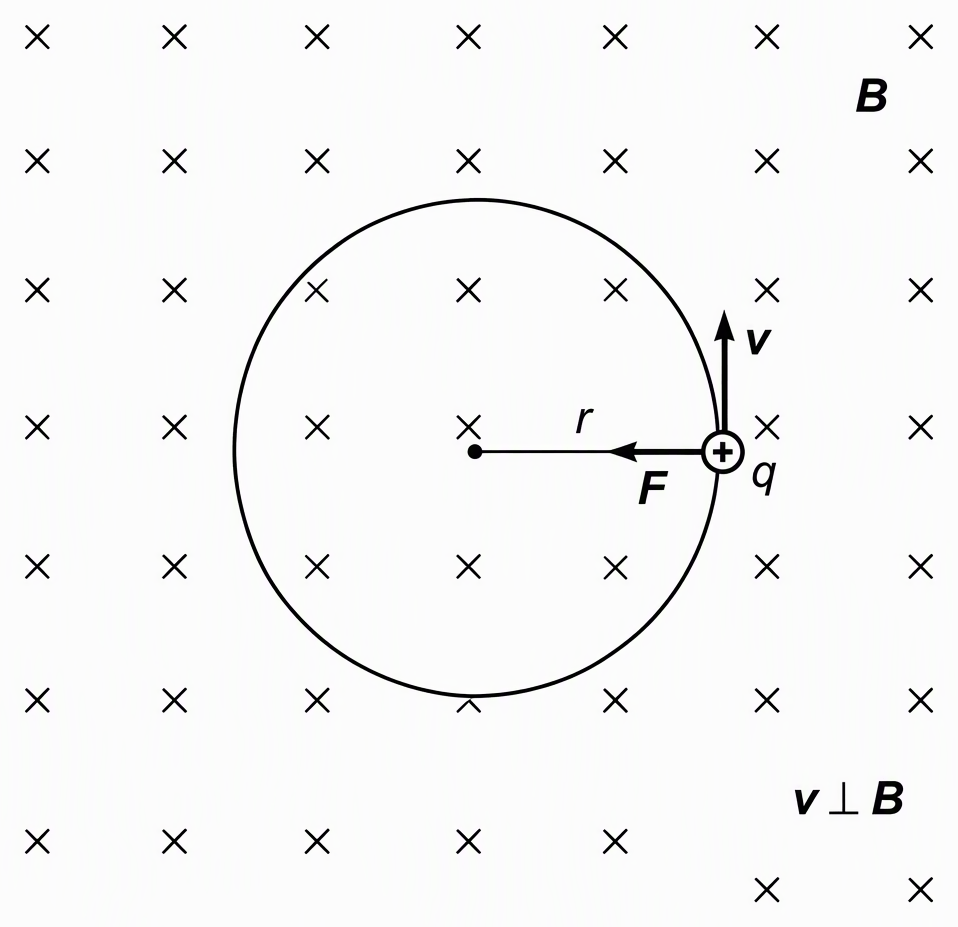
For perpendicular entry into a uniform magnetic field:
At equal speed and magnetic field:
At equal kinetic energy and magnetic field:
The charge magnitude matters in both comparisons. Work through Alpha Particle and Sulfur Ion Radius with the givens identified before choosing the substitution.
Build practice from basic single-concept questions to JEE Main previous-year questions, then mixed or multi-concept Advanced work where appropriate. Repair basic setup errors before moving to harder questions.
Classify attempts honestly:
- Independent: Correct on a fresh attempt without hints or a solution.
- Assisted: Completed after help, including a hint or a recently viewed method.
- Incorrect: Your attempt contains a wrong step or remains unsolved; keep this first-attempt record even after correction.
For fresh topic questions, JEEnius daily practice problems provide a ten-question set every day, with free sets daily. Ten is the product’s set size, not a universal daily target.
What should I study first in Class 11, Class 12 or a drop year?
Check the current official syllabus at jeemain.nta.nic.in, then repair prerequisites that block your present chapter. For Advanced, also consult its current official syllabus. Choose prerequisite order over a supposedly permanent high-weightage list. Follow your teaching schedule while repairing the earlier skills your current work requires.
Useful prerequisite chains include:
- Units, vectors and basic graphs: Establish these before mechanics calculations and graph interpretation.
- Kinematics and Newton’s laws: Use these before connected mechanics problems involving motion, forces and constraints.
- Electrostatic force and potential: Establish these before capacitance problems.
- Ray-optics sign conventions: Learn the required conventions before substituting into lens relations.
These are examples of prerequisite order, not a complete syllabus. Do not postpone every other unit until mechanics is perfect.
Your stage changes how you apply the route:
- Class 11: Follow the teaching sequence and repair foundational gaps as they appear. If components are blocking force problems, repair components within the current chapter’s work.
- Class 12: Keep current-chapter work separate from Class 11 repair. Use the recall block for earlier material and designate selected concept blocks for backlog repair.
- Droppers: Begin previously studied chapters with fresh questions. Let their first failed steps decide which explanations need replaying instead of automatically restarting every lecture.
Give each resource one job:
- NCERT: Prescribed content, definitions and the treatment of topics included in the current syllabus.
- Notes or one teaching source: Explanation and targeted clarification.
- One main problem source: Regular independent practice.
- Previous-year questions: Checking your preparation against actual exam demands.
Reading NCERT is not a substitute for independent JEE-level problem practice. No single book guarantees readiness, and adding books cannot compensate for leaving attempted questions uncorrected.
How should I review the week and practise for Main and Advanced?
Use a suggested 30-minute weekly review to choose next week’s concept repairs, fresh practice and due revisions. Base changes on where independent attempts broke down and whether those failures returned. A repeated setup error calls for different work from a correct solution that took too long.
For each reviewed question, track:
- Chapter and question identifier.
- First-attempt outcome: Independent, assisted or incorrect.
- Help used: None, hint, notes or full solution.
- First wrong step: The earliest point where the reasoning failed.
- Later unaided result: Whether you solved it without reopening help.
If the same setup error returns, repair the underlying model before adding another similar set. If fresh untimed questions are working but timed sets deteriorate, shift some concept time to timed practice.
Start with covered-topic tests when syllabus coverage is limited. Move toward full-paper mocks as preparation broadens:
- JEE Main: Reserve the official 180 minutes for a full mock and a separate suggested 90-minute analysis block. Practise in a computer-based format where possible. Marking is +4 correct, −1 wrong and 0 unattempted, so accuracy and question selection matter; do not assume every question must be answered.
- JEE Advanced: Practise for two compulsory three-hour papers. Question types and marking vary by year, so read the specific paper instructions rather than applying Main’s pattern.
A Main mock plus analysis takes 270 minutes. It replaces normal study blocks rather than adding to them; if that exceeds your available window, schedule the analysis separately.
For repeated-error revision, the free, unlimited JEEnius mistake notebook automatically saves every question you get wrong and returns it at 1, 3, 7 and 14 days until you get it right three times.
Before stopping today, select one current chapter, schedule tomorrow’s Physics block and identify one recurring error to repair.
Next step: the mistake notebook on JEEnius and every question you get wrong is saved automatically and returned to you at 1, 3, 7 and 14 days until you get it right three times (free, unlimited).
Frequently asked questions
How many hours should I study Physics daily for JEE?
For a four-hour self-study day, the sample plan allocates 90 minutes to Physics and 75 minutes each to Maths and Chemistry. With two hours available, it suggests 45 minutes for Physics, 40 for Maths and 35 for Chemistry. These are starting allocations, not universal requirements; review unfinished work and repeated errors after one week before adjusting.
Why can't I solve JEE Physics questions after watching lectures?
Following an explanation does not establish independent solving ability. Attempt a fresh question without help and identify the first step you cannot execute: recalling the principle, building the model, calculating or working under time pressure. Repair that specific failure rather than automatically replaying the entire lecture.
Is NCERT enough for JEE Physics preparation?
Reading NCERT is not a substitute for independent JEE-level problem practice. Use it for prescribed content, definitions and syllabus topics, alongside one teaching source, one main problem source and previous-year questions. Correct failed attempts before adding more books.
Which chapters should I study first for JEE Physics?
Check the current official syllabus and follow your teaching sequence while repairing prerequisites that block your present chapter. Useful foundations include units, vectors and graphs before mechanics calculations, and kinematics and Newton's laws before connected mechanics problems. These are prerequisite examples, not a complete syllabus or a reason to postpone every other unit until mechanics is perfect.
How should Physics practice differ for JEE Main and Advanced?
Both need concept recall, independent problems and correction of mistakes, but examination practice differs. For Main, practise full mocks in the official 180-minute window and schedule separate analysis. For Advanced, prepare for two compulsory three-hour papers and read each paper's instructions because question types and marking vary by year.