
What is the alpha-particle and sulfur-ion question in Magnetism JEE 2021?
Equal accelerating voltage does not mean equal speed or equal kinetic energy. That distinction solves this Magnetism JEE 2021 question from JEE Advanced 2021, Paper 1, Physics, not JEE Main. It is a numerical-answer question with no supplied answer options.
An alpha particle of mass 4 atomic mass units and a singly charged sulfur ion of mass 32 atomic mass units start from rest. Each crosses the same accelerating potential difference, then enters the same uniform magnetic field perpendicular to its velocity. Both follow circular paths; the question asks for the sulfur orbit radius divided by the alpha orbit radius.
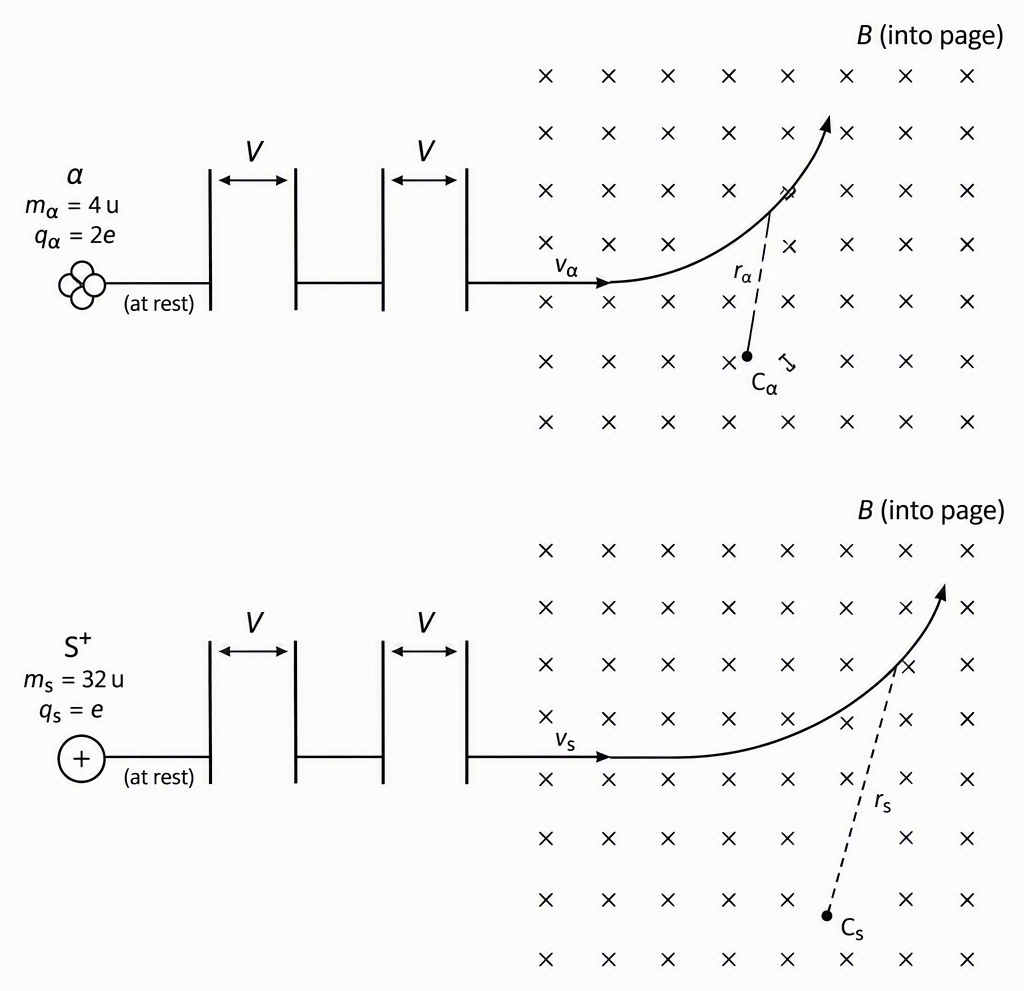
The answer is 4. The derivation below follows the official energy-conservation and magnetic-force method, using these charges:
The requested ratio is:
How does the accelerating voltage determine each particle’s speed?
The electrical energy gained becomes kinetic energy because each particle starts from rest. The gain depends on charge as well as voltage, so the alpha particle receives twice the energy of the sulfur ion. This energy-conservation step fixes each particle’s speed before magnetic motion begins.
Use the following symbols:
Initial kinetic energy is zero, so:
Rearrange for the square of the speed, then take the positive square root:
The same voltage therefore gives different kinetic energies:
Keep the accelerating potential symbolic. Neither a numerical voltage nor conversion of atomic mass units into kilograms is needed, since we want a ratio.
How does magnetic force give the orbit-radius formula?
The perpendicular magnetic force supplies the centripetal force. It changes the velocity’s direction without changing the particle’s speed, so the speed found during acceleration is also the speed around the orbit. The field bends the path without adding kinetic energy.
Because entry is perpendicular to the field, the magnetic-force magnitude is:
Equate this to the centripetal force:
Cancel one speed factor:
Rearrange for the radius:
Now substitute the speed obtained from the accelerating voltage:
Bring the positive mass-to-charge factor inside the square root and simplify:
For the same accelerating potential and the same magnetic field:
Use this dependence here because both conditions are shared. It is not a universal radius rule: equal-speed and equal-energy comparisons require different dependences.
How do the masses and charges give a radius ratio of 4?
The sulfur ion’s mass-to-charge ratio is sixteen times the alpha particle’s. With the same accelerating voltage and magnetic field, the orbit-radius ratio is the square root of that factor, giving four. Keep sulfur in the numerator because that is the ratio requested.
Retain the units while substituting:
Therefore:
The atomic mass unit and elementary charge cancel inside the ratio, leaving a dimensionless answer. Enter 4, not one-quarter.
The qualitative check agrees: sulfur has the larger mass-to-charge ratio. It therefore has the larger orbit under these conditions.
Why does assuming equal speeds give the wrong answer, 16?
Equal accelerating potentials do not justify cancelling the velocities: the particles gain different speeds because their charge-to-mass ratios differ. Since this is a numerical-answer question, 16 is an illustrative wrong result, not an official wrong option.
Start from the valid radius formula:
The faulty route cancels the speeds as though they were equal:
Check the speeds using the expression already derived:
The sulfur ion moves at one-quarter of the alpha particle’s speed. Restoring that factor gives:
The mass-to-charge factor is sixteen, but the speed factor is one-quarter. Identify the shared physical condition before choosing a proportionality.
How do equal speed, equal energy and doubled voltage change the answer?
Equal speed gives sixteen; equal kinetic energy gives four times the square root of two. Doubling both original accelerating potentials enlarges both orbits by the square root of two without changing their ratio. These are original practice variations, not additional verified PYQs; all retain perpendicular entry into the same uniform magnetic field.
- Question 1: What is the radius ratio if both particles enter with equal speeds? With speed and magnetic field shared, radius is proportional to mass divided by charge. There is no square root:
- Question 2: What is the radius ratio if both particles have equal kinetic energies? Express speed through kinetic energy first. Substitution puts mass inside the square root but leaves charge outside:
- Question 3: What happens if both original accelerating potentials are doubled? Each radius increases by the square root of two, while their ratio stays four. With the magnetic field fixed:
Cover the solutions and write the shared condition above each variation: equal speed, equal kinetic energy or equal voltage. Then derive the radius dependence from that condition.
Next step: the past-paper archive on JEEnius and search every JEE Main paper from 2002 and every Advanced paper from 2007, by year, subject or chapter, each with a worked solution (free).
Keep going with JEE Maths Preparation: Daily Practice and Study Plan.
Frequently asked questions
What is the answer to the alpha-particle and sulfur-ion question in JEE Advanced 2021?
The sulfur-ion orbit radius divided by the alpha-particle orbit radius is 4. For particles accelerated from rest through the same voltage and entering the same magnetic field perpendicularly, r is proportional to √(m/q). Substituting sulfur's mass and charge, 32u and e, and the alpha particle's, 4u and 2e, gives √16 = 4.
How do you find the magnetic orbit radius after acceleration through a voltage?
For a particle starting from rest, energy conservation gives qV = mv²/2. Perpendicular entry into a uniform magnetic field gives qvB = mv²/r. Combining these equations gives r = √(2mV/q)/B, where q is the charge magnitude.
Why is the sulfur-to-alpha radius ratio 4 and not 16?
The value 16 comes from incorrectly assuming equal speeds and comparing only the mass-to-charge ratios. Equal accelerating voltages give the sulfur ion one-quarter of the alpha particle's speed. Including this speed factor gives the radius ratio 16 × 1/4 = 4.
What is the sulfur-to-alpha radius ratio at equal kinetic energy?
For perpendicular entry into the same uniform magnetic field at equal kinetic energy, r = √(2mK)/(qB). The sulfur-to-alpha radius ratio is therefore √(32/4) × 2 = 4√2. This differs from equal accelerating voltage, because equal voltage gives these differently charged particles different kinetic energies.