What is the answer to the Circle JEE 2026 equal-intercepts question?
The squared radius is 8; the key correction is that the circle passes through the origin rather than touching an axis. This Circle JEE 2026 question describes a circle centred in the first quadrant, cutting equal lengths on the coordinate axes and meeting their union at exactly three distinct points. A given line cuts a chord of known length; the task is to find the squared radius.
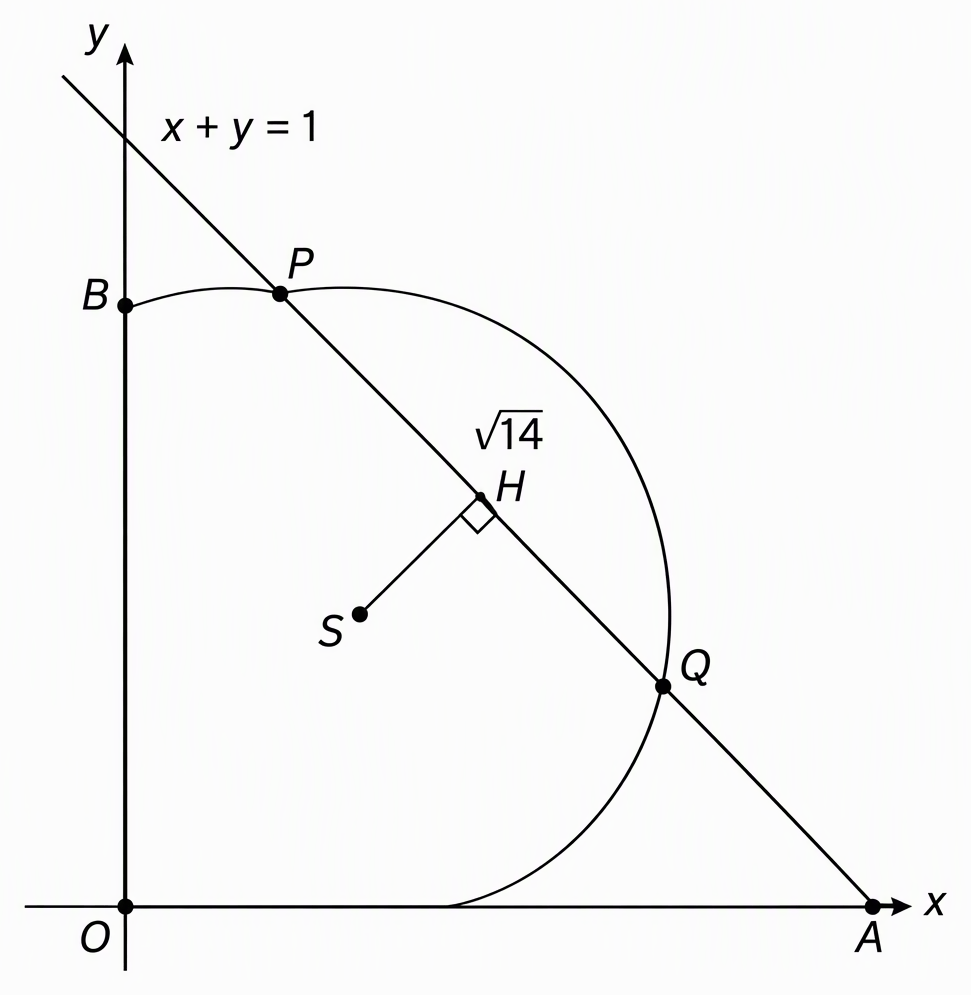
The given line and chord length are:
Count distinct points in the union of the axes, not intersections separately by axis. The source rates this numerical-answer question hard and gives an expected solving time of 300 seconds, or five minutes, not a universal target.
Why do three distinct axis intersections mean the circle passes through the origin?
Start with a first-quadrant centre and the standard circle equation:
Equal axis-intercept lengths force the centre coordinates to be equal. This rules out tangency to just one axis, so the three-point condition must come from a shared intersection at the origin.
Setting the other coordinate to zero gives the squared axis-chord lengths:
Equating them gives:
Both coordinates are positive, hence:
The centre is equally distant from both axes. Tangency to one would therefore mean tangency to both, producing only two distinct contact points.
Both axes must cut proper chords. Their four intersection incidences represent only three distinct points because one point belongs to both axes. The axes share only the origin, so the origin lies on the circle.
Substitute the origin:
The supplied working incorrectly assumes tangency:
It then reaches an impossible quadratic:
This has no real solution. Retain the source’s centre-distance and chord-length method, but reject its tangency premise.
How does the given chord length give a squared radius of 8?
The chord condition gives a centre coordinate of 2, and the squared radius is twice its square. Use the corrected radius relation, not the source’s tangency assumption.
The centre and chord line are:
The perpendicular distance from the centre to the line is:
A perpendicular from the centre bisects a chord because the two right triangles have equal radius hypotenuses and a common perpendicular leg. Each triangle has the radius as its hypotenuse, with the perpendicular distance and half the chord as its legs.
By Pythagoras:
Substitute the given length and corrected radius relation:
Expand the square. The quadratic terms cancel:
Therefore:
This matches the supplied key’s value 8, labelled option C in the question bank. That label belongs to the bank, not to the numerical-answer exam interface.
Does the resulting circle satisfy all three conditions?
Yes: the circle has three distinct axis-intersection points, both axis intercepts have length 4, and the given line cuts the required chord. Check these directly in the resulting equation:
Set the vertical coordinate to zero:
Set the horizontal coordinate to zero:
The three distinct points are:
Both axis intercepts have length 4. The origin appears in both calculations but counts only once.
For the given chord line, the squared perpendicular distance and chord length are:
The centre is:
Both coordinates are positive, confirming the first-quadrant condition. The answer satisfies the geometry, not just the supplied key.
Why is 4 wrong if the centre coordinate is 2?
Squaring a centre coordinate does not give the squared radius here. A solver can correctly find the centre coordinate but then make this incorrect identification:
That produces the supplied bank’s option A. The centre coordinate measures the perpendicular distance to either axis, not the distance to the origin.
Since the origin lies on the circle, the radius is:
Before substituting into the chord formula, label these three quantities separately. They measure different distances:
Which two practice questions test the same method?
Use the first problem to check the axis geometry and the second to check the chord calculation. Both are original related practice, not additional verified PYQs.
1. Original related practice: equal intercepts of length 6
A circle with first-quadrant centre passes through the origin and cuts equal axis intercepts of length 6. Find its centre and squared radius.
The other axis intersections are:
The centre lies on the perpendicular bisectors of both axis chords. Their midpoints fix its coordinates:
Since the origin lies on the circle:
2. Original related practice: move the chord line
For the circle below, find the chord length on the stated line:
The centre and radius remain unchanged. Only the perpendicular distance to the chord line changes:
Hence:
Before checking either answer, write down the squared radius and squared perpendicular distance separately. Subtract those quantities inside the chord formula, not the centre coordinate.
Next step: photograph a doubt on JEEnius and photograph any question you are stuck on and get a step-by-step solution, with a free-body diagram when the question needs one (20 free).
Related on JEEnius: Equilibrium JEE 2025: Nylon 6,6 Dumas Nitrogen Answer.
Frequently asked questions
What is the answer to the Circle JEE 2026 equal-intercepts question?
The squared radius is 8, and the centre is (2,2). The circle is (x−2)² + (y−2)² = 8, which cuts equal axis intercepts of length 4 and a chord of length √14 on x+y=1.
Why must the circle pass through the origin instead of touching an axis?
Equal axis-intercept lengths and a first-quadrant centre imply that the centre is (a,a), equally distant from both axes. Tangency to one axis would therefore mean tangency to both, giving only two distinct contact points. With both axes cutting proper chords, three distinct intersection points are possible only when the origin is shared by the two axis chords.
How do you use the chord length to find the squared radius?
For centre (a,a), passing through the origin gives r² = 2a², while the squared distance to x+y=1 is d² = (2a−1)²/2. Substitute these into L² = 4(r²−d²) with L = √14 to get 14 = 8a−2. Thus a = 2 and r² = 8.
Why is the squared radius 8 and not 4 when the centre is (2,2)?
The centre coordinate 2 is the perpendicular distance to either axis, not the radius. Since the origin lies on the circle, the squared radius is the squared distance from (2,2) to (0,0): r² = 2² + 2² = 8.