
What changes in the JEE Advanced 2020 X-ray tube question?
Electrons leave a heated filament cathode and travel to a higher-potential target anode, where continuous and characteristic X-rays are emitted. A and C are correct in the JEE Advanced 2020 X-ray tube question: the cut-off wavelength halves, characteristic wavelengths stay fixed, and intensities decrease under the supplied solution’s model.
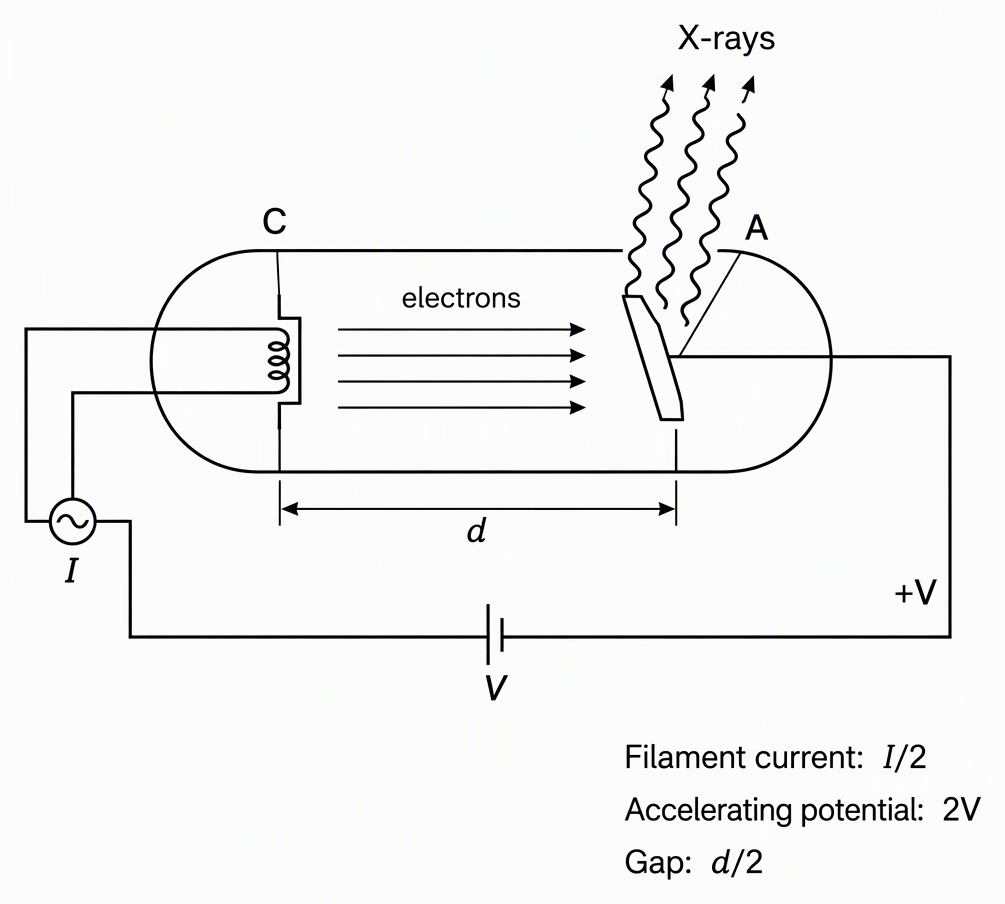
With the target material unchanged, filament heating current, accelerating potential and cathode–anode gap change simultaneously:
The source is JEE Advanced 2020, Paper 1, Physics, a multiple-correct question from Electronic Devices. Its medium difficulty is the question bank’s classification, not an official exam rating.
Select every correct alternative:
Why does doubling the voltage halve the cut-off wavelength?
Doubling the accelerating voltage doubles the maximum electron energy. At the continuous spectrum’s short-wavelength limit, one photon receives that entire energy. Use the potential difference, not the cathode–anode gap, to calculate the electron’s kinetic energy:
Here, the symbols mean:
The maximum-energy photon receives the electron’s entire kinetic energy, giving:
Using Planck’s constant and the speed of light, substitute the frequency–wavelength relation:
Substitute the changed voltage explicitly:
Thus, the wavelength ratio is:
The cut-off is the minimum wavelength of the continuous spectrum, corresponding to the maximum possible photon energy. It is not the wavelength of a characteristic line, so this calculation does not determine the characteristic wavelengths. Those require a separate check of the target’s atomic energy levels.
Why do the characteristic wavelengths remain unchanged?
The unchanged target has the same atomic shell-energy differences. Characteristic X-rays arise from transitions between inner atomic shells of target atoms, rather than from an incident electron losing its entire kinetic energy in one event. The transition energy sets the photon wavelength:
The relevant energy-level differences, and therefore the characteristic wavelengths, remain unchanged. This assumes the accelerating voltage is sufficient to produce the relevant transitions.
Doubling an incoming electron’s available kinetic energy does not double an atomic shell-energy difference. It changes the energy available for excitation, not the target’s characteristic energy spacing.
How do filament current and the shorter gap affect the result?
Under the supplied solution’s model, reduced filament heating current means fewer emitted electrons per unit time. Fewer electrons strike the target, reducing X-ray photon production. The intensities of both continuous and characteristic X-rays decrease in this question.
Filament heating current is not the electron-beam current. Halving the heating current does not establish that the beam current, or X-ray intensity, halves exactly. No quantitative intensity ratio follows here.
Keep this intensity argument separate from the electron-energy argument. Energy gained across the tube is set by the potential difference:
The doubled voltage gives:
The shorter gap does not supply another energy multiplier. Only as a consistency check, assume an idealised uniform electric field:
Even though the field quadruples, the travel distance halves:
A stronger field over a shorter distance still gives the energy fixed by the full potential difference. The gap change therefore does not alter the cut-off result obtained from voltage.
Which options are correct after checking both clauses?
A and C pass both checks. B fails on the cut-off wavelength, while D fails despite its correct intensity clause. Each option requires both its wavelength claim and its accompanying claim to hold:
What reasoning mistake produces option D?
Doubling voltage correctly gives twice the electron energy, but incorrectly assuming that wavelength also doubles produces D’s wavelength claim. Combining that error with the supplied solution’s correct intensity decrease produces option D. The missing step is the inverse relation:
Larger photon energy means shorter wavelength, not longer wavelength. The electron-energy argument must pass through this photon relation before giving a wavelength claim.
Check the direction of change before selecting options:
Doubling voltage must increase the maximum frequency and decrease the cut-off wavelength. If your working predicts the opposite, recheck the energy-to-wavelength conversion.
How do you solve related Electronic Devices questions?
Check which setting changes electron energy, target shell-energy differences or electron supply. The following are original follow-up practice questions, not additional verified PYQs. Each isolates one control from the original problem; solve it before reading its answer.
- Question 1: The target and filament settings stay unchanged. Accelerating voltage becomes three times its original value. Find the new cut-off wavelength and describe existing characteristic-line wavelengths, assuming sufficient excitation.
Answer: Substitute the changed voltage:
Existing characteristic-line wavelengths remain unchanged because the target’s relevant shell-energy differences remain unchanged.
- Question 2: Accelerating voltage stays fixed while the cathode–anode gap halves. Find the final electron kinetic energy and cut-off wavelength.
Answer: Both remain unchanged:
A larger electric field does not mean a larger potential difference. In the uniform-field model, the shorter travel distance offsets the stronger field.
- Question 3: For an unchanged target with sufficient excitation voltage, filament heating current decreases while accelerating voltage stays fixed. Which spectral properties change under this question’s model?
Answer: Cut-off and characteristic wavelengths stay fixed; both intensities decrease. No exact intensity ratio follows.
Before substituting in your next tube question, write three separate checks: energy per electron, target energy levels, electrons per second.
Next step: photograph a doubt on JEEnius and photograph any question you are stuck on and get a step-by-step solution, with a free-body diagram when the question needs one (20 free).
Keep going with How to Study Application of Derivatives JEE: 6 Steps.
Frequently asked questions
Which options are correct in the JEE Advanced 2020 X-ray tube question?
A and C are correct. Doubling the accelerating voltage halves the cut-off wavelength because λc = hc/(eV), while the unchanged target keeps characteristic wavelengths fixed. Intensities decrease under the supplied solution’s model.
Why do characteristic X-ray wavelengths stay unchanged when voltage doubles?
Characteristic wavelengths depend on the target atoms’ shell-energy differences, not directly on the accelerating voltage. With the target unchanged, these wavelengths remain fixed, provided the voltage is sufficient to produce the relevant transitions.
Does halving filament current halve X-ray intensity?
No exact intensity ratio follows from halving the filament heating current. Filament heating current is not the electron-beam current. Under the supplied solution’s model, reduced heating means fewer emitted electrons and lower intensities of both continuous and characteristic X-rays.
Does reducing the cathode–anode gap change the cut-off wavelength?
At fixed accelerating voltage, reducing the gap does not change the cut-off wavelength because electron energy is set by eV. A stronger electric field across a shorter distance does not add an energy multiplier. In the 2020 question, the cut-off halves because voltage doubles, not because the gap halves.