
What is the key to the Gravitation JEE 2020 aluminium-block question?
For the Gravitation JEE 2020 aluminium-block question, divide the volume strain by three before calculating the edge contraction. This is a JEE Advanced 2020, Paper 1, Physics numerical-answer question. Its medium difficulty and 120-second solving target are question-bank classifications, not official exam labels.
An aluminium cube has an initial edge of 1 metre at Earth’s surface and is lowered onto the floor of an ocean 5 kilometres deep. Its bulk modulus is 70 gigapascals; use an average water density of 1000 kilograms per cubic metre and gravitational acceleration of 10 metres per second squared. Find the magnitude of its edge-length reduction in millimetres.
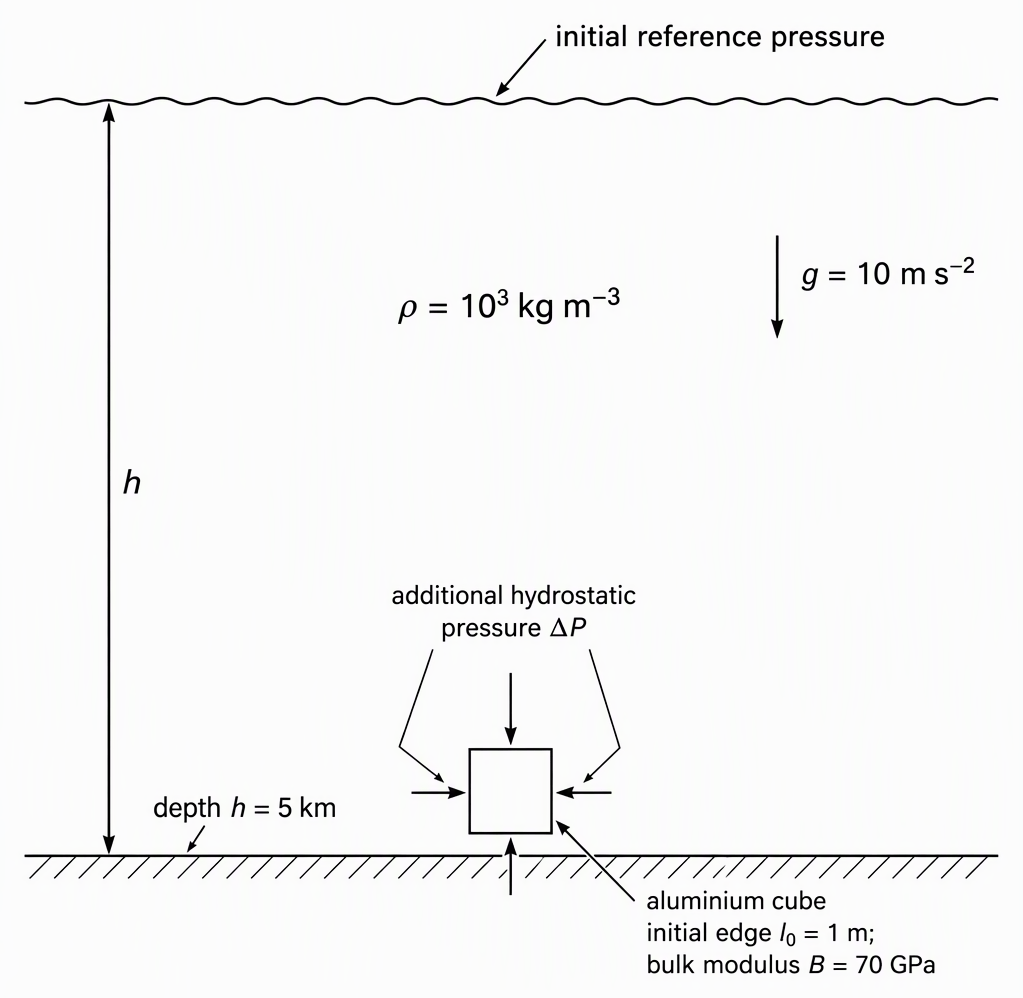
The edge decreases by 0.238 mm. Here is the calculation, step by step.
How do you calculate the additional pressure at the ocean floor?
Use the pressure increase due to the water column, not the absolute pressure at the ocean floor. The cube’s stated initial size already includes the effect of atmospheric pressure at the surface, so atmospheric pressure must not be added again when calculating the change.
First convert the depth into SI units:
The additional hydrostatic pressure is:
Substituting the supplied values gives:
Use the supplied average water density and constant gravity. Ocean-density models or depth-dependent gravity would change the stated model, not improve this solution.
How does bulk modulus give the volume strain?
Bulk modulus connects the pressure increase to the fractional decrease in volume, not directly to the edge contraction. Start from its definition:
Pressure increases while volume decreases, so the negative sign makes the bulk modulus positive. Define the positive magnitude of the volume reduction as:
The official solution uses the small-strain relation:
Convert the given modulus into pascals before dividing:
Therefore:
This is dimensionless volume strain because the pressure units cancel. It is much smaller than one, which justifies the first-order conversion to length strain used next. It describes the fractional reduction in the whole volume, not along one edge.
Why do you divide volume strain by three to get edge contraction?
All three dimensions shrink under isotropic compression, so the volume strain is approximately three times the strain along one edge. Bulk modulus describes the combined volume response, not the response of a single length.
For a cube:
Differentiating and dividing by the original volume:
Define the positive edge contraction as:
For isotropic small compression:
Terms involving the square and cube of the fractional edge contraction are neglected. Since the volume strain is already small, this first-order treatment is justified.
Using the original one-metre edge:
Convert metres to millimetres explicitly:
The signed final-minus-initial change is negative:
The required numerical entry for the magnitude of the decrease is:
Combining the pressure increase, volume strain and linear strain gives the reusable small-strain result:
Why is 0.714 mm a method error rather than a rounding error?
The value 0.714 mm comes from treating volume strain as linear strain. It is an illustrative wrong result, not a supplied answer option: this is a numerical-answer question. The mistake occurs before the arithmetic, so changing rounding or significant figures cannot repair it.
The incorrect step is:
That route produces:
Compare this with the correct contraction of 0.238 mm. The wrong result is three times larger because it assigns the entire fractional volume reduction to just one edge.
When bulk modulus is used to find an isotropic length change, convert volume strain to linear strain before multiplying by the original length. This accounts for shrinkage along all three dimensions.
Which two original Gravitation questions can check this method?
Use one question on gravity outside a spherical planet and one on gravity inside a uniform-density Earth. These are original practice questions, not additional verified JEE PYQs.
Question 1: A spherical planet has Earth’s mass but twice Earth’s radius. Taking Earth’s surface gravity as 10 metres per second squared, find the planet’s surface gravity and the contraction of the same block under the same water column. Assume constant gravity through that column.
Worked check: Surface gravity follows:
With everything else unchanged, contraction scales directly with gravity:
Question 2: Inside an ideal uniform-density spherical Earth, find gravity at a depth equal to half its radius. Surface gravity is 10 metres per second squared.
Worked check: Only enclosed mass contributes, and that mass scales with the cube of distance from the centre:
At the specified depth:
Before using a radius ratio, identify whether the point is outside or inside the body. Use inverse-square scaling outside a spherical body; linear scaling with distance from the centre inside a uniform-density sphere.
Next step: the past-paper archive on JEEnius and search every JEE Main paper from 2002 and every Advanced paper from 2007, by year, subject or chapter, each with a worked solution (free).
Keep going with How to Study Amines JEE: Basicity, Reactions and Tests.
Frequently asked questions
What is the answer to the JEE Advanced 2020 aluminium-block question?
The magnitude of the edge-length reduction is approximately 0.238 mm. Using the small-strain relation, the contraction is lρgh/(3B), with l = 1 m, ρ = 1000 kg/m³, g = 10 m/s², h = 5000 m and B = 70 × 10⁹ Pa.
Why is volume strain divided by three to find edge contraction?
For a cube, V = l³, so differentiation gives dV/V = 3 dl/l. Under isotropic small compression, the fractional edge contraction is therefore one-third of the fractional volume reduction.
Should atmospheric pressure be added in the aluminium-cube question?
No, because the initial one-metre edge is measured at Earth's surface and already includes the effect of atmospheric pressure. The additional pressure on lowering the cube is ΔP = ρgh = 5 × 10⁷ Pa.
Why do I get 0.714 mm instead of 0.238 mm?
You have treated the volume strain ΔP/B as the linear strain. Divide it by three before multiplying by the original edge length to obtain 0.238 mm. This is a method error, not a rounding error.