
What is the JEE Advanced 2023 cubic-unit-cell question?
A, B and D are correct in the JEE Advanced 2023 cubic-unit-cell question. Metal x forms an fcc cell, metal y a bcc cell and metal z a simple-cubic cell, with their respective edge lengths and atomic radii labelled below.
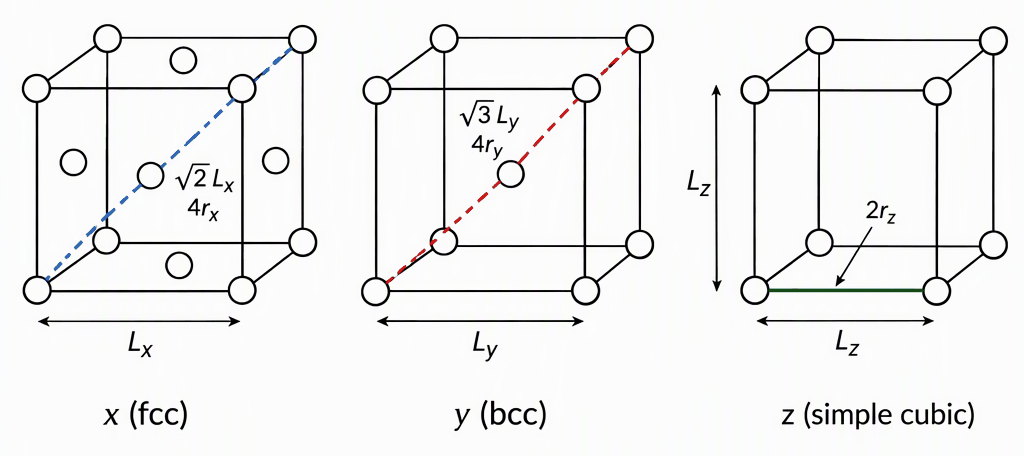
This is a multiple-correct question from JEE Advanced 2023, Paper 2, Chemistry, under Properties of Solids and Liquids. It is rated medium on this question bank’s scale.
The respective edge lengths and atomic radii are:
The given relations are:
The capital M symbols denote the respective molar masses. Select every correct claim:
Why is option A correct for packing efficiency?
The occupied-volume fraction decreases from fcc to bcc to simple cubic. Start the official method by counting atoms: each corner atom contributes one-eighth to a cell, each face-centre atom contributes one-half, and a body-centre atom belongs entirely to its cell.
Atoms touch along the face diagonal in fcc, the body diagonal in bcc, and an edge in simple cubic. These contact chains give:
Packing efficiency is the total atomic-sphere volume divided by cell volume. It is a dimensionless occupied-volume fraction:
Substituting each atom count and radius–edge relation gives:
The radius cancels within each calculation, so equal atomic radii are not required. The ranking confirms A is correct:
Is the bcc cell edge longer than the simple-cubic edge?
Yes, the y-to-z edge ratio is four-thirds, so B is correct. Start with the two contact relations:
Use the supplied radius relation to express both edges using the radius of metal y:
The edge ratio is:
Keep both lengths in one radius variable. No absolute radius or length is needed.
Why is option C false for the fcc and bcc edges?
The x cell has a shorter edge than the y cell. Form the exact ratio from the contact relations before substituting the given unequal radii:
Substitute the supplied relation explicitly:
C is incorrect. Retain the reciprocal for the density calculation:
Why is metal x denser than metal y?
The x and y cells have equal mass, but the x cell occupies less volume. Following the official method, write density as cell mass divided by cell volume:
Here, Avogadro’s constant converts molar mass to mass per atom. The cell mass and volume are:
For the two metals:
Avogadro’s constant cancels in the ratio:
The edge ratio must be cubed because density depends on volume, not length. Both given molar-mass relations yield:
Substituting the mass and edge ratios:
Therefore, D is correct, and the final selection is A, B and D. Check the cell masses independently:
Dividing both sides by Avogadro’s constant gives equal cell masses. The smaller x cell must therefore be denser.
What mistake can incorrectly make option C look true?
Assuming equal atomic radii falsely supports C. This shortcut fails because the two metals have explicitly unequal radii.
The wrong assumption gives:
That result applies to an equal-radius comparison, not this problem. The actual ratio is:
Lattice geometry supplies the coefficient relating edge length to radius. It does not make different metals’ radii identical.
Substitute the supplied radius relation before deciding the inequality. Packing efficiency alone cannot establish either edge length or mass density.
What do two related comparisons give using the same data?
The z-to-x edge ratio is twice the square root of two, and z is denser than y. These are original practice extensions using the same given data, not additional verified JEE questions.
What is the ratio of the z edge to the x edge?
The ratio is twice the square root of two. First express the radius of z using the radius of x:
Then use the respective contact relations:
Which is denser, y or z, and by what ratio?
Metal z is denser by a factor of sixteen-ninths, despite its lower packing efficiency. Separate atom count, molar mass and cell volume:
Occupied-volume fraction and mass density measure different things. For your next unit-cell comparison, write the atom count, radius–edge relation and molar-mass ratio separately before combining them.
Next step: the past-paper archive on JEEnius and search every JEE Main paper from 2002 and every Advanced paper from 2007, by year, subject or chapter, each with a worked solution (free).
Related on JEEnius: Oscillations and Waves JEE 2020: Tuning Fork Solution.
Frequently asked questions
What is the answer to the JEE Advanced 2023 cubic-unit-cell question?
The correct options are A, B and D in the Paper 2 Chemistry question. Packing efficiency follows x > y > z, the y cell has a longer edge than z, and metal x is denser than y. Option C is false because the x cell has a shorter edge than y.
What are the packing efficiencies of fcc, bcc and simple cubic cells?
The packing efficiencies are approximately 74% for fcc, 68% for bcc and 52% for simple cubic cells. Each value is the total atomic-sphere volume divided by the cell volume. The radius cancels within each calculation, so this ranking does not require equal atomic radii.
Why is option C wrong in the JEE Advanced 2023 unit-cell question?
The given unequal radii produce an x-to-y edge ratio of 3/(8√2), which is less than one. Assuming equal radii instead gives √(3/2), but that assumption contradicts the question. The supplied radius relation must be substituted before comparing the edges.
Why is metal x denser than metal y in this question?
The fcc cell of x contains four atoms and the bcc cell of y contains two, while the molar mass of y is twice that of x. Their cell masses are therefore equal, but the x cell has a smaller volume. Using density = ZM/(N_A L³), the x-to-y density ratio is 1024√2/27.