
What is the tuning-fork question in Oscillations and Waves JEE 2020?
The official answer to this Oscillations and Waves JEE 2020 question is 0.63, meaning an approximately 0.63% decrease in pipe length. It is a numerical-answer question from JEE Advanced 2020, Paper 2, Physics, rated medium on this question bank’s scale.
Initially, a stationary tuning fork resonates with the air column inside a pipe. The fork then moves at 2 m/s near the open end, while sound travels at 320 m/s. The question asks for the smallest percentage length adjustment needed to restore resonance. The supplied official solution treats the fork as approaching the open end along the pipe’s axis, not moving away from it.
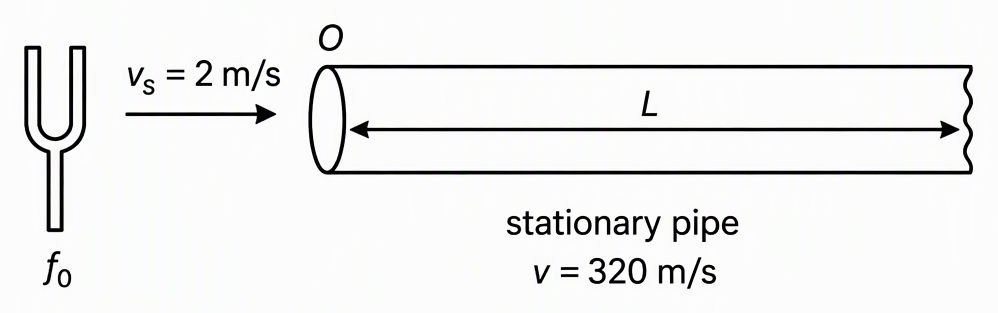
How do you find the frequency reaching the stationary pipe?
Use the moving-source Doppler formula, with the source speed subtracted from the sound speed in the denominator. The tuning fork moves, but the pipe and air remain stationary. A moving-receiver formula would describe a different physical situation.
Define the emitted and received frequencies:
For a source approaching a stationary receiver:
Substitute the given speeds:
Subtract the original frequency, then divide by it to find the fractional increase:
The received frequency increases because the approaching source compresses the spacing between successive wavefronts travelling towards the pipe. The sign agrees:
Why must the resonating pipe shorten, and where is the approximation?
For the same air-column mode, resonant frequency is inversely proportional to length. A higher received frequency therefore requires a shorter air column. The official route converts the fractional frequency increase into an approximately equal fractional length decrease, using a first-order small-change approximation.
Write the resonance relation as:
The constant remains fixed for the chosen mode and sound speed. We do not need to assume that the unspecified far end is open or closed.
For small changes:
Initially, the resonant frequency equals the stationary fork’s frequency. Restoring resonance requires the pipe’s resonant frequency to increase by the Doppler shift already calculated.
The signed length change is negative:
The requested adjustment is a positive magnitude:
Equal-and-opposite fractional changes are not an exact finite-change identity for an inverse relation. The approximation is justified here by the small speed ratio:
How does the calculation give the numerical answer 0.63?
Multiplying the fractional length adjustment by 100 gives approximately 0.63%. Enter 0.63, the supplied official answer to the requested smallest percentage change.
Therefore:
The numerical entry is:
Do not enter 0.0063. That is approximately the fractional change before conversion to a percentage.
Keep the physical chain attached to the calculation: approaching source → received frequency increases → resonant pipe length decreases. The official route needs no extra search over source directions or resonance modes.
Why is making the pipe longer a wrong solution?
Lengthening fails because a longer air column has a lower resonant frequency for the same mode. The approaching fork supplies a higher frequency, so lengthening moves the pipe’s resonance in the wrong direction. This is a numerical-answer question, and no wrong options are supplied.
A concrete incorrect step is:
This predicts a longer pipe. The error is treating resonant frequency and length as directly proportional, when they are inversely proportional.
An unsigned numerical response can hide this mistake: obtaining the accepted percentage magnitude does not establish correct reasoning. Write “shorter” beside the answer before entering the number.
Which two practice questions test the same skills?
Practise the moving-source denominator and the inverse frequency–length relation separately. These are original chapter practice questions, not additional verified JEE PYQs. The first checks the Doppler setup; the second checks the resonance relation.
What frequency ratio results when a tuning fork approaches at 4 m/s?
Use the moving-source denominator: sound speed minus source speed. For this original practice question, a tuning fork approaches a stationary receiver at 4 m/s through stationary air, where sound travels at 320 m/s. Find the ratio of received to emitted frequency.
The source speed belongs in the denominator, not the numerator. The ratio exceeds one, as required for approach.
What happens to a closed pipe’s fundamental when its length is halved?
The fundamental rises from 100 Hz to 200 Hz. For this original practice question, a pipe closed at one end and open at the other has length 0.80 m; sound speed is 320 m/s. Neglect end correction and find its fundamental frequency before and after halving its length.
For the original length:
After halving the length:
Halving the length doubles the frequency. Now redo the main question without looking: identify the moving source, write the denominator, and decide shorter or longer before calculating the percentage.
Next step: photograph a doubt on JEEnius and photograph any question you are stuck on and get a step-by-step solution, with a free-body diagram when the question needs one (20 free).
Keep going with How to Study Binomial Theorem JEE: Six Practical Steps.
Frequently asked questions
What is the answer to the JEE Advanced 2020 tuning-fork question?
The supplied official answer is 0.63, representing an approximately 0.63% decrease in pipe length. Enter 0.63, not 0.0063, because the question asks for a percentage adjustment.
Which Doppler formula applies when a tuning fork approaches a stationary pipe?
Use the moving-source formula f = f₀v/(v − vₛ), where v is the sound speed and vₛ is the source speed. With v = 320 m/s and vₛ = 2 m/s, the frequency received at the pipe is f₀ × 320/318.
Why must the pipe become shorter when the tuning fork approaches?
An approaching tuning fork increases the frequency received at the stationary pipe. For the same air-column mode, resonant frequency is inversely proportional to length, so the pipe must shorten to restore resonance.
What approximation gives the 0.63% pipe-length change?
The official route uses the first-order relation Δf/f ≈ −ΔL/L for resonance at a fixed mode. The fractional frequency increase is 2/318, giving an approximate percentage length decrease of 100 × 2/318 = 0.6289%, rounded to 0.63%. Equal-and-opposite fractional changes are not an exact finite-change identity.