
What are the correct options in the Rotational Motion JEE 2021 question?
A, B and C are correct; D is incorrect in this Rotational Motion JEE 2021 problem. It is a multiple-correct question from JEE Advanced 2021, Paper 1, Physics. The question bank classifies it as medium difficulty; this is not an official exam rating.
A particle of mass 0.2 kg starts at rest at coordinates (minus 10 m, minus 1 m). It accelerates constantly at 10 metres per second squared towards positive x, with torque and angular momentum measured about the origin O. Define ell as the initial horizontal offset of 10 m and h as the perpendicular offset of 1 m. The particle travels from P through Q to R along a horizontal path below O.
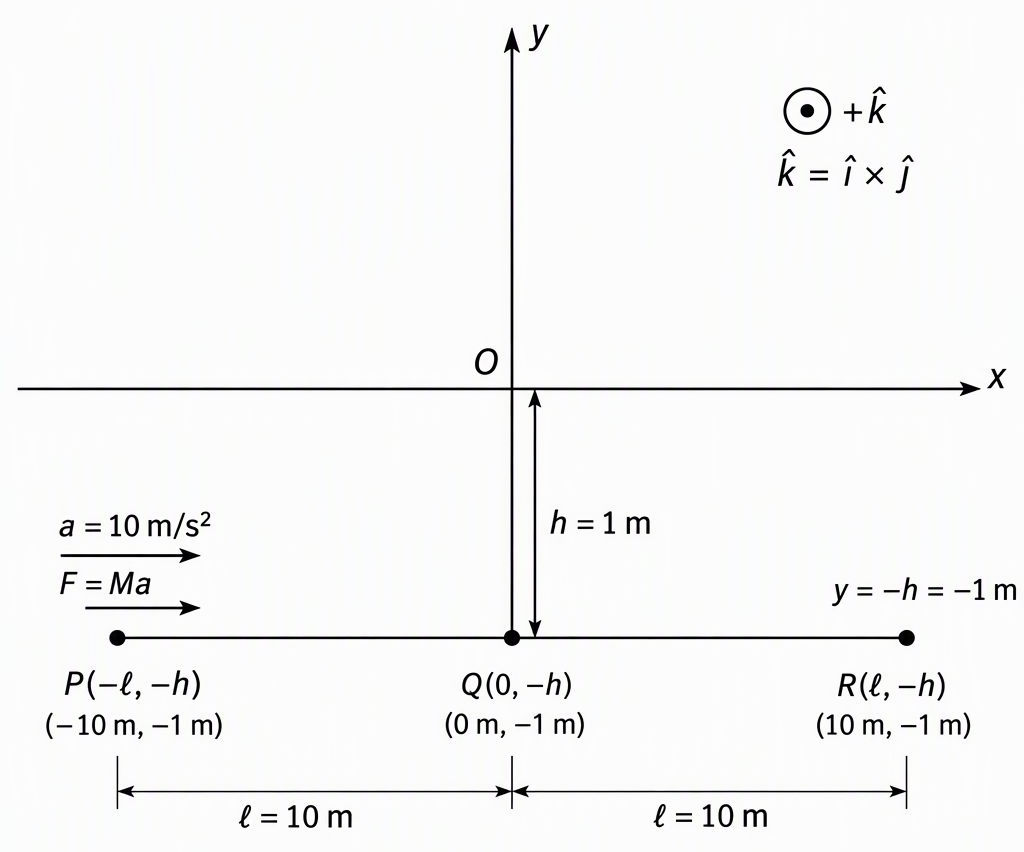
Test each statement independently:
- A: Arrival at R takes 2 s.
- B: Torque about O at R is
- C: Angular momentum about O at R is
- D: Torque about O at Q is
The lever arm is the perpendicular distance from O to the force’s line of action. It is not the changing horizontal coordinate.
How do you find the arrival time and check A?
The particle reaches R after 2 s, so A is correct. Its displacement is 20 m, even though its final x-coordinate is only positive 10 m. Keep the initial negative coordinate in the position equation.
The official solution starts with kinematics:
Both the initial y-velocity and y-acceleration are zero. The vertical coordinate therefore stays fixed:
At R, substitute the final horizontal coordinate:
Discard the negative root because elapsed time cannot be negative. The calculation uses the full displacement from minus 10 m to plus 10 m.
How do you calculate torque and check B and D?
The torque is constant and points out of the page: B is correct and D is incorrect. The force’s line of action stays one metre below O throughout the motion. Passing directly below O does not change this perpendicular lever arm.
Calculate the force and write the instantaneous position vector:
Expand the cross product before inserting coordinates:
The sign follows from the order of the unit vectors:
Thus, using SI values,
The horizontal term vanishes because it is parallel to the force. Only the fixed perpendicular offset contributes to torque.
At R, this gives the value stated in B. At Q, the torque remains
rather than
A zero x-coordinate does not put the particle at the origin. Q is still below O:
How do you calculate angular momentum and check C?
At R, angular momentum points out of the page and has magnitude 4 kilogram metres squared per second, so C is correct. Use the same cross-product method, replacing force with linear momentum. The horizontal coordinate again contributes nothing.
First calculate momentum:
Then expand angular momentum about O:
The parallel term is zero; the second term is positive because the cross product contributes another minus sign. With the one-metre offset and time measured in seconds,
At the arrival time of 2 s,
Final selection: A, B and C are correct; D is incorrect.
Check consistency by differentiating:
Straight-line motion need not have zero angular momentum about an off-path origin. Here the perpendicular offset stays fixed while momentum grows, so angular momentum grows too.
How could halving the force produce the wrong option D?
A possible faulty calculation gives D by averaging a supposed zero initial force with the actual force. This explains a method error, not what candidates selected.
The incorrect reasoning is: “It starts from rest, so the initial force is zero.” Averaging that with 2 N gives
Using the correct one-metre lever arm then gives
which matches D. But zero initial velocity does not mean zero force: the acceleration is constant from the start, so throughout. Constant acceleration permits averaging initial and final velocities,
not inventing a zero initial force and averaging it with the actual force.
Can you solve two related questions using the same geometry?
Use the same position equation and cross products, keeping O as the reference point. These are author-created practice questions based on the supplied setup, not additional verified JEE PYQs. Use the original figure for both.
Question 1: What is the angular momentum about O when the particle crosses Q?
At Q, the horizontal coordinate is zero. Solve for the crossing time:
Substitute into the angular-momentum expression:
It is not zero. Q remains one metre below O.
Question 2: What angular impulse does the torque about O deliver from release to arrival at R, and does it equal the angular-momentum change?
The constant torque acts for 2 s. Its angular impulse is
The particle starts at rest, so its initial angular momentum is zero. Hence,
The values agree, including direction. Check the units too: newton metre seconds and kilogram metres squared per second are equivalent.
Next step: the past-paper archive on JEEnius and search every JEE Main paper from 2002 and every Advanced paper from 2007, by year, subject or chapter, each with a worked solution (free).
If that step was the hard part, work through JEE Chemistry Revision Strategy: A 30-Day Main Plan.
Frequently asked questions
What are the correct options in the Rotational Motion JEE 2021 question?
A, B and C are correct; D is incorrect in this JEE Advanced 2021 Paper 1 question. The particle reaches R in 2 s, where its torque about O is 2 N m and its angular momentum is 4 kg m²/s, both directed out of the page.
Why is the torque at Q not zero?
Q has coordinates (0, −1 m), so it is not the origin. The 2 N force acts horizontally along a line 1 m below O, giving a torque of 2 N m out of the page. The perpendicular lever arm remains unchanged throughout the motion.
Can a particle moving in a straight line have angular momentum?
Yes, a particle can have angular momentum about an origin that is not on its line of motion. In this problem, the perpendicular offset is 1 m, so angular momentum about O has magnitude L = m v h. At R, m = 0.2 kg and v = 20 m/s, giving 4 kg m²/s out of the page.
Why is option D wrong in the JEE 2021 rotational motion question?
Option D gives the torque at Q as 1 N m out of the page, but the correct value is 2 N m in that direction. The force is 2 N from the start because acceleration is constant. Starting from rest means zero initial velocity, not zero initial force, so averaging a supposed zero force with 2 N is invalid.