
What is the answer to the JEE Advanced 2024 hydrazine–oxygen fuel-cell question?
A and C are correct in the JEE Advanced 2024 hydrazine–oxygen fuel-cell question on redox reactions and electrochemistry. This Chemistry, Paper 2 multiple-correct MCQ is rated medium by the question bank, which gives an expected solving time of 120 seconds, not an official time limit.
The cell operates in an alkaline aqueous medium. Hydrazine reacts electrochemically with oxygen, delivering electrical energy and producing nitrogen gas.
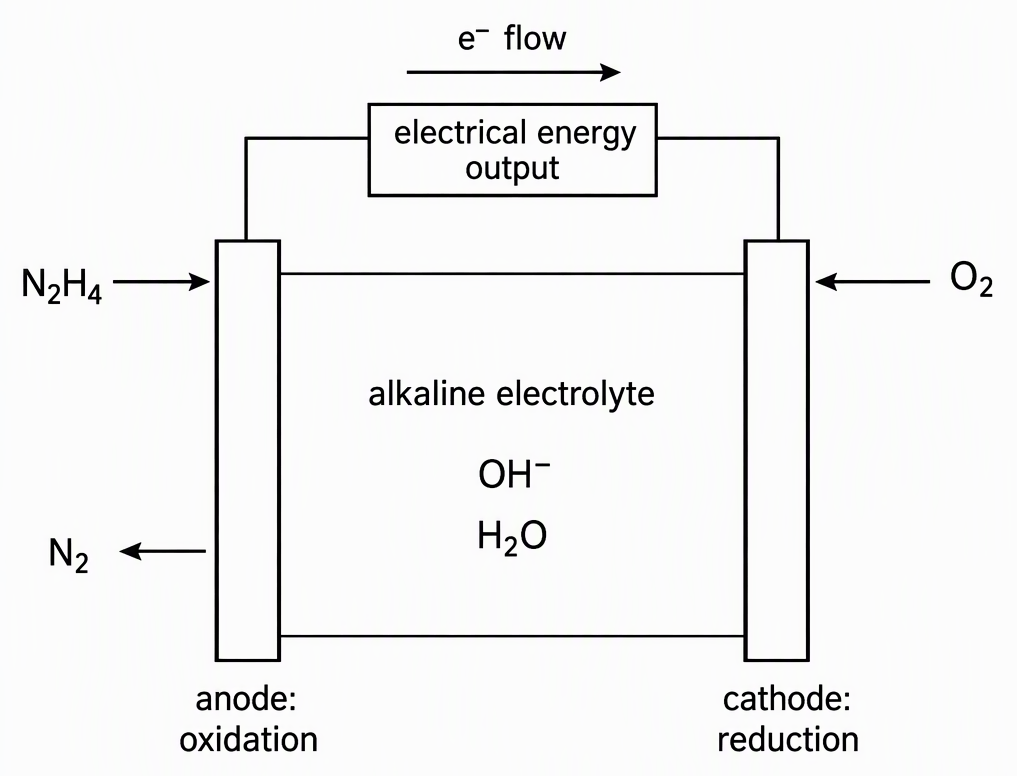
Which statements hold? Select every correct option.
What is the overall fuel-cell reaction?
The official solution starts with this overall reaction, whose net products are nitrogen and water. Each side contains two nitrogen atoms, four hydrogen atoms and two oxygen atoms.
This equation identifies the net products but does not locate the electrode processes or show how hydroxide participates. To check A and C, balance the alkaline half-reactions using two rules: oxidation occurs at the anode; reduction occurs at the cathode.
How do you balance hydrazine oxidation at the anode?
Hydrazine loses four electrons as it becomes nitrogen. Balance hydrogen and oxygen using hydroxide on the reactant side and water on the product side, then balance charge with electrons.
Start with the nitrogen skeleton:
Introduce unknown coefficients:
Oxygen balance, followed by hydrogen balance, gives:
Before adding electrons, the left-hand charge is minus four and the right-hand charge is zero. Add four electrons to the right, giving the official anode equation:
Check both sides explicitly:
The oxidation states provide a supporting check. Average nitrogen oxidation state rises from minus two in hydrazine to zero in nitrogen gas:
The two nitrogen atoms therefore lose four electrons in total. A is correct: hydroxide is consumed and electrons are released at the anode.
How do you balance oxygen reduction and recover the net equation?
Oxygen accepts four electrons at the cathode and forms hydroxide. Adding the half-reactions cancels electrons and hydroxide completely; water cancels only partly, leaving two water molecules as net products.
Start with:
Hydrogen and oxygen balances give:
The right side has charge minus four. Add four electrons to the left:
On both sides:
Oxygen accepts electrons, confirming reduction and option C. Add the complete electrode equations:
Cancel four electrons and four hydroxide ions from each side:
Cancel two reactant water molecules against two of the four product water molecules:
Hydroxide participates at both electrodes but has zero net consumption. It is consumed at the anode and regenerated at the cathode.
Why are A and C correct but B and D incorrect?
A and C match the balanced electrode reactions. B puts hydrazine oxidation at the wrong electrode; D introduces major by-products absent from the process described by the official solution.
Answer: A and C.
Why can you not treat this fuel cell like combustion?
A nitrogen-containing fuel reacting with oxygen does not automatically imply major nitrogen-oxide production. Having the required elements available does not establish a reaction pathway.
Nitrogen-oxide formation under some high-temperature combustion conditions cannot establish the products of this controlled electrochemical process. The question specifies nitrogen gas, and the balanced electrode reactions recover nitrogen and water.
Use the stated product and balanced electrode reactions to judge D, rather than adding a product because its elements are available. D is incorrect for this question; that does not mean every practical hydrazine fuel cell is incapable of side reactions under all operating conditions.
How do you solve two related electrochemistry practice questions?
Use the net equation for fuel-to-oxygen amounts and the anode equation for electron transfer. For an alkaline hydrogen–oxygen fuel cell, retain the oxygen-reduction equation and derive the oxidation equation for hydrogen.
Both questions below are original practice questions, not additional verified JEE PYQs.
Question 1: If 0.25 mol of hydrazine reacts completely through the stated fuel-cell reaction, how many moles of oxygen are consumed and how many moles of electrons pass through the external circuit?
The net equation gives one mole of oxygen per mole of hydrazine. The anode equation gives four moles of electrons per mole of hydrazine:
Question 2: In an alkaline hydrogen–oxygen fuel cell, write both half-reactions and obtain the overall equation.
At the anode:
At the cathode:
Double the anode equation. Add, cancel four electrons and four hydroxide ions, then cancel two water molecules:
Oxygen reduction is unchanged; the fuel determines the oxidation half-reaction. Cover the worked answers and rebuild both anode equations, checking atoms first and charge second.
Next step: photograph a doubt on JEEnius and photograph any question you are stuck on and get a step-by-step solution, with a free-body diagram when the question needs one (20 free).
Related on JEEnius: Electromagnetic Induction JEE 2022: LC Current Solution.
Frequently asked questions
What is the answer to the JEE Advanced 2024 hydrazine fuel-cell question?
A and C are correct. Hydrazine oxidation consumes hydroxide and releases four electrons at the anode, while oxygen reduction produces hydroxide at the cathode. The net products are nitrogen and water, not major nitrogen-oxide by-products.
What are the half-reactions in an alkaline hydrazine–oxygen fuel cell?
The anode reaction is N₂H₄ + 4OH⁻ → N₂ + 4H₂O + 4e⁻. The cathode reaction is O₂ + 2H₂O + 4e⁻ → 4OH⁻. Adding them and cancelling common species gives N₂H₄ + O₂ → N₂ + 2H₂O.
How many electrons does one hydrazine molecule release in this fuel cell?
One hydrazine molecule releases four electrons when oxidised to nitrogen. The average nitrogen oxidation state rises from −2 in N₂H₄ to 0 in N₂, giving a total loss of four electrons across two nitrogen atoms.
Is hydroxide consumed overall in the hydrazine–oxygen fuel cell?
Hydroxide has zero net consumption in the stated fuel-cell reaction. Four hydroxide ions are consumed in the anode half-reaction and regenerated in the cathode half-reaction, so they cancel from the overall equation.