
What is the answer to the electromagnetic induction JEE 2022 LC question?
The maximum current is 4 mA, even though the induced emf is constant. This electromagnetic induction JEE 2022 solution covers JEE Advanced 2022, Paper 1, Physics. The question is medium difficulty on this question bank’s scale, with a suggested attempt time of 180 seconds.
Consider a planar LC circuit with inductance 0.1 H, capacitance 0.001 F and enclosed area 1 m². It lies in an initially constant magnetic field perpendicular to its plane. Starting at time zero, the field increases linearly from its initial magnitude at 0.04 tesla per second. Find the maximum magnitude of current in mA.
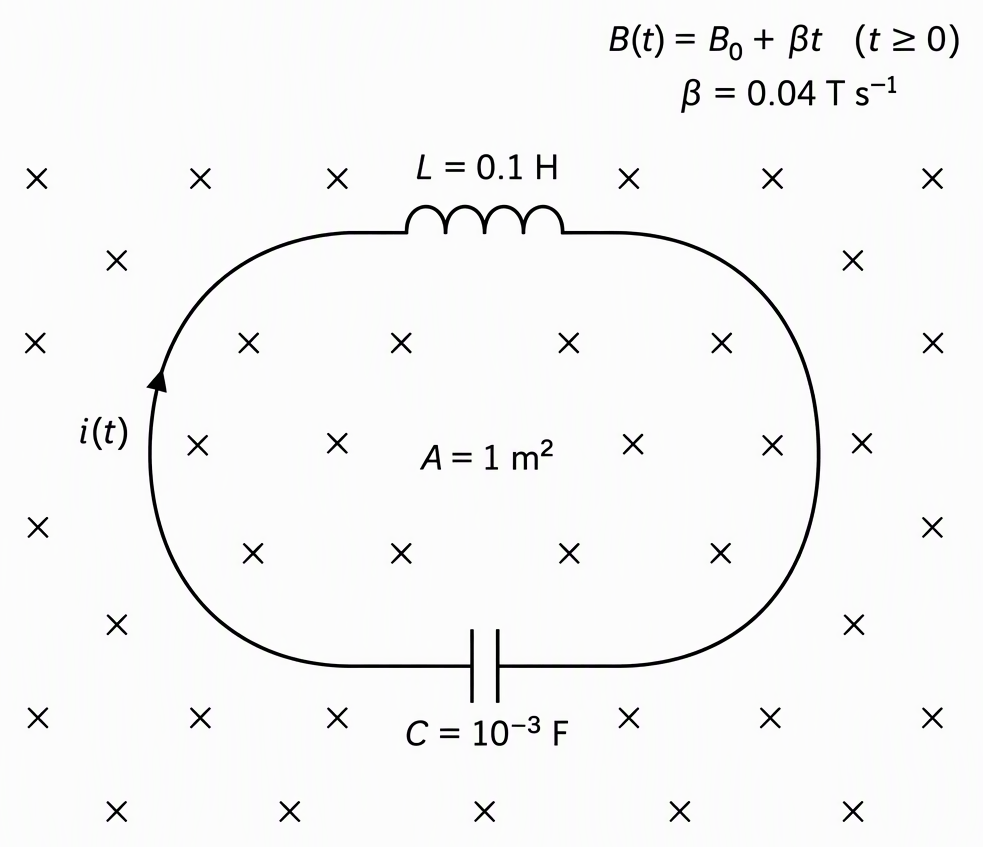
This is a numerical-answer question, with no supplied answer options.
How does the changing magnetic field produce a constant emf?
The induced emf is 0.04 V because the field increases at a constant rate through a fixed area. Magnetic field is measured in tesla; flux measures the field passing through the loop’s area. Emf depends on how quickly that flux changes, not on the field’s magnitude.
Because the field is perpendicular to the loop plane, the flux magnitude is
For a fixed loop area, Faraday’s law gives the emf magnitude:
Differentiate the stated field:
The constant initial field contributes no induced emf. Substituting the area and rate gives
This constant drive switches on at time zero. Constant emf does not establish constant current: the inductor and capacitor still have a time-dependent response.
How do you derive the current instead of quoting the LC formula?
The current is sinusoidal because the constant drive shifts the capacitor’s equilibrium charge without damping the oscillation. The official solution uses an initially uncharged capacitor and zero initial current. These are the initial conditions used in that solution, not quoted wording from the question:
Define capacitor charge so that positive reference current increases it. For the counterclockwise reference shown, the induced driving emf is positive:
The circuit equation balances the inductor and capacitor voltage terms against the drive. Substituting the charge-current relation gives the second equation:
Shift the charge by its equilibrium value. Since the emf is constant, this shift has zero time derivative:
The shifted charge obeys the simple harmonic motion equation. Its general solution is
Apply the initial charge condition:
Differentiate before applying the initial current condition:
Substitute these constants to recover the charge. Differentiating it gives the current:
The equilibrium charge is not the maximum charge. It is the charge at which the capacitor voltage balances the driving emf:
The initial charge lies below that value. With no resistance to remove energy, the ideal circuit oscillates about this shifted equilibrium rather than settling there.
How does the maximum current work out to 4 mA?
The sine term has maximum magnitude one, so its coefficient gives 4 mA. The negative half-cycle gives the same maximum magnitude as the positive half-cycle:
Keep the powers of ten visible during substitution:
The numerical entry is 4. For a physical check, calculate the angular frequency and full current:
This gives zero initial current, as required. Its initial slope also matches the circuit equation:
The initially uncharged capacitor has zero voltage, so the entire initial emf drives the inductor’s current change. A constant current would fail this initial-slope check.
Why would isolated-LC energy conservation wrongly give 0 mA?
A hypothetical answer of 0 mA comes from treating the circuit as isolated and ignoring the induced drive. It is not an official distractor: this numerical question supplies no answer options.
The flawed reasoning starts with zero initial capacitor energy and zero initial inductor energy. If their sum were conserved at zero, both charge and current would have to remain zero:
The mistake is the conservation assumption, not the initial energies. Multiply the driven circuit equation by current:
Using the charge-current relation gives
The changing-field drive can transfer energy to the circuit, so its stored energy need not stay zero. Retain the induced emf on the right-hand side and apply the initial conditions to the driven equation, not the homogeneous equation.
What two follow-up questions can you solve with this result?
The derived expressions give the maximum capacitor charge and the first current peak. These are original follow-up practice questions based on the same circuit, not additional verified PYQs. Use the charge expression for the first and the current expression for the second.
Question 1: What is the maximum capacitor charge in the same circuit?
The maximum charge is 80 μC, reached when the cosine becomes minus one. That makes the bracket in the charge expression equal to two:
The factor of two matters: the capacitor passes through equilibrium and continues charging. It reaches maximum charge when the current falls to zero.
Question 2: At what first positive time does the current reach maximum magnitude?
The first peak occurs at approximately 15.7 ms, when the sine first reaches one. Use the angular frequency already calculated:
Next, attempt Alternating Current Practice Questions JEE: 5 Solved Drills. Write the driving term and initial conditions before choosing a current formula.
Frequently asked questions
What is the answer to the electromagnetic induction JEE 2022 LC question?
The maximum current magnitude is 4 mA, so the numerical entry is 4. With zero initial charge and current, the maximum current is emf × √(C/L) = 0.04 × √(0.001/0.1) = 0.004 A.
Why does constant induced emf not produce constant current in an LC circuit?
A constant emf shifts the capacitor's equilibrium charge to C × emf, but an ideal LC circuit has no resistance to damp its oscillations. For zero initial charge and current, the current is sinusoidal; in this problem, i(t) = 0.004 sin(100t) A.
What initial conditions are used in the JEE 2022 LC solution?
The official solution uses an initially uncharged capacitor and zero initial current: q(0) = 0 and i(0) = 0. These conditions are used in the solution, rather than explicitly stated in the question wording.
Why is the energy of the LC circuit not conserved in this question?
The changing magnetic field supplies an induced drive, so the circuit is not isolated. Its stored energy changes at the rate emf × current, rather than remaining at its initial value of zero.