
What is the answer to the qualitative analysis JEE 2019 zinc question?
B, C and D are correct; A is false. This qualitative analysis JEE 2019 solution covers the zinc-reactions question from JEE Advanced 2019, Paper 2, Chemistry. It is multiple-correct, not single-correct: select every valid claim.
The question bank labels it medium, with an expected solve time of 150 seconds. These are bank metadata, not an official difficulty rating or prescribed examination time.
Consider these three unbalanced transformations:
Select every correct claim:
How do you identify all seven products?
The acid reaction gives zinc sulphate, sulphur dioxide and water; the alkali reaction gives sodium zincate and hydrogen; precipitation gives zinc sulphide and ammonium sulphate. Follow the official solution’s reaction-first method. Keep the stated conditions attached to each reaction, since zinc gives different gases with dilute and hot concentrated acid.
With hot, concentrated sulphuric acid, the balanced reaction is:
The gas here is sulphur dioxide, not hydrogen. Using the dilute-acid reaction would assign the wrong molecule to R and invalidate the shape check.
With concentrated sodium hydroxide, zinc gives sodium zincate and hydrogen. Retain the sodium zincate formula exactly as the official solution does:
Finally, zinc sulphate reacts with hydrogen sulphide in ammoniacal medium, supplied by ammonium hydroxide. Zinc sulphide precipitates:
X remains water. Its position changes between the unbalanced statement and the balanced equation, but product order does not determine identity.
Keep this letter-to-species map beside the option checks:
- G: Zinc sulphate.
- R: Sulphur dioxide.
- X: Water.
- T: Sodium zincate.
- Q: Hydrogen.
- Z: Zinc sulphide.
- Y: Ammonium sulphate.
Why is A false but B true?
Zinc’s oxidation state in sodium zincate is plus two, so A is false. R is sulphur dioxide, whose molecular shape is bent, so B is true. Use charge balance for A and electron-region counting for B.
For A, let the oxidation state of zinc in neutral sodium zincate be:
Sodium contributes plus one per atom and oxygen minus two:
Therefore, A is false. For B, first substitute the identified product:
The official solution’s “two bond pairs and one lone pair” means two bonding regions and one lone-pair region around sulphur. Multiple bonds do not add extra VSEPR directions.
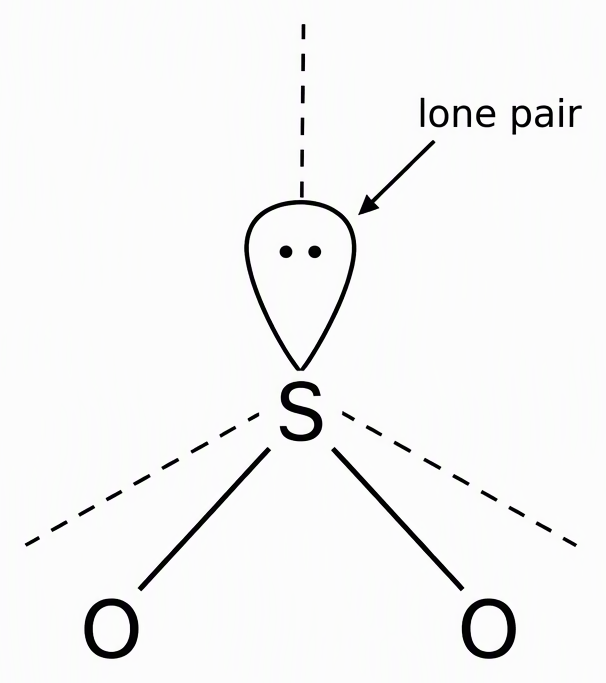
The electron-region geometry is trigonal planar, but molecular geometry counts atom positions only. With one region occupied by a lone pair, the molecule is bent or V-shaped. B is true.
Why are C and D correct?
Zinc sulphide is a white to dirty-white precipitate, which supports C. Ground-state hydrogen has two bonding electrons and no antibonding electrons, giving bond order one and supporting D. Check the two products separately.
For C, substitute:
Zinc sulphide is a white to dirty-white precipitate in the stated qualitative-analysis reaction. Revision notes calling it “white” do not invalidate the supplied “dirty white” description. C is true.
For D, substitute:
The hydrogen molecule has two electrons in total. In its ground state, both occupy the bonding sigma 1s orbital; none occupies the antibonding sigma-star 1s orbital:
Bond order is half the difference between the bonding and antibonding electron counts:
This gives the following independent verdicts:
Correct options: B, C and D.
What formula mistake could incorrectly make A look correct?
Halving only the sodium and oxygen subscripts in sodium zincate produces a different formula and an incorrect oxidation state of plus one. This is a possible reasoning error, not a claim about how frequently students make it:
Charge balance for that altered formula gives:
This would incorrectly support A. The arithmetic follows the altered formula, but the original atom ratio is:
Every subscript must be divided by the same factor to preserve composition. This ratio has no common integer factor greater than one; changing it to one-to-one-to-one changes the compound.
Repair: Copy the formula unchanged, attach oxidation states, multiply by every actual subscript, then impose charge balance.
Which three related questions should you practise next?
Practise precipitate identification, zincate charge balance and the effect of acid concentration using these original related practice questions, not additional verified JEE PYQs. Cover each answer before attempting it, and identify the product before checking its properties.
- A zinc salt solution gives a white to dirty-white precipitate with hydrogen sulphide in ammoniacal medium. Identify it and write the reaction for zinc sulphate.
The precipitate is zinc sulphide. Ammonium hydroxide supplies the ammoniacal medium:
- Zinc reacts with concentrated sodium hydroxide. Identify the gas and calculate zinc’s oxidation state in sodium zincate.
The gas is hydrogen, and zinc’s oxidation state is plus two. Use the unchanged zincate formula:
- How does the gas change when dilute sulphuric acid replaces hot concentrated sulphuric acid?
Dilute acid gives hydrogen; hot concentrated acid gives sulphur dioxide. The balanced equations show the change:
Before assigning any unknown gas, underline the reagent conditions. Reaction conditions are part of product identification, not optional wording.
Next step: the past-paper archive on JEEnius and search every JEE Main paper from 2002 and every Advanced paper from 2007, by year, subject or chapter, each with a worked solution (free).
Keep going with How to Study Current Electricity JEE: A Practice Plan.
Frequently asked questions
What is the answer to the qualitative analysis JEE 2019 zinc question?
B, C and D are correct; A is false. Zinc in sodium zincate has oxidation state +2, sulphur dioxide is bent, zinc sulphide is white to dirty-white, and ground-state hydrogen has bond order 1. This is a multiple-correct question from JEE Advanced 2019, Paper 2, Chemistry.
Does zinc give hydrogen with hot concentrated sulphuric acid?
No. Zinc reacts with hot concentrated sulphuric acid to produce zinc sulphate, sulphur dioxide and water. Dilute sulphuric acid gives hydrogen instead, so the stated acid conditions determine the gas.
What is the oxidation state of zinc in Na2ZnO2?
Zinc has oxidation state +2 in Na2ZnO2. Charge balance gives 2(+1) + x + 2(-2) = 0, so x = +2. Rewriting Na2ZnO2 as NaZnO changes the compound rather than simplifying its formula.
Why is SO2 bent and not linear?
SO2 has two bonding regions and one lone-pair region around sulphur. Its electron-region geometry is trigonal planar, but its molecular shape is bent because molecular geometry counts only atom positions. Multiple bonds do not add extra VSEPR directions.
What is the ground-state bond order of H2?
The ground-state bond order of H2 is 1. Both electrons occupy the bonding sigma 1s orbital, while the antibonding orbital is empty. Using half the difference between bonding and antibonding electron counts gives (2 - 0)/2 = 1.