What is the answer to the chemical bonding JEE 2017 diamagnetic-species question?
The answer is 6, including the beryllium dimer despite its zero elementary MO bond order. This chemical bonding JEE 2017 question comes from JEE Advanced 2017, Paper 1, Chemistry, not JEE Main.
Use molecular orbital theory to count the species with no unpaired electrons in this complete set:
The supplied atomic numbers are:
This is a single-digit integer-answer question, with no supplied answer options. The question bank assigns medium difficulty and a 120-second target, not the exam authority.
Which molecular orbital filling rules do you need?
Diamagnetic species have all electrons paired; paramagnetic species have at least one unpaired electron. Count all electrons for hydrogen and the helium molecular ion. From lithium through fluorine, count valence electrons because the omitted 1s core orbitals are fully paired.
A positive charge removes electrons; a negative charge adds them. The asterisk marks an antibonding orbital. Hund’s rule requires electrons to occupy equal-energy orbitals singly, with parallel spins, before pairing.
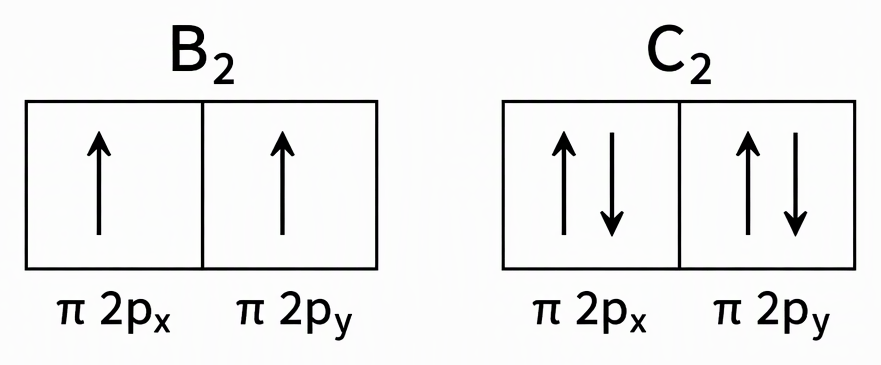
For boron, carbon and nitrogen dimers, use:
For the oxygen anion and fluorine dimer, use:
Do not use one orbital order across the entire set. The bonding sigma orbital formed from the axial p orbitals lies below the bonding pi pair for oxygen and fluorine.
How do you classify hydrogen, helium, lithium and beryllium species?
Hydrogen, lithium and beryllium dimers are diamagnetic; the helium molecular cation is paramagnetic. Their occupied orbitals come from s orbitals, so no equal-energy pi pair is involved. Count the electrons, then inspect each orbital’s occupancy.
- Hydrogen dimer: count both atomic electrons.
Both electrons occupy the same bonding orbital. There are zero unpaired electrons, so it is diamagnetic.
- Helium molecular cation: subtract one electron for the positive charge.
The antibonding orbital has one unpaired electron. The species is paramagnetic.
- Lithium dimer: each atom supplies one valence electron.
There are zero unpaired electrons, so it is diamagnetic. The omitted core electrons are also paired.
- Beryllium dimer: each atom supplies two valence electrons.
Both occupied orbitals contain pairs, giving zero unpaired electrons. It is diamagnetic under the stated MO filling, while its elementary bond order is:
Zero bond order does not introduce an unpaired electron. It does not change the magnetic classification requested.
How do you classify boron, carbon, nitrogen, superoxide and fluorine?
Carbon, nitrogen and fluorine dimers are diamagnetic; boron dimer and superoxide are paramagnetic. Use the appropriate orbital ordering before placing electrons. The deciding step is filling the equal-energy pi orbitals, not checking whether the electron total is even.
- Boron dimer: six valence electrons leave two electrons for the bonding pi pair.
Hund’s rule puts these electrons in separate orbitals. There are two unpaired electrons, so the species is paramagnetic.
- Carbon dimer: eight valence electrons fill both bonding pi orbitals.
All electrons are paired. The species is diamagnetic.
- Nitrogen dimer: the next two electrons fill the bonding sigma orbital above the pi pair.
All occupied orbitals contain pairs. The species is diamagnetic.
- Superoxide ion: the negative charge adds one electron to neutral oxygen’s twelve valence electrons.
Three electrons occupy the antibonding pi pair. One remains unpaired, so superoxide is paramagnetic. Interchanging the two pi orbital labels does not change the result.
- Fluorine dimer: fourteen valence electrons fill the antibonding pi pair completely.
Both antibonding pi orbitals contain pairs. There are zero unpaired electrons, so fluorine is diamagnetic.
What integer should you enter?
Enter 6. The six diamagnetic species are:
The three paramagnetic species provide the cross-check:
Together, these classifications account for all nine entries in the supplied set:
The requested answer is the diamagnetic count, not the total:
Why does excluding the beryllium dimer give the wrong count of 5?
Excluding it adds a stability condition that the question never asks for. Start with the six correctly identified paired-electron species, then discard the beryllium dimer because its elementary MO bond order is zero. The count becomes:
That is a wrong numerical answer, not an option. This question uses an integer-answer format, and the official solution classifies the listed species by electron pairing.
Answer the requested property first, and keep bond-order conclusions separate. Zero bond order does not turn paired electrons into unpaired electrons.
An even electron total does not guarantee diamagnetism either. Boron dimer has six valence electrons but two unpaired electrons because Hund’s rule places them in separate equal-energy pi orbitals.
Can you apply the same method to two related questions?
Yes: count electrons, choose the orbital order and inspect pairing. These are original follow-up practice questions, not additional verified PYQs. Attempt each before reading its answer check.
Question 1: How many of these species are diamagnetic?
Answer check: Their respective unpaired-electron counts are:
Only carbon and nitrogen dimers have every electron paired. The answer is:
Question 2: Classify these species by magnetic behaviour:
Answer check: In the order listed, the valence-electron totals are:
The antibonding pi pair therefore contains:
Hund’s rule gives these unpaired-electron counts:
- Neutral oxygen: paramagnetic.
- Superoxide: paramagnetic.
- Peroxide: diamagnetic.
The first added electron pairs one previously unpaired electron; the second pairs the remaining one. Before checking your next answer, write the occupancy of both antibonding pi orbitals explicitly.
Next step: photograph a doubt on JEEnius and photograph any question you are stuck on and get a step-by-step solution, with a free-body diagram when the question needs one (20 free).
If that step was the hard part, work through System JEE 2018: Torque, Velocity and Correct Options.
Frequently asked questions
What is the answer to the JEE 2017 diamagnetic species question?
The answer is 6. The six diamagnetic species are H2, Li2, Be2, C2, N2 and F2; each has no unpaired electrons under the stated molecular orbital filling.
Was the diamagnetic species question in JEE Main or JEE Advanced 2017?
It appeared in JEE Advanced 2017, Paper 1, Chemistry, not JEE Main. It was a single-digit integer-answer question with no supplied answer options.
Why is Be2 counted as diamagnetic if its bond order is zero?
In elementary MO filling, Be2 has two electrons in the bonding sigma 2s orbital and two in the antibonding sigma 2s orbital. All are paired, so it is classified as diamagnetic. Its zero elementary bond order does not justify excluding it from a question asking about electron pairing.
Why is B2 paramagnetic even though it has an even number of electrons?
B2 has six valence electrons, with the last two occupying separate equal-energy bonding pi orbitals according to Hund's rule. These two unpaired electrons make it paramagnetic. An even electron total alone does not guarantee diamagnetism.