
How should I study Mole Concept for JEE without hunting for formulas?
- Study Mole Concept for JEE as one conversion route: given quantity to moles, chemical relationship, then requested quantity. Learn in this order: atomic and molar mass, mass–mole–particle conversions, balanced equations, limiting reagents, then purity and concentration. Check that you can handle fractions, ratios and scientific notation before adding harder chemistry.
- Write what is given and exactly what is asked. Include the entity: atoms, molecules, ions or formula units. A mole is an amount of specified entities, not automatically a mole of atoms. Underline words such as “hydrogen atoms” or “unreacted acid”: they decide where your calculation must end.
- Convert usable data into moles, keeping units attached. Choose the conversion from the information supplied, not from whichever formula you remember first.
The symbols mean:
For molarity in moles per litre, use solution volume in litres. For an impure sample, correct the mass before calculating moles:
Use the molar mass of the actual species, not an atomic mass picked from its formula. For gases, use the ideal-gas relation when appropriate:
Here, the symbols mean:
Match the pressure and volume units to the gas constant, and use kelvin. Do not assume the following molar volume unless the stated temperature and pressure justify it:
- Select the relationship before calculating the answer. Particle counting uses formula subscripts; reactions use balanced-equation coefficients. With multiple reactants, compare available moles divided by the corresponding reactant coefficient:
The numerator is the available amount of reactant in moles; the denominator is its balanced-equation coefficient. The smallest value identifies the limiting reagent.
- Convert the resulting moles into the requested quantity. Apply the relationship first, then calculate mass, volume or entity count. Equation coefficients give mole ratios, never mass ratios. If the question asks for particles, an answer in moles is unfinished.
- Audit the result. Units must match the question. Consumption cannot exceed availability, leftovers cannot be negative, and atoms must be conserved.
Use this working template on every attempt. The following examples are original teaching problems, not claimed JEE previous-year questions.
How do I count molecules and atoms in the same sample?
Convert mass to molecules first, then use the formula subscripts to count atoms. For 9.0 g of water, find the number of water molecules, hydrogen atoms and total atoms. Use these supplied values:
Decision point: no chemical reaction occurs here, so use the molecular formula, not a balanced reaction. Each water molecule contains two hydrogen atoms and one oxygen atom, giving three atoms altogether.
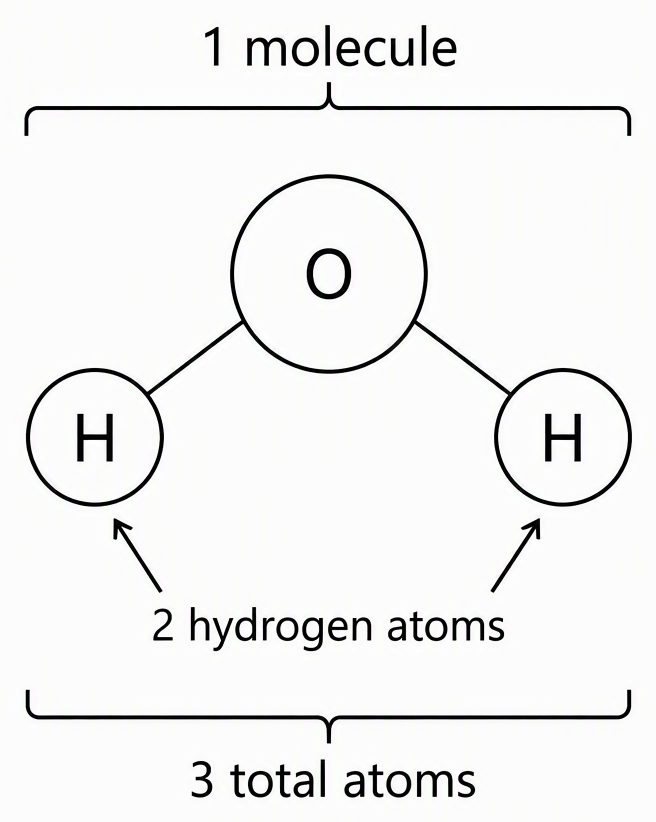
First convert mass into moles. This is an intermediate result, not the requested particle count:
Now identify the requested atom type before applying the subscript. For hydrogen atoms:
For total atoms, include oxygen too. Count all three atoms in each molecule:
Only the entity being counted has changed, not the sample. Transferable check: the molecule count and total atom count cannot be equal for water.
How do I find the limiting reagent and leftover reactant?
Compare moles divided by coefficients before calculating product. Suppose 4.0 g of hydrogen reacts with 16.0 g of oxygen to form water. Find the water formed and the mass of excess reactant left, assuming complete reaction.
The larger starting mass does not identify the excess reactant. Balance first and use the supplied molar masses:
Convert each reactant separately. Do not apply the equation ratio to the masses:
Decision point: divide each available amount by its coefficient. The smaller result sets how far the reaction can proceed:
Oxygen is limiting despite having the larger starting mass. Use its smaller ratio to calculate product and hydrogen consumption:
Subtract consumption from the starting mass to find hydrogen left. Then check mass conservation:
General rule: compare available moles divided by balanced-equation coefficients, not grams and not moles alone. Comparing raw moles happens to select oxygen here, but ignores the unequal proportions in which the reactants are consumed.
Solve another limiting-reagent problem without copying this working. JEEnius practice mode offers topic sets that skip questions already seen, with free sets included.
How do I combine purity, molarity and limiting reagents?
Correct purity and convert solution volume before comparing reactants. A 5.0 g sample containing 80% calcium carbonate by mass is treated with 100 mL of 1.0 mol per litre hydrochloric acid. Find the carbon dioxide mass produced and moles of acid remaining. Assume impurities are inert and the reaction proceeds to completion.
The longer wording adds conversions, not a new solving method. Start with the balanced equation and supplied molar masses:
Only the reactive portion enters the mole calculation. Apply the purity fraction before dividing by molar mass:
For the acid, molarity connects volume to moles. Convert the volume first:
Decision point: an acid solution is not automatically in excess. Compare both reactants after converting them into moles:
Calcium carbonate limits the reaction. Its coefficient matches that of carbon dioxide:
The acid consumed is twice the carbonate amount. Subtract this from the available acid:
Check these three failure points if your result differs:
- Purity: using all 5.0 g as calcium carbonate counts inert material as reactant.
- Volume: substituting 100 instead of 0.100 into the molarity conversion gives a thousandfold error.
- Relationship: treating carbonate and acid as a one-to-one ratio halves the required acid consumption.
The acid remainder is positive and smaller than its starting amount. Do not calculate a final acid molarity: the final solution volume has not been supplied.
What should I practise after these three examples?
Choose the next question from your first wrong step, not from hours of lectures watched. These examples provide a core stoichiometry method, not the entire Mole Concept syllabus. Use this sequence:
- Mass–mole–particle conversions and entity counting. Move on when you can explain each conversion without looking up a worked solution.
- Balanced-equation ratios, limiting reagents and leftovers. Then mix purity, percentage yield and concentration into these questions.
- Empirical and molecular formulas, molarity versus molality, dilution and gas stoichiometry. Dilution conserves solute amount only when no reaction or solute loss occurs.
After every attempt, tag the first wrong step as entity, conversion, equation, limiting reagent or arithmetic. Redo the problem from a blank page, then solve an unseen question at the same difficulty. Correcting only the final number does not repair the method.
Class 11 students should follow the full sequence. Class 12 students and droppers can attempt these three examples first, then restart at their earliest failed step. Use topic-wise JEE Main previous-year questions once basic skills are secure, followed by multi-step JEE Advanced previous-year questions; Advanced has no fixed question pattern.
JEEnius daily practice problems provide a fresh ten-question set on a topic every day, with free sets daily. Treat it as a convenient practice block, not a mastery threshold or guaranteed coverage of every subskill. For your next block, target the earliest error you recorded.
Next step: daily practice problems on JEEnius and get a fresh ten-question set on a topic every day (free sets daily).
Related on JEEnius: Magnetism Practice Questions JEE: Drills, PYQs and Mocks.
Frequently asked questions
In what order should I study Mole Concept for JEE?
Start with atomic and molar mass, then mass–mole–particle conversions and entity counting. Follow with balanced equations, limiting reagents, purity and concentration. Check that you can handle fractions, ratios and scientific notation before attempting harder chemistry.
How do I find the limiting reagent and excess reactant left?
Balance the equation, convert each reactant into moles and divide its available moles by its balanced-equation coefficient. The smallest ratio identifies the limiting reagent. Use the equation ratios to calculate how much excess reactant is consumed, then subtract that from its starting amount.
How do I solve mole questions involving purity and molarity?
Multiply the sample mass by its purity fraction before converting the reactive mass into moles. For a solution with molarity in moles per litre, multiply molarity by solution volume in litres. Compare reactant moles divided by their equation coefficients before calculating products or leftovers.
What should I practise after basic Mole Concept conversions?
Practise balanced-equation ratios, limiting reagents and leftovers, then add purity, percentage yield and concentration. Continue with empirical and molecular formulas, molarity versus molality, dilution and gas stoichiometry. Use topic-wise JEE Main previous-year questions once the basics are secure, followed by multi-step JEE Advanced questions; choose remedial practice from your first wrong step.