
Which options are correct in the JEE Advanced 2016 oxides of nitrogen question?
B and D are correct in the JEE Advanced 2016 oxides of nitrogen question: the product is dinitrogen pentoxide. The source is JEE Advanced 2016, Paper 2, Chemistry, p-Block Elements, and more than one option can be correct.
Nitric acid is treated with phosphorus pentoxide:
Test the resulting nitrogen-containing compound against these statements:
Answer checkpoint: The product is dinitrogen pentoxide:
Select B and D. The question bank classifies this as medium difficulty and gives an expected solving time of 60 seconds. That is its benchmark, not measured student performance.
What does phosphorus pentoxide do to nitric acid?
Phosphorus pentoxide acts as a strong dehydrating agent, removing water from nitric acid to form dinitrogen pentoxide. Follow the official solution: identify the product from the reagent’s role before testing the options.
The official schematic equation is:
Two nitric acid units contain the following atoms. Removing one water unit leaves dinitrogen pentoxide:
Dinitrogen pentoxide is the acid anhydride of nitric acid. Adding water reverses this relationship and regenerates the acid.
The water on the right expresses the dehydration relationship; the dehydrating agent removes it. Phosphorus pentoxide is not a catalyst, and this schematic is not a complete equation accounting for every phosphorus-containing species. Use it to identify the nitrogen-containing product, not to infer that water remains in the reaction mixture.
Why is C false and B true for dinitrogen pentoxide?
C is false because an oxygen atom bridges the nitrogen centres; B is true because all electrons are paired. The official solution uses molecular connectivity to check the claimed bond. Electron pairing requires a separate check of the structure.
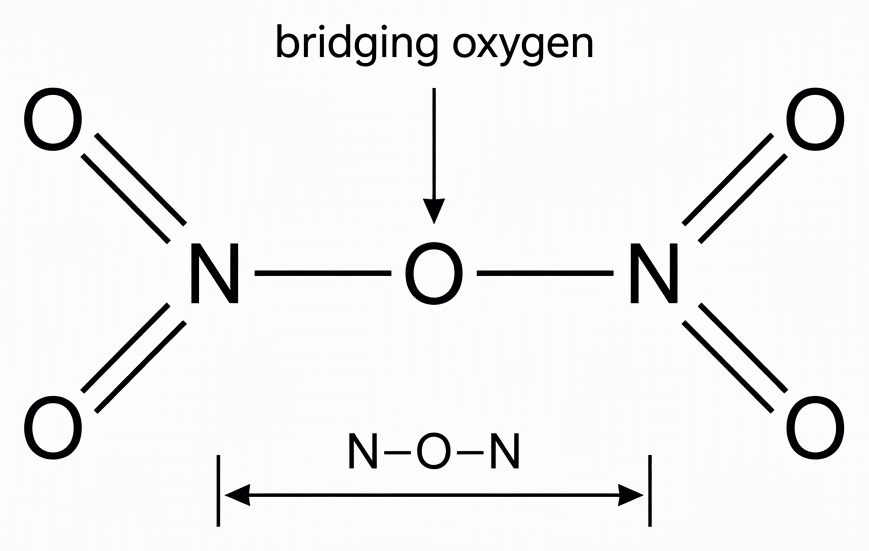
The connectivity is shown below. The central oxygen links the two nitrogen centres:
This path contains an intervening oxygen, not a direct nitrogen–nitrogen bond. Therefore, C is false.
For electron pairing, use this valid Lewis resonance contributor. It is not a unique fixed bonding picture:
The valence-electron total is:
In this contributor, two double bonds and four single bonds contain:
The remaining electrons occupy lone pairs:
That gives eight bonding pairs and twelve lone pairs, with no unpaired electrons. Hence dinitrogen pentoxide is diamagnetic, making B true.
An even electron total alone does not prove diamagnetism. The evidence is the arrangement of all those electrons in pairs, not merely the total count.
Why is A false but D true in this question?
Elemental phosphorus does not provide the same preparation, while sodium treatment can produce brown nitrogen dioxide. Check the two reaction statements independently: A concerns how the product is prepared; D concerns how it reacts.
For A, elemental phosphorus and phosphorus pentoxide are not interchangeable:
Nitric acid oxidises elemental phosphorus, rather than undergoing the dehydration used here. That reaction is not the stated preparation of dinitrogen pentoxide, so A is false.
For D, the official solution establishes that dinitrogen pentoxide can produce nitrogen dioxide on reaction with sodium metal:
Nitrogen dioxide is a brown gas, so D is true. This conclusion does not require an assumed mechanism, experimental conditions or a complete product equation.
- A false: phosphorus oxidation, not the required dehydration.
- B true: all electrons are paired.
- C false: an oxygen bridge connects the nitrogen centres.
- D true: brown nitrogen dioxide can form.
Final selection: B and D.
Why can’t you infer a nitrogen–nitrogen bond from the formula?
A molecular formula gives atom counts, not connectivity. The faulty inference behind C is that dinitrogen pentoxide contains two nitrogen atoms, so those atoms must be directly bonded. Nothing in the formula establishes that connection.
The actual path between the nitrogen centres is:
The bond asserted by C would instead require:
Those are different structural claims. Counting two atoms of an element does not tell you whether they are neighbours.
Write the structural connectivity before counting a claimed bond. Then trace the atom-to-atom connection and check whether another atom lies between the claimed pair. This settles C without turning an atom count into an assumed bond.
How do you solve three related p-block practice questions?
Reverse the dehydration equation, calculate oxidation states and compare reagent roles. The following are original related practice questions, not verified past-paper questions, with worked answers immediately below each question.
1. Which nitrogen oxide gives nitric acid when water is added?
Dinitrogen pentoxide gives nitric acid. Work backwards from the dehydration step: restoring the removed water regenerates two nitric acid units.
2. Does nitrogen change oxidation state during this dehydration?
No. Nitrogen’s oxidation state is unchanged. Use the usual oxidation states for hydrogen and oxygen:
For nitrogen in nitric acid:
For nitrogen in dinitrogen pentoxide:
Nitrogen has the same oxidation state in both compounds. Hydrogen and oxygen also retain theirs, so this step is dehydration, not redox.
3. Can elemental phosphorus replace phosphorus pentoxide in this preparation?
No. The substitution changes the reaction role. Nitric acid oxidises elemental phosphorus, whereas phosphorus pentoxide removes water from nitric acid.
Sharing the same element does not make two reagents chemically interchangeable. Before accepting a replacement, write what the original reagent does, then check whether the replacement performs that same job.
Next step: the past-paper archive on JEEnius and search every JEE Main paper from 2002 and every Advanced paper from 2007, by year, subject or chapter, each with a worked solution (free).
If that step was the hard part, work through Optics JEE 2017: Photoelectron Wavelength Ratio Solved.
Frequently asked questions
Which options are correct in the JEE Advanced 2016 oxides of nitrogen question?
B and D are correct, and the product is dinitrogen pentoxide, N2O5. B is true because all its electrons are paired. D is true because treatment with sodium metal can produce brown nitrogen dioxide, NO2.
What happens when nitric acid reacts with phosphorus pentoxide?
Phosphorus pentoxide acts as a strong dehydrating agent, removing water from nitric acid to form N2O5. It is not a catalyst. Elemental phosphorus cannot replace it in this preparation because nitric acid oxidises phosphorus instead.
Does N2O5 have a direct nitrogen-nitrogen bond?
No, its molecular connectivity is O2N-O-NO2, with an oxygen atom bridging the two nitrogen centres. The connection is N-O-N, not N-N, so option C is false. A molecular formula gives atom counts, not connectivity.
Why is N2O5 diamagnetic?
N2O5 is diamagnetic because all its electrons are paired. A valid Lewis resonance contributor accounts for its 40 valence electrons as eight bonding pairs and twelve lone pairs. An even electron count alone does not prove diamagnetism.