
What is the answer to the Oscillations and Waves JEE 2023 string question?
The tension is 5 N in this Oscillations and Waves JEE 2023 question, found from the difference between the two harmonic frequencies. The source is JEE Advanced 2023, Paper 2, Physics. This is a numerical-answer question, not an MCQ; no answer choices are supplied.
A one-metre string of total mass 0.00002 kg is stretched under an unknown tension. Its neighbouring harmonics have frequencies 750 Hz and 1000 Hz; find the tension in newtons. The official solution models the string as fixed at both ends.
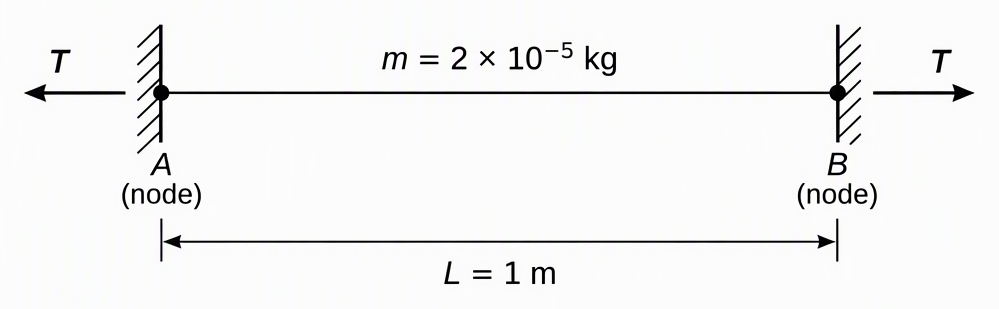
The question bank classifies this as medium difficulty and gives 90 seconds as its expected solving time. That is a practice benchmark, not an official exam allowance.
How does subtracting successive harmonics give the wave speed?
Subtracting the harmonic equations removes the unknown harmonic number and gives a wave speed of 500 m/s. “Successive” means the harmonic numbers differ by exactly one. We do not need to identify those numbers before calculating the speed.
Define the symbols:
For a stretched string fixed at both ends, the harmonic frequency and the next harmonic frequency are:
Subtract explicitly:
Substitute the measured frequencies and length:
Adjacent harmonics are separated by the fundamental frequency. Neither measured frequency needs to be the fundamental.
Use subtraction first. It follows directly from the fixed-end model and avoids guessing which harmonics were observed.
How do you calculate the linear density and tension?
Divide the string’s total mass by its length, then multiply that linear density by the wave speed squared to get 5 N. The wave-speed formula requires mass per unit length, not total mass.
The stretched-string wave-speed relation is:
Square both sides, then rearrange:
Substitute the density and speed:
The tension is 5 N. The numerical entry is 5.
Check that the units give a force:
After completing the official calculation, check the harmonic numbers:
The observations are the third and fourth harmonics, so they are successive. Total mass and linear density have the same numerical value here because the length is one metre, but they have different units and physical meanings. Do not substitute total mass directly into the wave-speed formula.
Why is taking 750 Hz as the fundamental wrong?
The lower of two observed successive harmonics is not necessarily the first harmonic. Calling 750 Hz the fundamental produces 45 N, but the reasoning fails before the arithmetic. Since this is a numerical-answer question, 45 N is a calculated wrong result, not a supplied answer option.
The mistaken assumption gives:
The resulting tension is:
If 750 Hz were the fundamental, the next harmonic would be:
That contradicts the observed 1000 Hz. The mistaken assumption triples the wave speed and therefore multiplies the tension by nine, because tension depends on speed squared.
How can you apply the same idea to three related questions?
Use the frequency gap to find the fundamental, combine that gap with length to find speed, then use linear density to find tension. All three exercises below are original practice questions based on the solved concept, not additional verified PYQs.
What are the fundamental frequency and harmonic numbers for the original string?
The fundamental is 250 Hz, and the observations are the third and fourth harmonics. Find the spacing first, then divide each observed frequency by it:
What is the tension in a two-metre string with successive frequencies of 300 Hz and 400 Hz?
The tension is 3.2 N when the total string mass is 0.00004 kg and both ends are fixed. This string has the same linear density as the original, despite having twice its total mass.
What happens to the harmonic spacing when the original tension rises from 5 N to 20 N?
The spacing doubles to 500 Hz, provided the original length and linear density stay unchanged. Quadrupling tension doubles wave speed, rather than quadrupling it.
On your next string question, identify the spacing before substituting numbers: harmonic spacing determines speed at fixed length, while tension depends on the square of that speed.
Next step: photograph a doubt on JEEnius and photograph any question you are stuck on and get a step-by-step solution, with a free-body diagram when the question needs one (20 free).
Keep going with How to Study D Block JEE: Derive, Recall and Practise.
Frequently asked questions
What is the answer to the JEE Advanced 2023 string tension question?
The tension is 5 N, so the numerical entry is 5. This numerical-answer question is from JEE Advanced 2023, Paper 2, Physics; it has no supplied answer choices.
How do you find string tension from two successive harmonic frequencies?
For a string fixed at both ends, the frequency gap equals the fundamental frequency, so v = 2L(f_next - f_previous). Calculate linear density using μ = m/L, then find tension using T = μv². For the given 1 m string, the 250 Hz gap gives v = 500 m/s and T = 5 N.
Why is 750 Hz not the fundamental frequency in this question?
If 750 Hz were the fundamental, the next harmonic would be 1500 Hz, not the observed 1000 Hz. The actual fundamental is the difference, 250 Hz, making the observations the third and fourth harmonics. Using 750 Hz as the fundamental incorrectly gives a tension of 45 N.
What happens to harmonic spacing when string tension is quadrupled?
For unchanged string length and linear density, harmonic spacing is proportional to the square root of tension. Raising the original tension from 5 N to 20 N therefore doubles the spacing from 250 Hz to 500 Hz.