What is the eccentricity-and-roots question in Complex Numbers JEE 2026?
Option C, 26, is correct for this Complex Numbers JEE 2026 question. The source is JEE Main Mathematics, 6 April 2026, morning shift, under Complex Numbers and Quadratic Equations.
The problem gives two unequal roots:
The set of real parameter values for which both roots represent hyperbola eccentricities is:
The set for which the first root represents an ellipse eccentricity and the second represents a hyperbola eccentricity, respectively, is:
Find:
The question bank rates this hard on its own scale. Treat it as an algebraic root-location problem: no conic sketch is needed.
How do you establish distinct, positive real roots?
Use Vieta first, then check reality before claiming positivity. Eccentricities must be real, so a positive sum and product alone cannot establish admissible roots.
Define:
Vieta gives:
The relevant eccentricity ranges are:
Zero is impossible here because the root product is two. Thus both eccentricities must be strictly positive.
Distinct real roots require:
Once reality is established, the positive product makes the roots have the same sign. Their sum must then be positive to make both roots positive; the negative-parameter branch gives two negative roots and is rejected.
The shared admissibility condition is therefore:
For both conic cases, test the position of one using:
How do you prove that both roots are greater than one?
Combine the reality and positivity checks with a positive value of the quadratic at one. The root product then rules out the alternative that both roots lie below one.
The requirement is:
An upward-opening quadratic is positive outside its two distinct real roots and negative between them. A positive value at one therefore places one outside the interval between the roots.
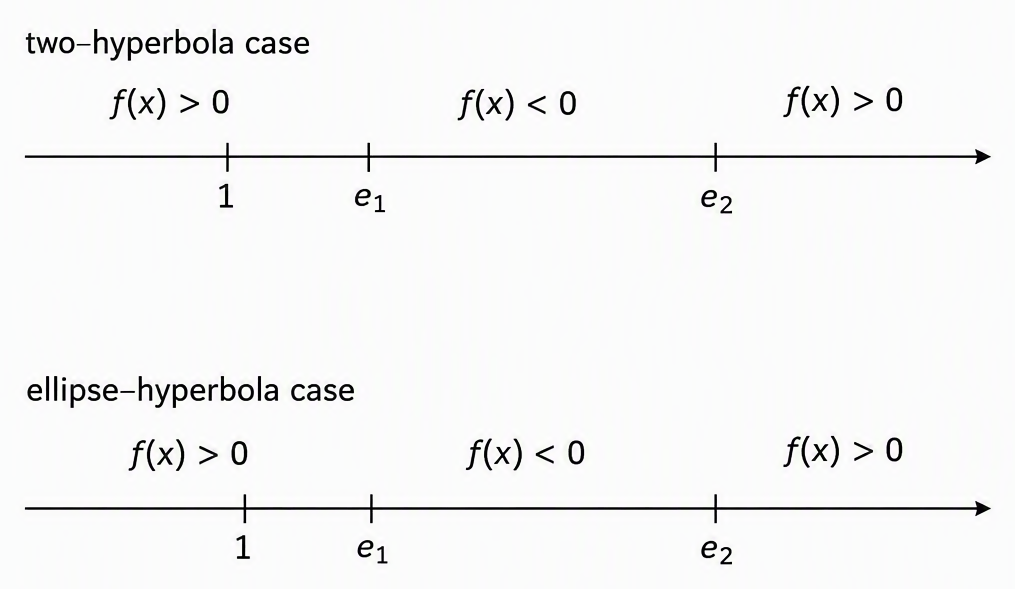
This alone does not tell us which side contains both roots. If both positive roots were below one, then:
contradicting their product of two. Therefore both must be above one.
Now intersect the conditions:
Thus:
Both endpoints are excluded:
- The lower endpoint gives a repeated root, violating distinctness:
- The upper endpoint gives roots one and two. Eccentricity one is not hyperbolic:
How does the ellipse–hyperbola case give option C?
The number one must lie strictly between the roots, so the quadratic evaluated at one must be negative. This gives a parameter greater than three, which already satisfies the reality and positivity checks.
Respecting the question’s assignment, the first root is the ellipse eccentricity:
Therefore:
Since: the roots are distinct, real and positive. Hence:
Three is excluded because it puts one root exactly at eccentricity one, outside both required ranges. The requested calculation is:
Answer: option C. Use this method sequence:
How can skipping the discriminant produce option A, 18?
A route to option A is to treat a positive sum and product as proof of positive real roots. That drops the reality check and incorrectly moves the first interval’s lower endpoint to zero.
The incorrect argument uses:
to claim:
Retaining the correct second-case endpoint then gives:
Positive sum and positive product establish positivity only after the roots are known to be real. They cannot replace the discriminant test.
For a counterexample admitted by the false interval, take:
Then:
The roots are non-real and cannot be eccentricities. Restoring: restores the positive lower endpoint and its missing squared contribution:
That is exactly the difference between the incorrect result and 26.
Which two related quadratic questions should you solve next?
Practise the same checks with thresholds one and two. These are original related practice questions, not additional verified PYQs; neither requires explicit root formulas.
What is the answer to Question 1 when both roots must exceed one?
The allowed interval is:
Question 1: Find all real values of the parameter for which this equation has two distinct roots, both greater than one:
Vieta gives product three and sum equal to the parameter. Distinct positive roots require:
For this quadratic:
Both positive roots below one would have product less than one, contradicting product three. Intersecting the conditions gives the stated interval.
The lower endpoint gives repeated roots. The upper endpoint gives roots one and three, so one root fails the strict threshold.
What is the answer to Question 2 when both roots must exceed two?
The allowed interval is:
Question 2: Find all real values of the parameter for which this equation has two distinct roots, both greater than two:
Vieta gives product six and sum equal to the parameter. Distinct positive roots require:
Now evaluate at two:
Both positive roots below two would have product less than four, contradicting product six. Intersecting the conditions gives the stated interval.
The lower endpoint gives repeated roots. The upper endpoint gives roots two and three, again violating the strict threshold.
For an upward-opening quadratic with distinct real roots: puts the threshold outside the root interval, not necessarily to its left. Before accepting either answer, write the product contradiction that rules out both roots lying below the threshold.
Next step: the past-paper archive on JEEnius and search every JEE Main paper from 2002 and every Advanced paper from 2007, by year, subject or chapter, each with a worked solution (free).
Related on JEEnius: Principles Related JEE 2025: Phenol Adsorption Solution.
Frequently asked questions
What is the answer to the JEE Main 2026 eccentricity-and-roots question?
The answer is option C, 26. For x² − ax + 2 = 0, both roots are hyperbola eccentricities when a ∈ (2√2, 3), while an ellipse–hyperbola pair requires a > 3. Hence α = 2√2, β = 3 and γ = 3, giving α² + β² + γ² = 8 + 9 + 9 = 26.
When are both roots of x² − ax + 2 = 0 greater than 1?
Two distinct roots are both greater than 1 exactly when a ∈ (2√2, 3). The discriminant and positivity conditions give a > 2√2, while f(1) > 0 gives a < 3. Both positive roots cannot lie below 1 because their product is 2. The endpoints are excluded because they give either repeated roots or a root equal to 1.
When can one root be an ellipse eccentricity and the other a hyperbola eccentricity?
For x² − ax + 2 = 0, this occurs when a > 3, with the smaller root assigned to the ellipse. The condition f(1) = 3 − a < 0 places 1 strictly between the roots, and a > 3 also ensures distinct positive real roots. At a = 3, the roots are 1 and 2, so the ellipse condition fails.
Why is 18 the wrong answer to the eccentricity-and-roots question?
A route to 18 is to skip the discriminant check and incorrectly use (0, 3) as the interval for two hyperbola eccentricities. A positive sum and product establish positive roots only after reality has been checked. Distinct positive real roots require a > 2√2, so the correct lower endpoint contributes (2√2)² = 8, changing 18 to 26.