
What is the positronium question in Atoms and Nuclei JEE 2025?
The required answer is 11.80 eV, provided you retain the atom’s 5 eV translational energy. This Atoms and Nuclei JEE 2025 question comes from JEE Advanced 2025, Paper 2, Physics. It is a numerical-answer question, not an MCQ.
A hydrogen atom, initially stationary in its ground state, absorbs a photon and ejects an electron with 10 eV kinetic energy. That electron combines with an initially stationary positron, emitting another photon and forming ground-state positronium with 5 eV centre-of-mass kinetic energy. Electron and positron have equal masses and, in the Bohr model, both orbit their common centre of mass.
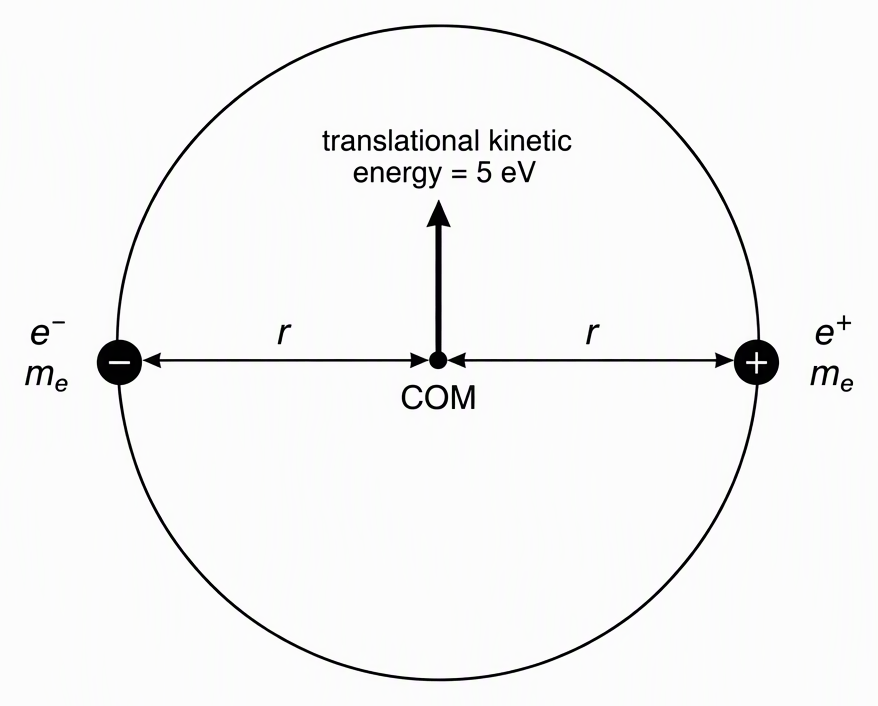
The photon frequencies are labelled:
No other energy loss is considered. Find the absorbed photon energy minus the emitted photon energy, in eV.
How do you find the absorbed photon energy in step 1?
The absorbed photon supplies 23.6 eV: enough to free the electron from hydrogen and leave it with 10 eV kinetic energy. Define the two photon energies separately:
Hydrogen’s ground-state energy, measured relative to a separated electron and proton, is:
Reaching the zero-energy threshold therefore requires 13.6 eV. The outgoing electron’s 10 eV is energy above that threshold, not a replacement for the ionisation energy.
Following the official solution’s treatment:
Carry only the electron’s 10 eV kinetic energy into the capture stage. The rest of the absorbed photon energy has supplied the ionisation threshold.
Why is positronium’s ground-state energy negative 6.8 eV?
Positronium has half the hydrogen ground-state binding-energy magnitude because its reduced mass is half the electron mass. For the same Coulomb charge magnitude, Bohr energy levels scale directly with reduced mass.
The reduced mass of two particles is:
For the equal-mass electron–positron pair:
Using the official solution’s hydrogen reference:
The internal energy is negative because the bound state lies below the separated-particle energy. The positive binding-energy magnitude, 6.8 eV, is the energy needed to separate the particles.
Internal orbital motion is already included in this Bohr energy level, along with the electric potential energy. The given 5 eV describes motion of the atom’s centre of mass, so it must be counted separately.
How does the capture energy balance give 11.80 eV?
The emitted photon carries 11.8 eV after accounting for both the atom’s translation and its negative internal energy. Use a separated electron and positron at rest as the zero of internal energy.
- Initial energy: 10 eV from the electron, plus zero kinetic energy from the stationary positron.
- Final translational energy: 5 eV in centre-of-mass motion.
- Final internal energy: negative 6.8 eV for ground-state positronium.
- Final photon energy: the energy carried away by the emitted photon.
Energy conservation gives, with all terms expressed in eV:
Combine the atom’s two contributions:
Therefore:
In words, 5 eV of the incoming kinetic energy remains available after translation, and binding releases another 6.8 eV. Together, these supply the emitted photon.
The question asks for the difference between photon energies:
The required numerical entry is:
The emitted photon energy and the requested difference happen to have the same numerical value here. Calculating the emitted photon energy alone does not complete the reasoning.
Check that the final capture-stage energies recover the initial energy:
What wrong answer results if you omit the atom’s motion?
Omitting the centre-of-mass kinetic energy produces an incorrect answer of 6.8 eV. The supplied question is numerical-answer, so there are no listed wrong options to analyse.
The incorrect capture balance is:
It incorrectly gives:
Carrying that error into the requested subtraction gives:
Forming a bound atom does not mean its centre of mass is at rest. “Ground state” specifies the internal state, not the atom’s translational motion.
Before solving any capture problem, account separately for translational kinetic energy, internal energy and photon energy. Write those three contributions first rather than trying to recall a single capture formula.
Can you solve two related Bohr-model questions with the same method?
The same method gives 17.6 eV for the first practice question and 5.1 eV for the transition photon in the second. Both questions below are original practice variations, not verified previous-year questions.
Question 1: A stationary ground-state hydrogen atom is photoionised, and its electron leaves with 4.0 eV kinetic energy. Find the absorbed photon energy using the same treatment as above.
The photon must supply the ionisation threshold plus the outgoing kinetic energy:
Question 2: In the same Bohr treatment of positronium, find its second-level energy and the photon energy for a transition from the second level to the ground state. Neglect recoil.
Use level-energy notation to distinguish the internal energy from the main solution’s emitted photon energy:
Thus:
The emitted photon carries the drop in internal energy:
Now cover the main solution and rebuild its capture balance. Write translation, internal energy and photon energy separately before substituting any values.
Next step: photograph a doubt on JEEnius and photograph any question you are stuck on and get a step-by-step solution, with a free-body diagram when the question needs one (20 free).
Keep going with How to Study Carboxylic Acids JEE: Acidity and Reactions.
Frequently asked questions
What is the answer to the JEE Advanced 2025 positronium question?
The required difference between absorbed and emitted photon energies is 11.80 eV. The absorbed photon supplies 23.6 eV, while the emitted photon carries 11.8 eV after accounting for the positronium atom’s 5 eV centre-of-mass kinetic energy.
Why is positronium’s ground-state energy −6.8 eV?
The electron and positron have equal masses, so their reduced mass is half the electron mass. Bohr energy levels scale with reduced mass, giving half the hydrogen reference energy of −13.6 eV. The negative sign means the bound state lies below the separated-particle energy.
How do you calculate the emitted photon energy when positronium forms?
Keep the atom’s translational kinetic energy separate from its internal energy. For this question, energy conservation gives 10 = 5 − 6.8 + E, with all energies in eV. The emitted photon energy is therefore 11.8 eV.
Why is 6.8 eV the wrong answer to the positronium question?
That result comes from omitting the positronium atom’s 5 eV centre-of-mass kinetic energy. The omission gives an emitted photon energy of 16.8 eV and an incorrect photon-energy difference of 6.8 eV. Ground state specifies the internal state, not whether the atom is moving.