
What is shared in the two-particle JEE 2005 question?
Equal final speed does not mean equal travel time. For this motion in a straight line JEE 2005 solution, keep both time and distance differences in the order A minus B.
Two particles, A and B, start from rest and move along a straight line with constant accelerations. A takes longer and travels farther before reaching the same speed as B; find the relation between their accelerations and these differences.
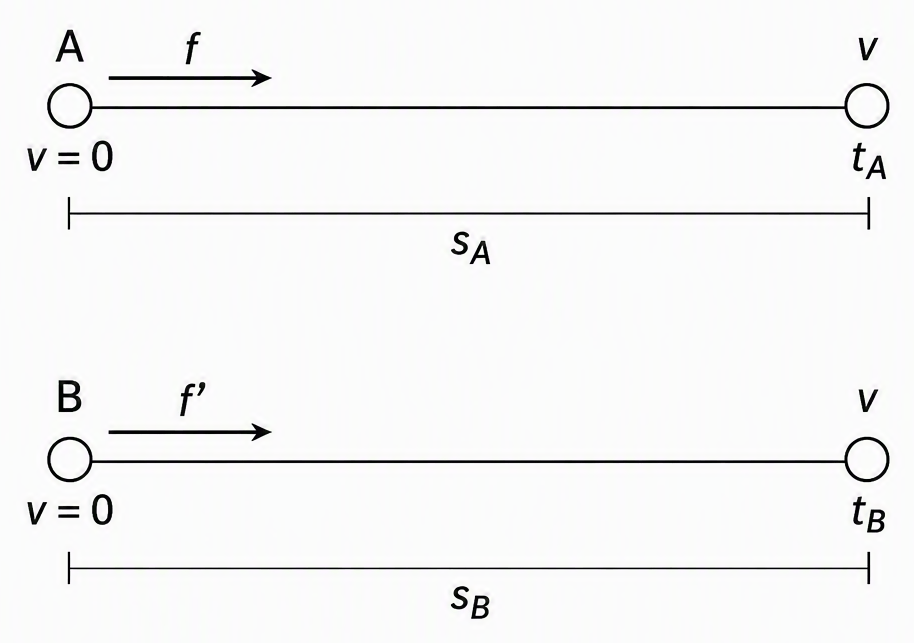
The quantities are defined as follows. The figure compares independent journeys, not a shared starting position or simultaneous arrival at the target speed.
The supplied question bank labels this problem 2005 and Hard. These are bank labels, not an independently verified historical session.
How do I write the equations for the two journeys?
Write one constant-acceleration equation for each particle, then connect them through the stated differences. The common final speed links the journeys; it does not make their durations equal. Keep every difference in the order A minus B, because A takes longer and covers more distance.
Define the common final speed, individual distances and elapsed times below. Each time is measured from that particle's own start:
Begin with the supplied solution’s method. Both initial speeds are zero, so:
Translate “A travels farther” and “A takes longer” directly. The distance and time comparisons are:
The velocity-time equations share the final speed. Solving each separately gives the elapsed times:
The first equation also gives each distance. Substitute those expressions into the distance comparison:
Do not insert a single shared time into both velocity equations. That would force equal accelerations and erase the stated positive time difference.
How do I eliminate the common speed to get Option 4?
Express the common speed using the time difference, then substitute it into the distance difference. Keep the acceleration difference in the same order throughout; reversing it in only one equation changes the sign incorrectly. The elimination below retains the square on the speed and shows every cancellation.
Start with A's time minus B's time. Factor out the common speed, then solve for it:
Use the same subtraction order for distance. Combining the fractions gives:
Substitute the speed explicitly, squaring the entire fraction. This gives:
Cancel one acceleration-difference factor and one factor of each acceleration. Then multiply across:
This is Option 4, as identified by the supplied answer key. Check the sign physically: A needs more time to reach the same positive speed from rest, so its acceleration must be smaller:
Both sides are therefore positive. Their dimensions also agree:
Here the squared symbol on the right represents the squared time difference, not square metres. Equal accelerations would give equal times and distances at the target speed, contradicting the positive differences. These checks validate the derivation; they do not replace it.
Why does using final speed for distance lose a factor of one-half?
Using final speed as though it were constant throughout the journey doubles the distance difference. The supplied record identifies Option 4 but omits the other options, so the following wrong expression cannot be assigned to a particular listed distractor.
The incorrect step treats final speed as the speed at every instant. It gives:
The time relation below is correct. Combining it with the incorrect distance expression produces the wrong result:
The factor of one-half has disappeared. For constant acceleration from rest, the average speed is:
That explains the missing factor. Use this observation to diagnose the error, not to replace the supplied kinematic-equation method.
How do I solve three related straight-line motion questions?
Use the two difference equations to recover the speed, impose an acceleration ratio, or check a numerical case. These are three original practice questions, not additional verified PYQs.
What is the common final speed using only the two differences?
Original practice question 1: Express the target speed using only the extra distance and extra time. Divide the derived distance-difference equation by the time-difference equation:
The result has speed units: length divided by time. The acceleration factors cancel because both journeys end at the same speed.
What are the accelerations if B accelerates twice as much as A?
Original practice question 2: Determine both accelerations in terms of the two differences. Insert the given ratio into the derived relation:
This simplifies as follows. Cancel the nonzero acceleration only after making the substitution:
How do I find the time and distance differences from given accelerations?
Original practice question 3: Find both differences for the values below. Calculate each journey separately before subtracting:
Subtract B from A to obtain the differences. Both are positive, as required:
Check these values in the derived relation. Both sides give the same value and units:
Now cover the answers and redo this numerical case. Write both journeys before taking either difference.
Next step: the past-paper archive on JEEnius and search every JEE Main paper from 2002 and every Advanced paper from 2007, by year, subject or chapter, each with a worked solution (free).
If that step was the hard part, work through Matrices and Determinants JEE 2010: Worked Solution.
Frequently asked questions
What is the answer to the two-particle JEE 2005 motion question?
The relation is (f' - f)n = (1/2)ff'm², identified as Option 4 in the supplied answer key. Here f and f' are the accelerations of A and B, while m = t_A - t_B and n = s_A - s_B are A's extra time and distance. Both particles start from rest and reach the same final speed under constant acceleration.
Why is A's acceleration smaller than B's?
Both particles start from rest and reach the same positive final speed, so their elapsed times are t_A = v/f and t_B = v/f'. Since A takes longer, its acceleration must be smaller: f < f'. Equal final speed does not imply equal travel time.
Why can't I use s = vt in this question?
Here v is the final speed, not a constant speed throughout the journey. For constant acceleration from rest, the average speed is v/2, so the distance is s = vt/2. Using s = vt doubles the distance and removes the required factor of one-half from the final relation.
How do I find the common final speed from the time and distance differences?
The common final speed is v = 2n/m, where n is A's extra distance and m is A's extra time relative to B. Both journeys have average speed v/2 because they start from rest and end at the same speed under constant acceleration. Subtracting their distances therefore gives n = vm/2.