What is the answer to the refraction and lenses JEE 2013 glass-plate question?
The final object distance in the refraction and lenses JEE 2013 question is 5.6 m in front of the lens, not a movement of 5.6 m. Initially, an object 2.4 m in front of a lens forms a sharp image on film 12 cm behind it. A glass plate, 1 cm thick with refractive index 1.50, is inserted between the lens and film, with its faces parallel to the film.
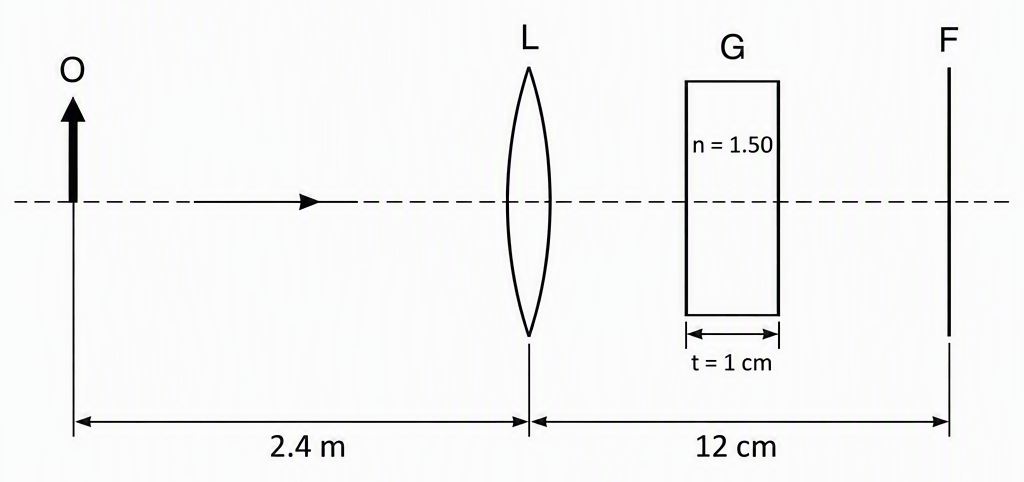
Find the object's new distance from the lens when sharp focus returns to the stationary film. The solution must establish why 5.6 m works: the plate changes where the converging rays meet, but neither the lens nor the film moves.
How do you find the focal length before inserting the plate?
Use the original sharp image to find the focal length, keeping every distance in centimetres. Take rightward as positive because incident light travels left to right. The real object is on the negative side of the lens; the real image is on the positive side.
Retain the exact fraction for the second calculation. The plate sits behind the lens; it is not a surrounding medium that changes the lens's focal length.
Why must you subtract the plate shift when the film stays fixed?
Subtract the shift because the lens must now produce a beam whose no-plate focus lies just before the film. The plate then shifts that focus onto the film. For an unchanged incoming converging beam, a plane-parallel glass plate shifts the focus farther from the lens, not towards it.
The official solution uses the standard paraxial normal shift. Substituting the plate thickness and refractive index gives:
The film position is fixed, but the lens-alone image distance must change. Define the primed image distance as the no-plate focus distance for the new object position, not the physical lens-to-film distance. The physical focus must land on the film:
- Fixed film distance: 12 cm behind the lens.
- Image distance for the second lens-formula calculation:
The subtraction does not mean the plate shifts the focus backwards. It sets the lens-alone focus closer to the lens to compensate for the plate's forward shift.
How does the lens formula give the new object distance of 5.6 m?
The new signed object distance is negative 560 cm, so the object must end up 5.6 m in front of the lens. Use the same focal length and the corrected no-plate image distance. Keep fractions exact because the next subtraction involves two nearly equal numbers.
The negative sign places the object on the incoming-light side, agreeing with the supplied official answer. For a directional check, reducing the lens-alone real-image distance towards the focal length requires moving the real object farther away.
The question asks for the final distance from the lens, not how far the object travels. Final distance: 5.6 m in front. Movement required: 3.2 m away from the lens.
Why does adding the shift to 12 cm give a wrong answer?
Adding the shift describes the focus after inserting the plate without moving the original object. It does not give the lens-alone image distance needed to restore focus on fixed film. Mixing those two situations produces a calculated wrong result of about 1.56 m.
The mistaken argument uses the plate's forward shift to justify adding it to the fixed film distance. Following that substitution through gives:
This moves the object closer, while compensation requires moving it farther away. The option texts are absent, so 1.56 m is a calculated wrong result, not a verified listed distractor.
Repair the method by writing the physical relation before inserting numbers. When the physical focus must remain at 12 cm, the lens-alone distance must be smaller:
Which two related practice questions check the same idea?
Keeping the object fixed tests addition of the shift; using a thinner plate tests compensation at fixed film. These two author-created related practice questions are not additional verified PYQs.
Related practice 1: Keep the original object at 2.4 m and insert the same 1 cm plate of refractive index 1.50. Where should the film go for sharp focus?
The lens-alone image remains at 12 cm. Add the plate shift to find the actual focus:
Place the film there, behind the lens: move it one-third centimetre away. Moving the film permits addition; fixing it requires compensation through the object position.
Related practice 2: For the original lens and fixed film at 12 cm, use a 0.5 cm plate of refractive index 1.50. Find the new object distance.
The thinner plate requires less outward movement: the final distance lies between 2.4 m and 5.6 m. Before using the lens formula, identify what stays fixed.
Next step: photograph a doubt on JEEnius and photograph any question you are stuck on and get a step-by-step solution, with a free-body diagram when the question needs one (20 free).
Keep going with How to Crack JEE Main 2027: Study Plan from September.
Frequently asked questions
What is the answer to the JEE 2013 lens and glass-plate question?
The final object distance is 5.6 m in front of the lens. Since the object starts 2.4 m in front, it must move 3.2 m away from the lens; 5.6 m is not the movement.
Why do we subtract the glass-plate shift when the film is fixed?
The glass plate shifts the focus of a converging beam farther from the lens by d = t(n - 1)/n. To keep the actual focus on film fixed at 12 cm, the lens-alone focus must be at 12 - d. Here d = 1/3 cm, so the image distance used in the lens formula is 35/3 cm.
Does inserting the glass plate change the lens's focal length?
No: the plate sits behind the lens rather than changing its surrounding medium. The original object and image distances give 1/f = 1/12 + 1/240, so the focal length remains 80/7 cm.
Where should the film move if the object stays at 2.4 m?
With the original object fixed, the lens-alone image distance remains 12 cm. The 1 cm glass plate of refractive index 1.50 shifts the actual focus to 37/3 cm, approximately 12.33 cm behind the lens. The film must therefore move 1/3 cm farther from the lens.