
How can you crack JEE Main 2027 from September?
A chapter is prepared when you can solve its questions independently on a later test, not when its lectures end. How to crack JEE Main 2027 comes down to syllabus-based study, independent practice, spaced error correction and timed tests. From September 2026, target the expected January 2027 window, based on the usual session pattern. The school-going example provides 24 focused weekday hours plus 5 Sunday testing and review hours, not a minimum required to qualify.
What does a realistic 29-hour JEE Main timetable look like?
Use four focused hours from Monday to Saturday, followed by five hours of testing and review on Sunday. This example assumes school and travel finish by approximately 4 pm. Coaching must replace conflicting blocks, not sit on top of them. Every duration below is a planning recommendation, not an official requirement or an evidence-backed guarantee of results.
- Monday–Saturday; 6:30–7:00 am; Chemistry recall; 30 minutes. Retrieve reactions, facts or formulas before checking your notes.
- Monday–Saturday; 4:30–5:45 pm; Physics; 75 minutes. Repair a concept, solve independently and check errors.
- Monday–Saturday; 6:00–7:30 pm; Mathematics; 90 minutes. Write complete solutions, with a time limit for the solving portion.
- Monday–Saturday; 8:00–8:45 pm; Chemistry practice; 45 minutes. Practise questions connected to current work or morning recall.
- Sunday; 9:00 am–12:00 noon; testing block; 3 hours. Early in preparation, combine timed chapter tests with backlog repair. A full mock uses all 180 minutes.
- Sunday; 2:00–4:00 pm; analysis and correction; 2 hours. Diagnose errors, re-solve questions and schedule repairs.
Here, “weekday hours” means the six Monday–Saturday study days. The weekly total is:
The subject totals across those six days are:
- Mathematics: 9 hours.
- Physics: 7.5 hours.
- Chemistry: 7.5 hours.
Sunday remains a separate mixed-subject allocation. Do not count it again in the weekday subject totals.
Keep 8:45–9:45 pm for schoolwork. An example sleep window is 10:30 pm–6:30 am. The gaps between blocks allow meals and breaks; the period after school allows food and recovery. If travel ends later, reduce the schedule instead of borrowing from sleep.
On coaching-heavy days, use this 2-hour independent-study version. Coaching replaces the conflicting blocks; it is not an extra evening shift.
- Mathematics: 45 minutes, mainly written solving.
- Physics: 40 minutes, including a model check and application.
- Chemistry: 35 minutes, split between recall and questions.
Droppers may add an optional 2-hour morning block, for example 9:00–11:00 am, for concept repair and independent practice. Add it only after consistently completing and reviewing the base workload.
How should you divide time between Physics, Chemistry and Mathematics?
Begin with the sample split, then change it using error records rather than confidence. In the current Paper 1 structure, each subject has 25 questions and carries 100 marks within a 300-mark paper. Equal marks do not require identical study hours, but neglecting an entire subject is a poor starting strategy.
Use the weekday allocation as a starting hypothesis:
- Mathematics, 9 hours: slightly more uninterrupted solving time. Write full solutions under a time limit, rather than mentally following worked examples.
- Physics, 7.5 hours: combine concepts with application. Choose the model, draw a diagram when useful, check units and solve without looking at the solution.
- Chemistry, 7.5 hours: distinguish NCERT-based recall, conceptual understanding and numerical practice. Reading alone cannot replace all three.
Chemistry is not automatically easiest, and Mathematics does not always deserve the largest share. Keep Sunday’s 5 mixed-subject hours outside these weekday totals.
After two weekly reviews, identify the subject with repeated, repairable errors. Move 30 minutes on three weekdays towards it, taking that time from blocks where performance is more stable. Preserve contact with every subject and reassess the following week.
For example, repeated Physics setup errors may justify transferring part of three Mathematics blocks. Specify the repair: identifying forces, selecting a conservation law or connecting a graph to motion.
A prerequisite problem is different from a time-allocation problem. If weak algebra blocks your Physics calculations, targeted algebra repair is more useful than another random Physics set. Record the actual obstruction before changing the clock.
What mistakes can make this timetable fail?
Double-counting coaching, treating lectures as preparation and skipping test analysis make this timetable fail. Count only available independent-study time and judge chapters by later solving, not videos completed. When a block is missed or a backlog grows, replace lower-priority work rather than adding another shift.
- Double-counting school, coaching and self-study: count only independent blocks that remain available. If coaching occupies the evening, use the shorter version instead of claiming that both schedules happened.
- Treating lectures as proof of preparation: a finished video series does not make a chapter usable. Require questions solved without help, followed by a later retest. Rewatch only the part linked to an identified gap.
- Letting Class 11 backlog swallow Class 12: repair the prerequisite blocking the next task. If vector resolution is the obstruction, repair that skill before restarting the whole Mechanics sequence.
- Taking mocks without analysis: keep the Sunday review appointment even after a disappointing score. Each reviewed error needs changed reasoning or a specific repair.
- Doubling tomorrow after missing today: move one priority task into the next available block. Drop lower-priority extras rather than cutting sleep.
- Changing resources and chasing predicted weightage: keep one stable theory source, chapterwise previous-year questions and the official syllabus checklist. Unsupported “sure-shot chapter” lists are not evidence of what the 2027 paper might contain.
- Sacrificing sleep or promising daily score increases: retain the sleep window and use weekly evidence. Parents should ask about completed work, recurring errors and comparable test results, not hours claimed or a higher score every evening.
What should you finish between September 2026 and the 2027 sessions?
Start with a syllabus audit, not a universal completion deadline. Use the official syllabus as your checklist and give each chapter one of the three labels below. Select work according to prerequisites and what you can already solve, while maintaining current school or coaching coursework.
- Unstudied: you have not learned enough to attempt the chapter’s basic questions.
- Studied but unreliable: you recognise the material but still need hints, forget methods or make repeated errors.
- Independently solvable on a later test: you can apply it without help after a gap, including in mixed-topic work.
The supplied information contains no announced exact 2027 dates. January and April are expected windows, based on the usual session pattern. Check the official NTA portal, jeemain.nta.nic.in, for the 2027 bulletin, syllabus, eligibility and registration notices.
- September–October: maintain current coursework and repair blocking Class 11 prerequisites. Start chapterwise previous-year questions immediately after learning the relevant material, rather than waiting for the entire syllabus to finish.
- November–December: continue unfinished syllabus work while adding mixed-topic timed sets and revisiting earlier errors. Track movement between the audit labels instead of imposing one completion date on students with different starting points.
- Final weeks before the expected January session: prioritise retained knowledge, mixed-paper practice, recurring errors and exam execution. Study a new chapter selectively when its prerequisites are ready and enough time remains for practice and retesting.
- After Session 1: classify the actual difficulties you faced: missing knowledge, setup errors, calculation, reading or time use. Rebuild the plan around school or board commitments and the expected April opportunity. Under the current two-session arrangement, candidates may sit both sessions and the better total NTA score counts; verify the rule in the 2027 bulletin.
Late starters and students with large backlogs should prioritise prerequisite chains and chapters already close to usable, not fabricated marks-per-chapter rankings. Class 11 readers should first check their intended attempt year and eligibility before adopting this accelerated 2027 schedule.
What should you do inside each study block?
Use a fixed sequence: retrieve the relevant concept, attempt questions without solutions, diagnose mistakes, redo the reasoning and retest later. Spend the block on the smallest repair that lets you solve, rather than restarting a long lecture by default. Record what needs correction before moving to the next task.
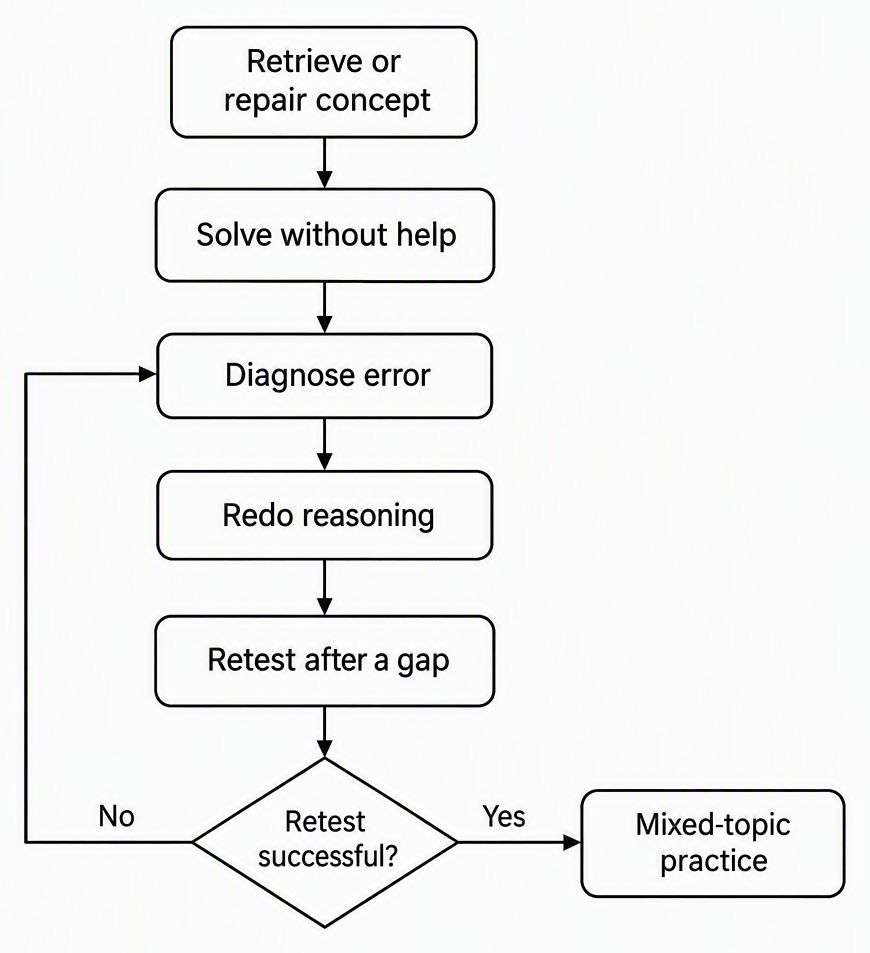
For a recommended 75-minute block, use:
- 15 minutes: retrieval or targeted concept repair.
- 45 minutes: independent solving, with solutions kept closed.
- 15 minutes: checking and recording errors with corrective actions.
Keep error records short but specific:
- Concept gap: identify the missing idea, review it and solve a basic application.
- Wrong setup: rewrite the model, diagram or starting equations before calculating.
- Calculation or algebra: locate the failed step and practise that operation.
- Misreading: record the missed condition, unit or quantity asked, then check it before reattempting.
- Time management: identify where progress stopped and set a rule for leaving and returning.
A copied solution is not a corrective action. Seeing the answer creates familiarity; solving later without help tests retention. Do not mark a chapter secure after one successful sitting.
For a bounded practice task, JEEnius daily practice problems provide a fresh ten-question topic set every day, with free sets daily. Ten questions are not a complete daily workload, and they need not fit every timed block.
A paper notebook and scheduled reminders are enough to run the correction cycle. Keep deliberate error reattempts separate from unseen-question practice: the first checks whether a repair lasted, while the second checks whether you can transfer the method.
How should mocks and weekly reviews change your next week’s plan?
Judge the plan by later independent solving, repeated-error counts and comparable test results. Take a diagnostic full paper early, then use chapter or mixed tests during coverage. Move to a weekly full mock once coverage makes whole-paper assessment useful. Extra mocks must never displace analysis.
The current JEE Main Paper 1 format is:
- Mode and duration: computer-based, 180 minutes.
- Question count: 75 questions, with 25 per subject.
- Each subject: 20 single-correct MCQs and 5 numerical-answer questions.
- Marks: 100 per subject, 300 overall.
- Marking: 4 marks for a correct answer, a deduction of 1 for a wrong answer and zero for an unattempted question.
There is no optional question subset. That does not mean you should blindly answer every question: leaving a question unattempted scores zero.
Use the recommended 2-hour Sunday review as follows:
- First 30 minutes: classify wrong, skipped and guessed-correct questions. Separate missing knowledge from execution errors.
- Next 60 minutes: re-solve selected questions independently. If stuck, check the smallest necessary hint, then redo the reasoning without it.
- Final 30 minutes: schedule repairs and later retests in named blocks for the coming week.
Record attempted, correct and wrong answers. Calculate score and attempted-question accuracy separately:
Accuracy is undefined when nothing is attempted. Compare papers of reasonably similar scope and difficulty, and read score trends alongside coverage and recurring errors. Do not change the plan on one score alone.
During mocks, practise a flexible first pass: secure accessible questions, leave attempts that have stopped progressing and return later. Test subject order rather than accepting one universal order.
Finish each weekly review by answering:
- What became independently solvable on a later test?
- Which error recurred despite correction?
- What blocked progress: time, a prerequisite or an ineffective method?
- Which three repair tasks enter next week’s timetable, and in which blocks?
Put the retest appointments beside those tasks now. If you use JEEnius, the free, unlimited mistake notebook automatically saves every wrong question and returns it at 1, 3, 7 and 14 days until you answer it correctly three times. Use those returns for independent reattempts, not another reading of the solution.
Next step: daily practice problems on JEEnius and get a fresh ten-question set on a topic every day (free sets daily).
For a worked example of the same idea, see Trigonometry JEE 2010: 3 Valid Solutions for θ in (0, π).
Frequently asked questions
How should I start preparing for JEE Main 2027 in September?
Audit chapters against the official syllabus and label each as unstudied, studied but unreliable, or independently solvable on a later test. Maintain current coursework while repairing prerequisites that block progress, and start chapterwise previous-year questions after learning the relevant material. Plan towards the expected January window, but verify dates and requirements in the official 2027 bulletin.
How many hours should I study daily for JEE Main 2027?
The sample timetable uses four focused hours from Monday to Saturday, plus five Sunday hours for testing and review, totalling 29 hours weekly. This is a planning example, not a minimum required to qualify or a guarantee of results. On coaching-heavy days, use the two-hour independent-study version: 45 minutes for Mathematics, 40 for Physics and 35 for Chemistry. Coaching replaces conflicting blocks; do not add it on top or cut sleep.
How do I clear my Class 11 backlog while studying Class 12?
Repair the specific Class 11 prerequisite blocking your current work instead of restarting an entire subject. For example, fix vector resolution if that is preventing you from solving the next Physics task. Preserve current Class 12 coursework and replace lower-priority work with targeted backlog repair rather than adding another study shift.
When should I start full mocks for JEE Main 2027?
Take a diagnostic full paper early, then use chapter or mixed-topic tests during syllabus coverage. Move to a weekly full mock once your coverage makes whole-paper assessment useful. Reserve time to classify errors, re-solve selected questions and schedule repairs with later retests; extra mocks should not displace analysis.