What does the 2010 JEE Advanced matrix-match on mixed mathematics actually require?
It matches four statements to the values –4, 0, 4, 5, 6. Statement A asks for d² where a line from the origin intersects two given lines at P and Q, with d = PQ. Statement B asks for the values of x satisfying the given inverse-tangent difference equal to arcsin(3/5). Statement C asks for possible μ when non-zero vectors satisfy three given dot-product and magnitude conditions and a = μb + 4c. Statement D asks for the value of (2/π) times the integral of the given piecewise function f(x) over [-π, π]. Column II contains –4, 0, 4, 5, 6.
The verified official matching is A-t, B-p and r, C-q (or q and s), D-r.
How do you establish the 3D geometric arrangement before solving the line intersection in mixed mathematics JEE 2010?
A straight line from the origin intersects the first given line at P and the second at Q only if O, P and Q are collinear. This forces the position vector of Q to be a scalar multiple k of the position vector of P.
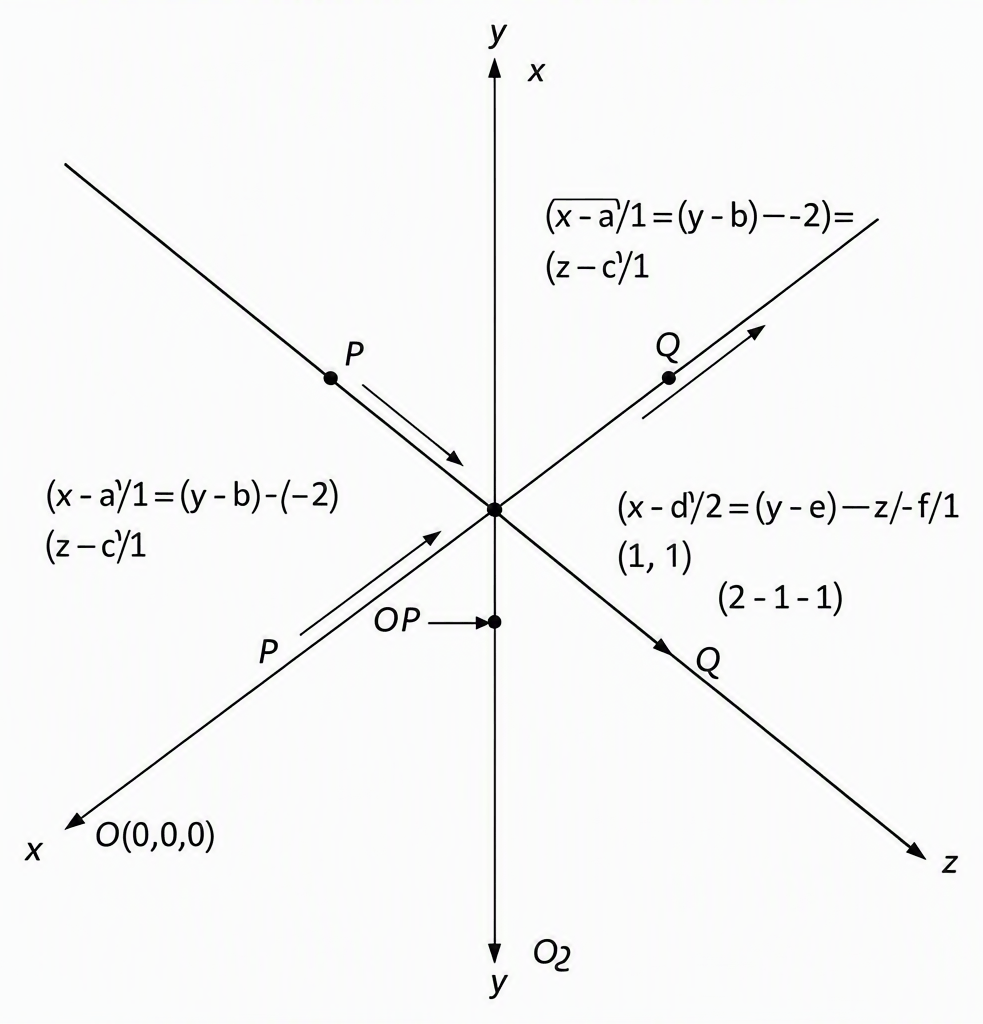
Parametric equations must follow the figure at once. Any approach with direction cosines wastes time.
What are the official calculations for all four columns in the mixed mathematics JEE 2010 question?
Parametrize the first line as and the second as . Collinearity gives Q = kP, so equate coordinates:
The last two equations yield kλ = 2. Substitute into the first to obtain k = 2/3, hence λ = 3. Then P(5, –5, 2) and Q(10/3, –10/3, 4/3). The vector PQ equals (1/3)P, so
This matches t.
Rewrite arcsin(3/5) as arctan(3/4). Apply tan(A–B) formula to reach 6/(x²–8) = 3/4. Solve to obtain x² = 16, so x = ±4 matching p and r. Convert arcsin to arctan first and verify the principal-value domain.
Substitute a = μb + 4c into dot-product conditions. Introduce B = |b|², C = b·c, D = |c|² to obtain C = –(μB)/4. Substitute into second condition to express D in terms of B and μ. The squared-magnitude relation reaches μ² – 5μ = 0, so μ = 0 or 5. Apply Cauchy–Schwarz C² ≤ BD which rules out μ = 5 leaving only μ = 0. The official key accepts q or q and s.
Use the identity for n = 4:
The cosine terms integrate to zero over [–π, π], leaving ∫f = 2π. Therefore (2/π)∫f = 4, which matches r.
Final matching: A-t, B-p and r, C-q (or q and s), D-r.
What method mistake produces one wrong matching in the vectors part of mixed mathematics JEE 2010?
The slip occurs after obtaining the quadratic μ(μ – 5) = 0 from the squared-magnitude equation. Students accept both roots without subsequently substituting back into the Cauchy–Schwarz condition C² ≤ B D.
For μ = 5 the derived C and D yield C² > B D, which is impossible for real vectors b and c. This omission would incorrectly pair C with both q and s instead of only q.
What practice problems combine the same topics as the mixed mathematics JEE 2010 matrix match?
Question 1 (3D + vectors): A line from (0,0,0) intersects r = (1,2,3) + λ(1,–1,1) and r = (4,1,5) + μ(2,1,–1); find possible distance between intersection points if they are collinear with origin. Use the identical scalar-multiple technique on position vectors.
Question 2 (inverse trig + integral): Solve tan⁻¹(2x+1) – tan⁻¹(2x–1) = π/4 and then evaluate a related definite integral of the resulting function over a symmetric interval. Convert to tangent difference and apply the same identity used in part D.
Question 3 (vectors): Non-zero a, b satisfy a·b = 0, |a – 2b| = |a + b| and a = k b + 3(a × b); possible integer values of k. Introduce scalar auxiliaries exactly as in the official C solution and close with Cauchy–Schwarz.
Solve these immediately after the official steps. The algebraic habits transfer directly.
Which algebraic habits make mixed questions from 3D, inverse trig, vectors and integrals easier?
Express collinearity through position-vector scalar multiple rather than direction cosines. Convert arcsin to arctan before applying the tangent subtraction formula and always record the domain of the inverse functions. Introduce the three scalars B, C, D systematically when vectors are linearly related, then enforce the Cauchy–Schwarz verification as the final gate. Recognise the standard sum-of-cosines form for sin((2n+1)x/2)/sin(x/2) so the integral collapses in one line.
You can search every JEE Advanced paper from 2007 by chapter in the past-paper archive to locate more mixed problems with worked solutions. If a fresh question blocks you, photograph the doubt for a step-by-step solution with diagram.
Next step: the past-paper archive on JEEnius and search every JEE Main paper from 2002 and every Advanced paper from 2007, by year, subject or chapter, each with a worked solution (free).
Keep going with Damping of Oscillations JEE 2019: N = 5000 Solution.
Frequently asked questions
What is the official matching for mixed mathematics JEE 2010?
The verified official matching is A-t, B-p and r, C-q (or q and s), D-r. Statement A gives d²=6, B gives x=±4, D gives 4. For C only μ=0 satisfies all vector conditions after Cauchy-Schwarz.
How to solve the 3D line intersection in mixed mathematics JEE 2010?
Parametrize the first line as P=(2+λ,1-2λ,-1+λ) and second as Q=(8/3+2μ,-3-μ,1+μ). Enforce collinearity by setting Q=kP. Solving yields k=2/3, λ=3, P(5,-5,2), Q(10/3,-10/3,4/3) and d²=6.
Why is μ=5 invalid in the vectors part of mixed mathematics jee 2010?
The squared-magnitude equation produces μ(μ-5)=0. Substituting μ=5 produces scalars where C² exceeds BD. This violates Cauchy-Schwarz, so only μ=0 is possible for real non-zero vectors b and c.
How do you evaluate the integral in JEE 2010 mixed mathematics?
Rewrite f(x) using sin(9x/2)/sin(x/2)=1+2(cos x+cos 2x+cos 3x+cos 4x). All cosine terms integrate to zero over [-π,π]. The integral of f(x) equals 2π, therefore (2/π)∫f from -π to π equals 4.
What common mistake occurs in the vectors question of mixed mathematics JEE 2010?
Students solve μ(μ-5)=0 but accept both roots without substituting back into Cauchy-Schwarz. For μ=5, C²>BD which is impossible. This wrongly pairs C with both q and s instead of only q.