
What was the JEE Main 2019 question on magnetic damping of a conducting strip?
The official answer is N = 5000. A thin conducting strip of length 0.1 m, mass 0.05 kg, resistance 10 Ω is attached to a spring of k = 0.5 N m^{-1} inside uniform B = 0.1 T. The strip is pulled from equilibrium and released. Its amplitude falls by a factor of e after N oscillations while air drag remains negligible.
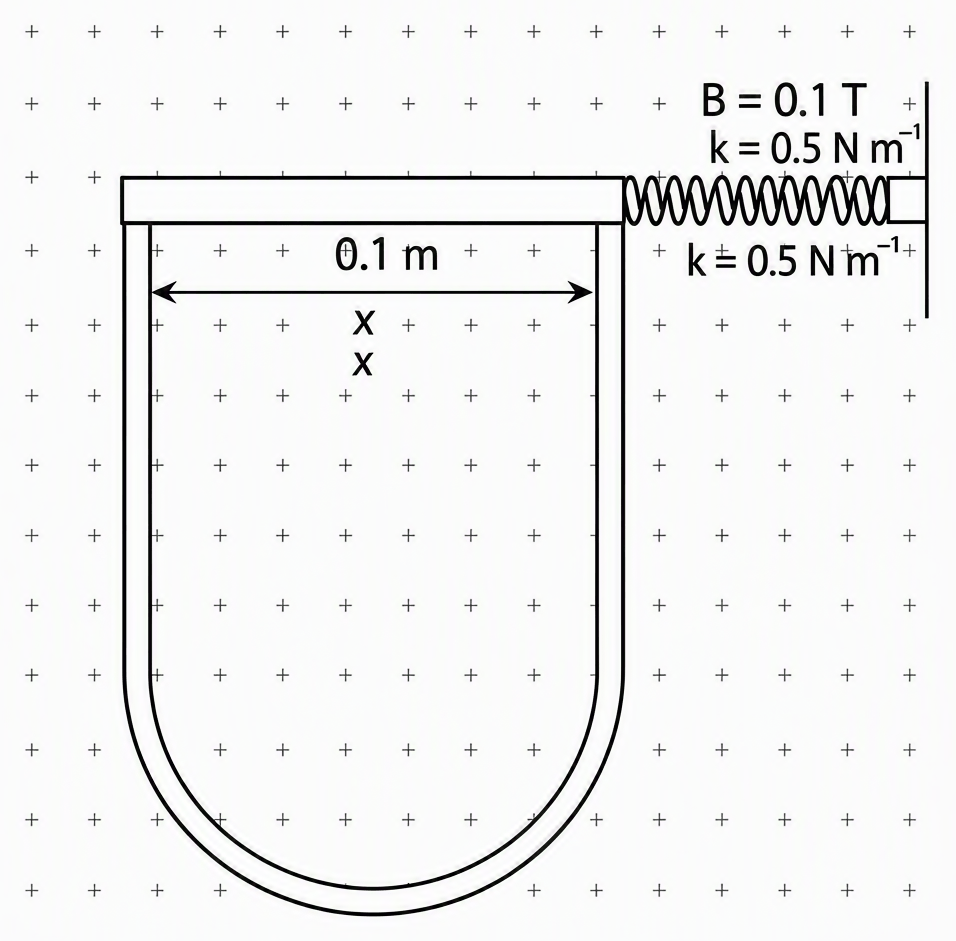
How Do You Derive the Damping Force from Induced Current in This Setup?
The moving strip cuts magnetic flux and experiences an induced emf = B l v. The current in the strip is I = (B l v)/R. This current interacts with the magnetic field to produce a force that opposes the velocity, exactly F = –I l B. Substituting the current gives the velocity-dependent opposing force F = –(B² l² / R) v.
Hence the damping constant b = B² l² / R. The numerical value is b = (0.1)² × (0.1)² / 10 = 10^{-5} SI units.
What Is the Full Official Step-by-Step Solution for the 2019 Question?
The equation of motion is
Under light damping the amplitude decays as
The amplitude drops by a factor of e when therefore
The natural period of oscillation is
The number of oscillations is therefore
The equivalent exact expression is
This remains close enough to 5000 that the correct choice is option 2.
What Exact Method Mistake Produces 10000 Instead of 5000?
The error consists of stopping after calculating the decay time t = 10^4 s and reporting that number directly as N. This omits division by the natural period T to convert elapsed time into oscillation count. It produces the distractor value 10000 instead of the required 5000.
How Do You Confirm the Light-Damping Approximation Is Valid Here?
The approximation is valid because b = 10^{-5} while the critical damping coefficient b_c = 2√(k m) = 2 √(0.5 × 0.05) ≈ 0.316. Since b ≪ 0.316 the light-damping exponential envelope holds. The decay time constant is independent of spring constant k.
What Two Related Practice Questions Test the Same Damping Concepts?
A conducting rod of mass m = 0.05 kg, length l = 0.1 m and resistance R = 10 Ω is attached to two springs each of constant k/2 = 0.25 N m^{-1} and slides on parallel rails in a perpendicular B = 0.1 T field. The time for amplitude to become 1/e of initial value uses the same b = 10^{-5}. This yields t = 2m/b = 10^4 s and N ≈ 5000.
In an LCR series circuit the charge on capacitor decays as e^{-(R/2L)t}. Choose L = 0.05 H, C = 2 F and R = 10^{-5} Ω so the electrical damping factor R/2L matches b/2m. The decay time is 2L/R = 10^4 s. The electrical period is 2π √(LC) ≈ 2 s, so N ≈ 5000. Both reinforce N = √(mk)/(π b).
You can search every JEE Main paper from 2002 and every Advanced paper from 2007, by year, subject or chapter, each with a worked solution (free) to locate more solved examples that mix induction and oscillation.
What Are the Key Takeaways for Solving Future Damping of Oscillations Problems in JEE Main?
Always compute b = B²l²/R first when a conductor moves in B with velocity. The decay time for amplitude factor e is always 2m/b regardless of k. N = t/T or equivalently √(mk)/(π b) must be evaluated; forgetting the division by T is the common slip.
If you encounter a similar trapped step during your practice, photograph any question you are stuck on and get a step-by-step solution, with a free-body diagram when the question needs one (20 free).
Next step: photograph a doubt on JEEnius and photograph any question you are stuck on and get a step-by-step solution, with a free-body diagram when the question needs one (20 free).
For a worked example of the same idea, see Laws of Motion JEE 2019: Quadratic Drag Ball Problem.
Frequently asked questions
What is the answer for the damping of oscillations JEE 2019 question?
The official answer is N=5000. The amplitude of the conducting strip falls by a factor of e after 5000 oscillations. This comes from calculating the decay time t=2m/b=10^4 s and dividing by the natural period T≈2 s.
How do you find the damping constant b in the JEE 2019 magnetic damping problem?
The damping constant b equals B²l²/R. For B=0.1 T, l=0.1 m and R=10 Ω, b=(0.1)²×(0.1)²/10=10^{-5}. This velocity-dependent force F=–b v is then used in the damped harmonic oscillator equation.
Why is N 5000 and not 10000 in damping of oscillations JEE 2019?
Students often calculate the decay time t=10^4 s correctly but forget to divide by the oscillation period T≈2 s. The number of oscillations N is t/T, which gives 5000. Reporting t directly produces the distractor 10000.
What is the exact formula for N in the JEE 2019 damping question?
Under light damping, N=√(mk)/(π b). Substituting the values gives approximately 5030, which is close enough to 5000. The article also confirms that b≪2√(km) so the light-damping approximation holds.
Is light damping approximation valid in the 2019 JEE oscillations problem?
Yes, it is valid. Here b=10^{-5} while critical damping b_c=2√(km)≈0.316. Since b is much smaller, the amplitude decays as e^{-(b/2m)t} and the period remains approximately the natural period.