What was the 2019 JEE Main question with the concave mirror at the bottom of water?
A concave mirror of radius 40 cm was placed at the bottom of a vessel. Water was filled to a height of 5 cm. A tiny particle floated on the water surface. The question asked for image distance d from the water surface when observed straight down from air. With μ_water = 1.33 the value is 8.75 cm, close to 8.8 cm.
How does the setup look for the concave mirror and floating particle in water?
The concave mirror sits at the base of the vessel. Water rises exactly 5 cm above the mirror. The particle rests on the water surface directly above the pole. The observer in air looks vertically downward.
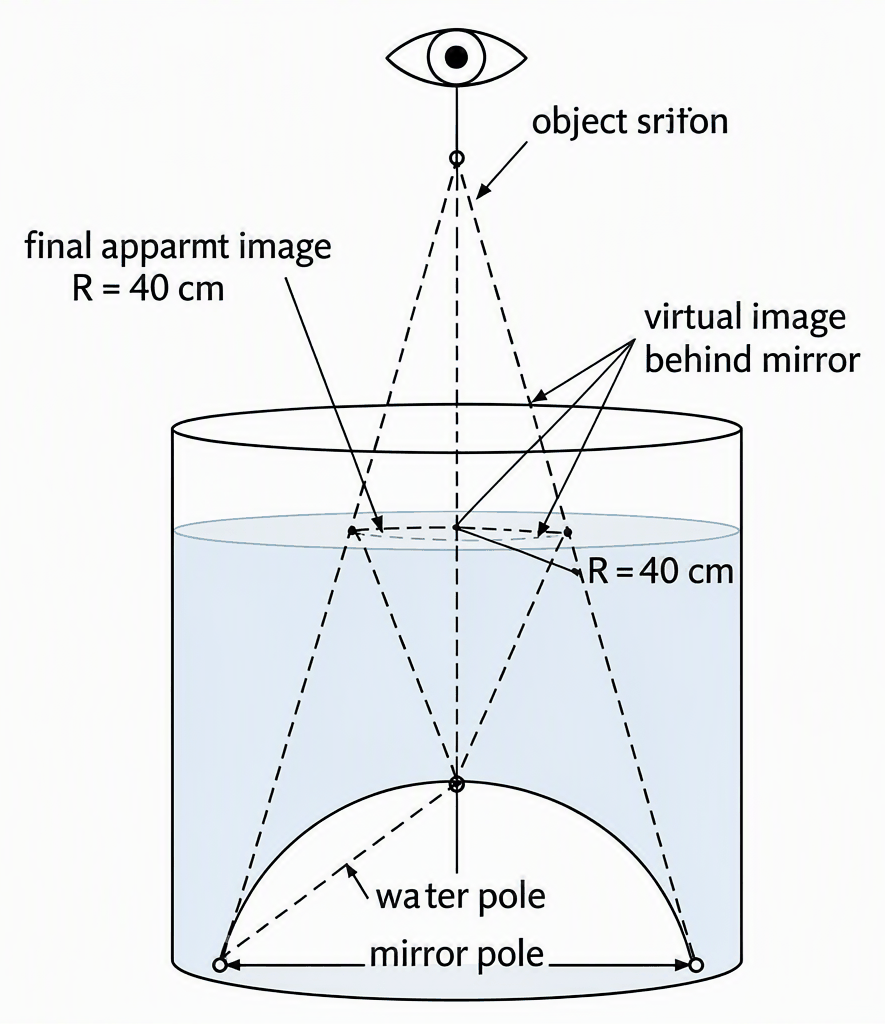
Light rays from the particle travel through 5 cm water, reflect from concave mirror, return through same water column into air.
What is the official NTA solution for the 2019 JEE Main concave mirror question?
The NTA solution gives d = 8.75 cm ≈ 8.8 cm. It starts with f = –20 cm, u = –5 cm using Cartesian sign convention for mirrors.
Thus v = +20/3 cm ≈ 6.67 cm (virtual image behind mirror). Real depth of this image below water surface equals 5 + 20/3 = 35/3 ≈ 11.67 cm. Apparent depth d equals real depth divided by μ, so (35/3) ÷ (4/3) = 35/4 = 8.75 cm ≈ 8.8 cm. Hence answer is 8.8 cm (option 2).
This locates the mirror image first in water, then applies the refraction correction for the observer in air.
What mistake produces 6.67 cm instead of 8.75 cm in this question?
The error is taking only the mirror-calculated distance 20/3 cm ≈ 6.7 cm as the final d from surface. This forgets that the virtual image lies 20/3 cm below the mirror so total real depth from surface is 5 + 20/3 = 35/3 cm. It then omits the refraction correction: apparent depth equals real depth divided by μ_water when observer is in air. Correct sequence is mirror image location first, then apparent-depth adjustment.
Which similar ray optics questions test the same sequence?
- A coin lies at the bottom of a 12 cm deep water tank (μ=4/3). Find its apparent depth when viewed from air.
- A concave mirror (f=–15 cm) has a 3 cm thick glass slab (μ=1.5) placed just in front; object is 20 cm in front of slab. Find final image shift due to slab.
- An object is placed 10 cm above a plane mirror at the bottom of a 4 cm water layer; calculate apparent distance of image from surface for observer in air.
Solve each on paper. Search every JEE Main paper from 2002 and every Advanced paper from 2007 by chapter in the past-paper archive for more, each with a worked solution.
How do you solve combined reflection and refraction problems in JEE Main?
You can solve any JEE-level combined reflection-plus-refraction problem by first locating the mirror image then applying the apparent-depth formula exactly as required. Always locate mirror or lens image position first treating the incident medium, then apply apparent-depth formula only for the observer’s medium. Sign convention must stay consistent from object to mirror. Positive v here correctly signals virtual image behind mirror. Hybrid problems carrying 240 s tag require writing every intermediate depth explicitly rather than jumping to final number.
When a fresh doubt appears while practising these, photograph a doubt to get a step-by-step solution, with a free-body diagram when the question needs one.
Next step: photograph a doubt on JEEnius and photograph any question you are stuck on and get a step-by-step solution, with a free-body diagram when the question needs one (20 free).
Related on JEEnius: Limit, Continuity and Differentiability JEE 2013: f(x) < 0 on (0,1).
Frequently asked questions
What is the answer to the 2019 JEE Main concave mirror water question?
The answer is 8.8 cm. The calculation starts with the mirror formula using u = -5 cm and f = -20 cm to get v = +20/3 cm. The real depth from surface is then 5 + 20/3 = 35/3 cm and apparent depth is (35/3)/(4/3) = 8.75 cm.
Why is the image distance 8.8 cm in reflection and refraction JEE 2019?
After reflection from the concave mirror the virtual image is 6.67 cm below the mirror. Adding the 5 cm water column gives 11.67 cm real depth. When viewed from air this appears at 11.67 / 1.33 ≈ 8.75 cm.
What is the common mistake in the 2019 JEE mirror in water problem?
Many students take the image distance as 6.67 cm from the surface. They forget that the image is behind the mirror requiring addition of the water height to get total real depth before dividing by refractive index of water.
How do you solve reflection and refraction problems in JEE Main?
Locate the position of the image formed by the mirror or lens in the first medium. Then adjust for apparent depth or shift due to refraction for the observer in the second medium. Maintain consistent sign convention throughout the solution.