
What was the 2019 JEE Main hard question on moment of inertia of a variable-density circular plate?
The answer is a = 8/5. A thin circular plate of total mass M and radius R has density that increases linearly with distance from the centre according to ρ(r) = ρ₀ r. Find the moment of inertia about an axis perpendicular to the plate that passes through a point on its circumference. The answer takes the form I = a M R² and requires the numerical value of a.
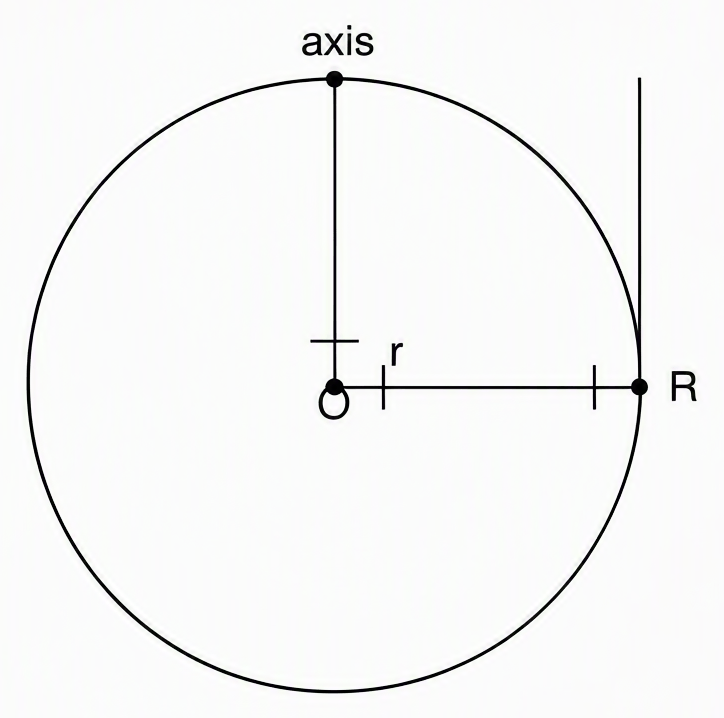
The official integration sequence first finds the central MI, substitutes ρ₀, then applies the parallel axis theorem to reach a = 8/5.
How do you express total mass M and solve for ρ₀?
dm = ρ(r) dA with dA = 2π r dr for an annular ring, so dm = ρ₀ r × 2π r dr = 2π ρ₀ r² dr.
Hence ρ₀ = 3M / (2π R³). This exact expression must be carried forward unchanged.
What is the moment of inertia about the central perpendicular axis?
Use the same dm.
Substitute ρ₀ = 3M/(2π R³) immediately after the antiderivative to obtain exactly (3M R²)/5.
For a uniform disc the same axis gives (1/2)MR². Here the extra r in density shifts the coefficient from 1/2 to 3/5.
How do you apply parallel axis theorem to shift to the edge?
The two axes are parallel (both perpendicular to plate). The distance between centre O and edge point P is exactly R.
Therefore I = a M R² implies a = 8/5. This matches the corrected official evaluation.
What algebraic slip produces the wrong coefficient 11/5?
A frequent slip is writing dm = ρ₀ r × (π r dr) instead of 2π r dr or dropping one power of r, which changes the r³ term in M to r² and ultimately doubles the coefficient after substitution.
This produces I_center = (6/5) M R². Adding M R² then gives (11/5) M R², matching one of the distractor values.
The fix is to remember that the area of the thin ring is always 2π r dr and that ρ(r) = ρ₀ r must multiply that area element exactly once before integrating.
What related questions from rotational motion test the same skills?
Related 1: A uniform thin disc of mass M and radius R. Find its moment of inertia about a perpendicular axis through a point on the circumference (answer must be derived via parallel axis on I_cm = MR²/2).
Related 2: A circular plate of mass M, radius R with density ρ(r) = ρ₀ r². Compute I about the central perpendicular axis and express as b M R², find b (requires new integrals for M and for I_center).
Related 3: A thin ring of radius R, mass M whose linear density varies as λ(θ) = λ₀ cos²θ. Find MI about the central axis perpendicular to its plane.
You can search every JEE Main paper from 2002 and every Advanced paper from 2007, by year, subject or chapter, each with a worked solution (free) in the past-paper archive.
What are the key takeaways for JEE rotational motion problems?
Always convert given density variation into dm before integrating. Never use uniform-disc formulae and then scale.
The parallel-axis shift distance is the straight-line separation of the two axes. For edge it is exactly R, never R/2.
Carry the constant ρ₀ symbolically until the final substitution. Premature numerical plugging creates coefficient errors of factor 2.
With practice expect to solve this tier in around 6 minutes because the integration ∫ r⁴ dr is standard and takes under 30 seconds under exam pressure.
When a similar question appears in your mock test and the dm setup is unclear, photograph a doubt to receive a step-by-step solution.
Next step: photograph a doubt on JEEnius and photograph any question you are stuck on and get a step-by-step solution, with a free-body diagram when the question needs one (20 free).
If that step was the hard part, work through Equilibrium JEE 2022 Empirical Formulae Multi-Correct Solution.
Frequently asked questions
How to find ρ₀ for variable density circular plate in JEE 2019?
Express dm = 2π ρ₀ r³ dr and integrate from 0 to R to obtain M = (2π ρ₀ R³)/3. Solving for the constant gives ρ₀ = 3M/(2π R³). This exact expression must be substituted only after computing the integral for I_center.
What is I_cm for the variable density plate with ρ(r)=ρ₀r?
I_center is found by integrating r² dm = 2π ρ₀ r⁴ dr from 0 to R, yielding 2π ρ₀ R⁵/5. Substituting ρ₀ = 3M/(2π R³) simplifies directly to (3/5)MR². This is higher than the uniform disc value of MR²/2 because mass is concentrated farther from the centre.
How to apply parallel axis theorem for the JEE 2019 moment of inertia question?
The axes are parallel and separated by distance R. Therefore I_edge = I_center + M R² = (3/5)MR² + MR² = (8/5)MR². This gives a = 8/5 in the expression I = a M R². The separation is exactly R, never R/2.
Why do students get 11/5 instead of 8/5 in moment of inertia JEE 2019?
The common algebraic slip is writing dm = ρ₀ r × π r dr instead of the correct 2π r dr. This alters the power of r in the mass integral, leading to ρ₀ = 3M/(π R³) and I_center = (6/5)MR². Adding MR² then produces the distractor value 11/5 MR².