
What was the 2019 JEE Main Laws of Motion question on a ball thrown upward with quadratic drag?
A ball is projected vertically upward with initial speed from Earth's surface. The drag force equals and always opposes instantaneous velocity. The task is to find the exact time taken to reach the highest point where velocity becomes zero.
The official solution sets up the differential equation for ascent, integrates to , and matches option 2 exactly.
How do forces and sign convention work for this quadratic drag problem?
Both gravity and drag act in the negative direction while velocity is positive. The upward positive convention is used throughout the solution.
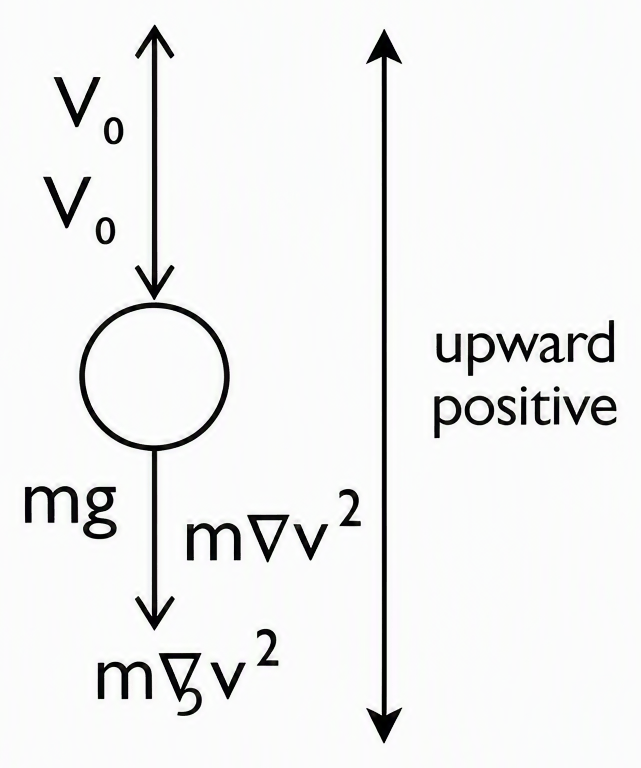
The drag force opposes velocity, so it carries a negative sign when velocity is positive. Gravity always carries a negative sign under this convention.
How do you derive the differential equation and evaluate the integral for the 2019 question?
The official solution begins with Newton's second law:
which simplifies to
Limits are at , ; at zenith . The time to zenith is
which flips to
Rewrite the denominator:
The standard integral yields
Evaluated from 0 to , the lower limit vanishes and leaves
This matches option 2 exactly.
What method mistake produces the logarithmic option in the 2019 JEE Main question?
The precise reasoning error is treating the denominator as a difference of squares or using the logarithmic antiderivative valid for linear drag (bv) or for the g - γv² descent case. This produces
evaluated from 0 to .
The error corresponds to selecting option 1 which was initially keyed but later corrected. The decisive recognition is that the + sign inside the denominator demands the inverse-tangent integral.
What related Laws of Motion problems test the same concepts?
Related 1: A particle falls under linear drag force bv. Derive terminal velocity and compare the integral form with the quadratic case above.
Equation:
Terminal velocity occurs when , so . Separate variables to get
The antiderivative is logarithmic, producing . This contrasts with the arctan form for quadratic ascent because the sign in the denominator changes from + to −.
Related 2: Two blocks of masses and (with ) lie on a rough horizontal surface with friction coefficient . An impulse strikes toward . Apply conservation of linear momentum immediately after the impulse, then use Newton's laws with friction to find acceleration.
During the short impulse, friction impulse is negligible, so total momentum after impulse equals . Common velocity . Afterwards, friction force opposes motion. Net acceleration is .
Related 3: A rocket ejects gas at constant relative velocity (backward). Set up the variable-mass equation and solve for velocity as function of time, assuming constant ejection rate.
Thrust term is (with proper sign). The equation is
Integration yields .
Why is the arctan form required for quadratic drag ascent?
The integral . The companion forms or produce logarithmic results. The 2019 question fixes the + sign, so only arctan fits.
Drag always opposes velocity, so the sign flips between upward and downward phases producing +γv² versus −γv². In the ascent case the denominator never changes sign while v drops from to 0.
In the zero-drag limit the expression reduces correctly: let , then arctan(z) ≈ z for small , and t approaches .
How should you prepare for similar hard variable-force problems?
Recognising the integral type the moment the sign inside the denominator is fixed is the skill this 2019 question builds. Expect to choose arctan reliably once the free-body diagram fixes the + sign in (g + γv²).
Solve every Laws of Motion PYQ from the past-paper archive (2002 onwards) paying attention to 300-second difficulty tier questions. Use the photograph-a-doubt feature for any free-body diagram or variable-force setup you cannot resolve in under four minutes. Remember JEE Main 2025 Session-1 is on 22 Jan 2025; allocate at least 40 minutes daily to Physics MCQs.
Next step: photograph a doubt on JEEnius and photograph any question you are stuck on and get a step-by-step solution, with a free-body diagram when the question needs one (20 free).
If that step was the hard part, work through Solutions JEE 2022: Vapour Pressure Numerical Yields 5 Ions.
Frequently asked questions
What is the time to reach highest point in the 2019 JEE quadratic drag problem?
The exact time is t = (1 / √(γg)) arctan(V₀ √(γ/g)). This is obtained by writing m dv/dt = -mg - mγv² during ascent, separating variables, and integrating dv/(g + γv²) from 0 to V₀.
Why is arctan used for quadratic drag ascent in JEE 2019 question?
The equation of motion produces the denominator g + γv². This matches the standard integral form 1/√(γg) arctan(v √(γ/g)). The logarithmic form applies only when the sign inside is minus, as in descent or linear drag cases.
What mistake leads to the logarithmic option in Laws of Motion JEE 2019?
Students treat the denominator as a difference of squares or apply the integral valid for g - γv². This yields the logarithmic expression instead of arctan. The official key was initially wrong and later corrected to the arctan option.
How do you set up the differential equation for ball with quadratic drag?
Take upward as positive. During ascent both gravity (-mg) and drag (-mγv²) act downward. Newton's second law gives m dv/dt = -mg - mγv² or dv/dt = -(g + γv²). Limits run from v = V₀ at t = 0 to v = 0 at the top.