Which statements are correct for iron extraction in the blast furnace at 900-1500 K?
The correct statements are A, B and C. Limestone removes silicate impurity as CaSiO3 slag. Pig iron contains about 4 percent carbon. Coke converts CO2 into CO. Option D is wrong because the exhaust gases are N2, CO and CO2 with no NO2.
Students remember the JEE Advanced 2022 Paper 2 question as asking which facts hold inside the 900-1500 K window. The four statements cover flux action, carbon percentage in molten iron, the role of coke in CO generation, and the identity of exhaust gases. It is a multi-correct question so all true statements must be selected.
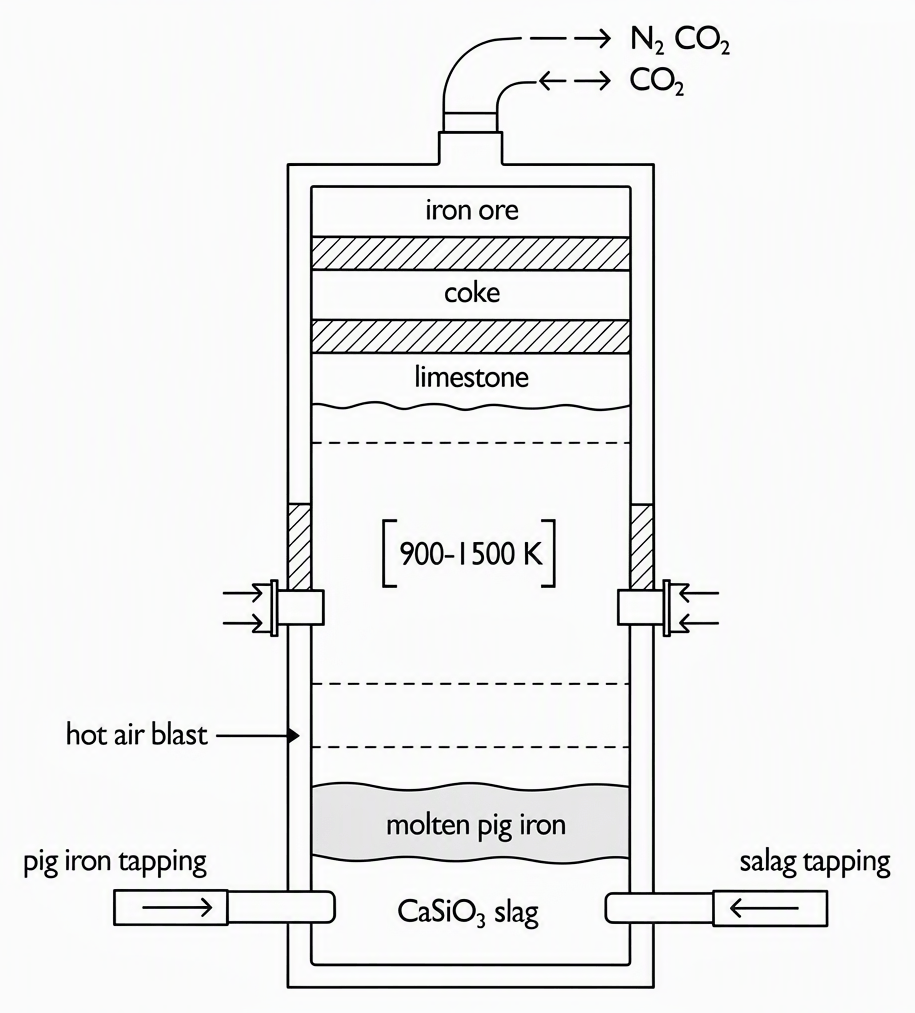
The process runs under reducing conditions with a continuous air blast rather than open combustion.
What does the official solution say for the JEE Advanced 2022 blast furnace question?
The official solution selects options A, B and C for the 900-1500 K range.
For A limestone acts as flux.
This removes silicate impurity as slag.
For B the molten iron is pig iron. It contains approximately 4 % carbon plus S, P, Si and Mn.
For C coke reacts with CO2.
The CO produced is the main reductant.
For D exhaust gases are mainly N2, CO and CO2. NO2 is absent so D is incorrect.
The correct options are therefore A, B and C.
What method mistake leads students to pick the wrong option in the blast furnace question?
Treating the furnace as an open combustion chamber where atmospheric nitrogen is oxidised to NO2 is the key error. This imports logic from high-temperature NOx formation in engines or power plants.
Students forget that the continuous blast of air supplies 78 % N2 which exits largely unreacted under reducing conditions. The redox environment keeps nitrogen inert.
Failure to cross-check each option against the specific temperature range and redox environment before marking produces the wrong selection. Always test option D against the given 900-1500 K bracket first.
Why does the 900-1500 K range decide which blast furnace statements are true?
The 900-1500 K range makes CO the principal reductant for FeO. Limestone decomposition and CaSiO3 slag formation occur efficiently inside this window. The Boudouard reaction is thermodynamically favoured here.
These steps dominate only in this interval. Below 900 K kinetics slow too much. Above 1500 K different equilibria shift and both carbon percentage and slag behaviour change.
What two practice questions test the same metallurgy concepts?
Cast iron from the blast furnace contains approximately 4 percent carbon while wrought iron contains less than 0.25 percent carbon. Explain why cast iron is brittle and cannot be welded easily. Link your answer to the form in which carbon exists.
In the extraction of copper from copper pyrite, silica is added as flux. Write the balanced equations showing slag formation and explain why the exhaust gases contain SO2 while the slag contains iron silicate. Contrast this with why NO2 does not appear in the iron blast furnace exhaust.
Solve both without notes. For more on p-block anomalies in the same year see The P-Block Elements JEE 2022: Why PbCl2 Dissolves in HCl.
You can search the past-paper archive for every JEE Advanced paper from 2007 by chapter to find similar metallurgy questions with worked solutions.
What exact facts must you memorise for blast furnace questions in JEE Advanced?
- Pig iron contains approximately 4 % carbon. Quote this number directly.
- Slag is CaSiO3. It forms because CaO (basic) reacts with SiO2 (acidic).
- Major exhaust components are N2, CO and CO2. NO2 never appears.
- Coke has dual roles as fuel and CO generator via C + CO2 → 2CO. Distinguish these instead of calling coke a direct reductant.
How do you approach similar multi-correct metallurgy questions?
Verify each option against the stated temperature range first. Write the actual balanced equation before deciding correctness. Never assume a gas is present simply because its element is supplied by air.
Start with temperature, write equations, then check environment. This order turns a 90-second question into a sub-60-second elimination drill.
Next step: photograph a doubt on JEEnius and photograph any question you are stuck on and get a step-by-step solution, with a free-body diagram when the question needs one (20 free).
Frequently asked questions
Which statements are correct for iron extraction in the blast furnace at 900-1500 K?
The correct statements are A, B and C. Limestone removes silicate impurity as CaSiO3 slag. Pig iron contains about 4 percent carbon. Coke converts CO2 into CO. Option D is wrong because the exhaust gases are N2, CO and CO2 with no NO2.
What does the official solution say for the JEE Advanced 2022 blast furnace question?
The official solution selects options A, B and C for the 900-1500 K range. Limestone acts as flux to form CaSiO3 slag. Pig iron contains 4% carbon. Coke reacts with CO2 to give CO, the main reductant. Exhaust gases are N2, CO and CO2.
Why does the 900-1500 K range decide which blast furnace statements are true?
In the 900-1500 K range CO is the principal reductant for FeO. Limestone decomposition and CaSiO3 slag formation occur efficiently. The Boudouard reaction is thermodynamically favoured here. Outside this range the equilibria and kinetics shift.
What exact facts must you memorise for blast furnace questions in JEE Advanced?
Pig iron contains approximately 4% carbon. Slag is CaSiO3 formed by CaO reacting with SiO2. Major exhaust components are N2, CO and CO2 with no NO2. Coke generates CO via C + CO2 → 2CO.
Why do students pick the wrong option in the blast furnace question?
Students treat the furnace as an open combustion chamber and assume atmospheric nitrogen forms NO2. The continuous air blast supplies N2 that exits unreacted under the reducing conditions inside the furnace. Always verify option D against the given temperature and redox environment.