What is the correct answer to the p-block elements JEE 2020 question?
A, B and D are correct in this p-block elements JEE 2020 question. Hypochlorite, chlorate and perchlorate are compared through statements about basicity, molecular shape and redox behaviour.
The source is JEE Advanced 2020, Paper 2, Chemistry, not JEE Main. This question bank rates it medium and sets a 150-second practice target, not an official exam allowance.
The original question reads:
With respect to hypochlorite, chlorate and perchlorate ions, choose correct statement(s).
(A) The hypochlorite ion is strongest conjugate base
(B) The molecular shape of only chlorate ion is influenced by the lone pair of electrons of Cl
(C) The hypochlorite and chlorate ions disproportionate to give rise to identical set of ions
(D) The hypochlorite ion oxidizes the sulfite ion
More than one option may be correct. Test each claim separately:
Why is hypochlorite the strongest conjugate base in option A?
Hypochlorite is the strongest base because its conjugate acid is the weakest. Follow the official solution: pair each ion with its conjugate acid before comparing their strengths.
For these oxoacids of the same central atom, extra oxygen atoms increase acid strength. They withdraw electron density and provide greater resonance stabilisation of the conjugate base. The acid-strength order is:
A stronger acid gives a weaker conjugate base: its stabilised anion has less tendency to accept a proton. Reverse the order:
Therefore, A is correct. Greater conjugate-base stability does not mean greater basicity; confusing those ideas reverses the answer.
Why is B correct even though hypochlorite has chlorine lone pairs?
B concerns lone-pair influence on molecular shape, not lone-pair presence. Molecular shape describes atom positions, while electron-pair geometry includes lone pairs.
Count bonding regions around chlorine. A multiple bond counts as one VSEPR bonding region, not two or three.
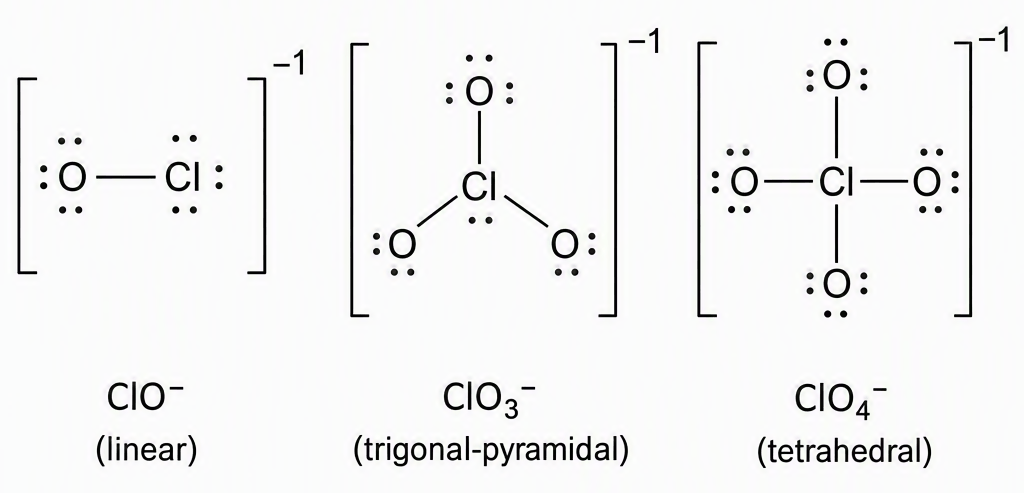
- Hypochlorite: It contains only two atoms and is necessarily linear. Chlorine has three lone pairs, but they cannot create an angle between two different bonds in a diatomic ion.
- Chlorate: Three chlorine–oxygen bonding regions and one chlorine lone pair give four electron regions. Its electron-pair geometry is tetrahedral, but its molecular shape is trigonal-pyramidal.
- Perchlorate: Four bonding regions and no central chlorine lone pair give a tetrahedral molecular shape.
Thus, B is correct. It does not claim that chlorate is the only listed ion containing a chlorine lone pair. Counting lone pairs without checking their effect on atom positions answers a different question.
Why does option C fail when both ions disproportionate?
The complete product sets differ, even though both contain chloride. Disproportionation means oxidation and reduction of the same element from one initial oxidation state. The official solution gives this reaction for hypochlorite:
Each side contains three chlorine atoms and three oxygen atoms. The total charge on each side is negative three.
The official chlorate reaction is:
Each side contains four chlorine atoms and twelve oxygen atoms. The total charge on each side is negative four.
Chlorine’s oxidation states are:
In each reaction, some chlorine is reduced to chloride while the rest is oxidised. Compare every product:
One shared ion does not make the sets identical. C is incorrect; recognising the reaction type alone cannot establish identical products.
How does hypochlorite oxidise sulfite in option D?
Hypochlorite converts sulfite to sulfate and is itself reduced to chloride. Track sulfur and chlorine separately to identify electron loss and gain.
Calculate sulfur’s oxidation number using oxygen’s usual value:
For chlorine in hypochlorite:
Chlorine ends as chloride, so its change is:
Sulfur loses two electrons, while chlorine gains two electrons. Hypochlorite is therefore the oxidising agent, even though it is itself reduced.
Both sides contain one chlorine atom, one sulfur atom and four oxygen atoms. Each side has total charge negative three, so atoms and charge balance.
D is correct. Final answer: A, B and D.
A correct; B correct; C incorrect; D correct.
What reasoning mistake leads to choosing C?
Checking only the shared reduction product ignores the oxidation product. The faulty inference is: both ions disproportionate and both form chloride, therefore their products must be identical.
Hypochlorite’s oxidation product is chlorate. Chlorate’s oxidation product is perchlorate, so the complete collections differ despite their shared chloride ion.
Repair the method in this order:
- Write both balanced equations.
- List every product species.
- Test the option’s exact wording.
Here, “identical set” requires all product species to match, not just one. A shared product is not enough to accept the claim.
Which three practice questions test the same method?
These original related practice questions, not additional verified PYQs, test conjugate-base strength, molecular shape and electron balance. Attempt each before reading its worked check.
Does the strongest chlorine oxoacid also give the strongest conjugate base?
No. If perchloric acid is strongest among hypochlorous, chloric and perchloric acids, perchlorate is their weakest conjugate base:
Stronger acids release protons more readily; their conjugate bases have less tendency to accept them. Reverse acid strength, not conjugate-base stability.
Which ion has tetrahedral electron-pair geometry but a different molecular shape?
Chlorate, among hypochlorite, chlorate and perchlorate, meets both conditions. Count its regions:
Its electron-pair geometry is tetrahedral. Its molecular shape is trigonal-pyramidal, because shape names include atoms but exclude lone-pair positions.
What is the reduced-to-oxidised chlorine-atom ratio in chlorate disproportionation?
One chlorine atom is reduced for every three oxidised. Check the electrons transferred per chlorine atom:
Thus:
Cover the equation and rebuild its coefficients from electron balance before checking atoms and charge.
Next step: photograph a doubt on JEEnius and photograph any question you are stuck on and get a step-by-step solution, with a free-body diagram when the question needs one (20 free).
Related on JEEnius: Refraction and Lenses JEE 2013: Glass-Plate Solution.
Frequently asked questions
What is the answer to the JEE 2020 hypochlorite, chlorate and perchlorate question?
A, B and D are correct; C is incorrect. The question is from JEE Advanced 2020, Paper 2, Chemistry, not JEE Main.
Why is hypochlorite a stronger base than chlorate and perchlorate?
Hypochlorite has the weakest conjugate acid of the three: hypochlorous acid. Acid strength increases from hypochlorous to chloric to perchloric acid, so conjugate-base strength follows the reverse order: hypochlorite > chlorate > perchlorate.
Why is only chlorate's molecular shape influenced by a chlorine lone pair?
Chlorate has three bonding regions and one chlorine lone pair, giving it a trigonal-pyramidal molecular shape. Hypochlorite has chlorine lone pairs but is necessarily linear because it contains only two atoms. Perchlorate has no central chlorine lone pair and is tetrahedral.
Why is option C incorrect in the JEE 2020 chlorine oxoanion question?
Hypochlorite disproportionates into chloride and chlorate, whereas chlorate disproportionates into chloride and perchlorate. Both reactions produce chloride, but their complete product sets differ. A shared reduction product does not make the sets identical.
How does hypochlorite oxidise sulfite?
Hypochlorite converts sulfite to sulfate while being reduced to chloride. Sulfur's oxidation state rises from +4 to +6, while chlorine's falls from +1 to -1. Sulfur loses two electrons and chlorine gains two, making hypochlorite the oxidising agent.