
What is the matching answer for Three Dimensional Geometry JEE 2009?
The Three Dimensional Geometry JEE 2009 matching key is A–q,s; B–p,r,s,t; C–t; D–r. The volume row describes a parallelepiped formed by three edge vectors drawn from a common vertex, so its volume comes from their scalar triple product.
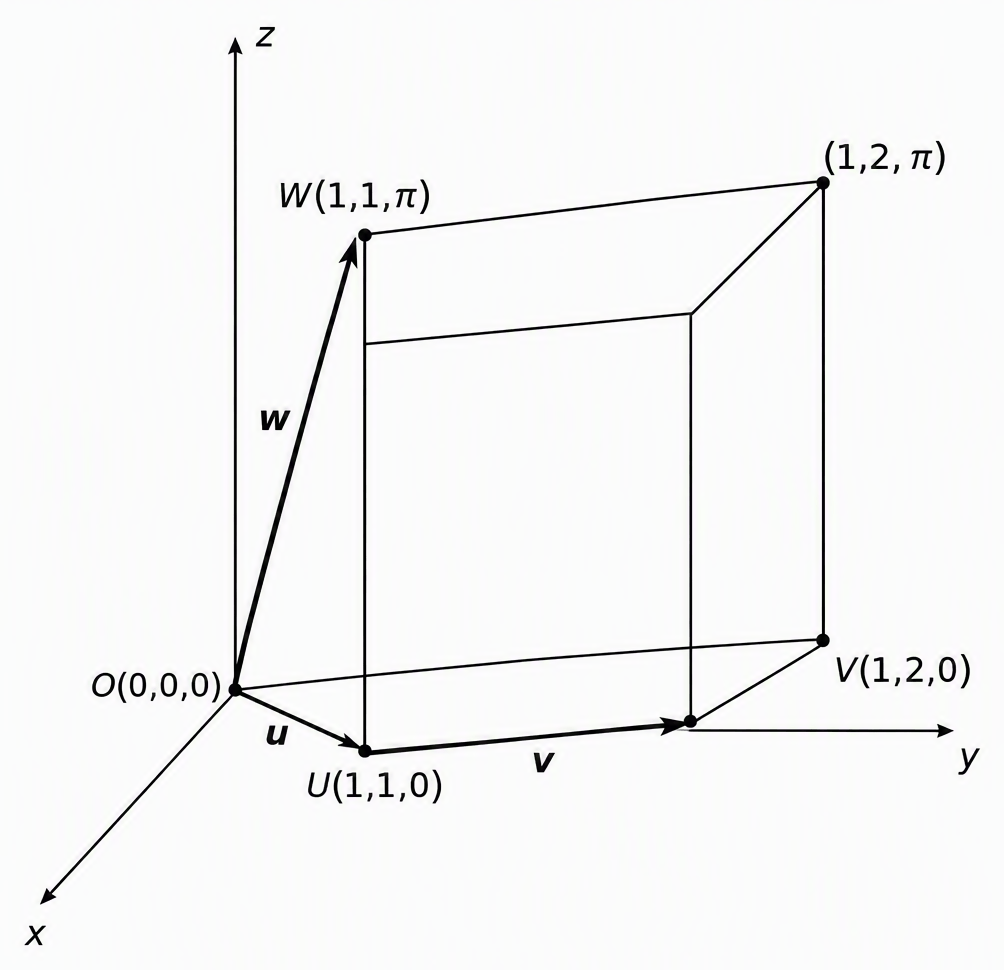
This is a JEE 2009 Paper 2, Mathematics, matrix-match question, classified under Three Dimensional Geometry. Its four rows also test trigonometry and continuity.
Match each statement with every suitable candidate value:
- A: Select the listed angles satisfying
- B: Select the listed discontinuities of
Floor means the greatest integer not exceeding its argument. Cosine uses radians and acts on the second floor value.
- C: Find the parallelepiped’s volume for the edge vectors
- D: Find the angle between the first two unit vectors when
The candidate key is:
- p:
- q:
- r:
- s:
- t:
A row can match multiple values, and a value can serve multiple rows. Check each pairing independently.
Which listed angles satisfy row A?
Only q and s work among the supplied values. The official substitution method reduces the equation to a quadratic in sine squared.
Use the double-angle identity and substitution:
Then:
Compare all five candidates:
- p, reject:
- q, include:
- r, reject:
- s, include:
- t, reject:
Therefore, A–q,s. These are the matches among the supplied values, not the equation’s only roots over all real angles.
Where is the floor-function product discontinuous in row B?
The product is discontinuous at p, r, s and t, but continuous at q. Floor boundaries identify possible jumps; the product’s actual one-sided limits must still be compared.
The possible jump locations satisfy:
Each ordered pair below records the first and second floor values. The arrows run from immediately left to immediately right.
- p, include: Floor pairs change from
The left-hand limit and right-hand limit/value are
- q, exclude: Both floors stay fixed in a neighbourhood:
- r, include: The limits are close, but unequal:
- s, include: Only the first floor changes:
The limits differ because
- t, include: Both floors change:
At every candidate, the function value equals the right-hand limit: each floor is right-continuous, and so is their stated product. The unequal one-sided limits establish B–p,r,s,t.
How do I calculate the parallelepiped’s volume in row C?
The volume matches t. Use the three pictured edges from the common vertex as the determinant rows, following the official scalar-triple-product method.
Expand down the third column:
The absolute value converts the signed scalar triple product into non-negative volume, giving C–t. For optional determinant practice, use Matrices and Determinants JEE 2010: Worked Solution.
How do I find the angle between the unit vectors in row D?
The angle matches r. Rearrange the relation, take magnitudes and square to expose the dot product without finding vector components.
Squaring and expanding gives:
Using the unit magnitudes:
For the angle between vectors:
Thus D–r. The complete matching key is:
- A–q,s
- B–p,r,s,t
- C–t
- D–r
Why does rounding wrongly add q to row B?
Nearest-integer rounding changes at half-integers; floor does not. Confusing these operations falsely suggests the incorrect row-value pairing B–q.
At q:
Nearest-integer rounding changes across this half-integer. The actual floor stays fixed, as does the second floor, throughout this interval:
This constant interval contains q in its interior, proving continuity there. Repair the method: locate integer arguments, not half-integers, then check whether the full expression actually changes.
Which two related questions should I solve next?
Practise changing the third edge and the vector coefficient. Both exercises below are original related practice, not additional JEE past-paper questions.
- Question 1: For these edges, find the volume in terms of the real parameter and the condition for coplanarity:
The same determinant expansion gives:
- Question 2: Three unit vectors satisfy the relation below. Find the angle between the first two.
Taking magnitudes and squaring gives:
Cover both answers and reproduce the determinant expansion and magnitude-squaring steps before checking your result.
Next step: the past-paper archive on JEEnius and search every JEE Main paper from 2002 and every Advanced paper from 2007, by year, subject or chapter, each with a worked solution (free).
Frequently asked questions
What is the matching answer for Three Dimensional Geometry JEE 2009?
The matching key is A–q,s; B–p,r,s,t; C–t; D–r. The candidate values are p = π/6, q = π/4, r = π/3, s = π/2 and t = π. Each row can match more than one value.
Why does q not match row B in the JEE 2009 question?
At q = π/4, the function f(x) = ⌊6x/π⌋ cos(⌊3x/π⌋) is continuous because both floor values remain fixed nearby. Throughout π/6 ≤ x < π/3, they equal 1 and 0 respectively, so f(x) = 1. Nearest-integer rounding would incorrectly introduce a jump at π/4; the floor function does not.
How do I calculate the parallelepiped volume in row C?
For the common-vertex edges (1,1,0), (1,2,0) and (1,1,π), take the absolute value of their scalar triple product. Expanding the determinant down the third column gives V = |π(2 − 1)| = π. Therefore, row C matches t.
How do I find the angle between the unit vectors in row D?
From a + b + √3c = 0 with all three vectors of unit magnitude, obtain |a + b|² = 3. Expanding gives 1 + 1 + 2a·b = 3, so cos θ = a·b = 1/2. The angle is π/3, and row D matches r.