
What does the vector addition JEE 2004 question give?
Maximum resultant means forces pointing in the same direction, not equal forces. The vector addition JEE 2004 question leads to option 3 by using both the maximum-resultant and perpendicular-resultant conditions.
Two forces act at one point. Their greatest possible resultant is 4 N; when those same forces act at right angles, their resultant is 3 N. Find their magnitudes, keeping both magnitudes unchanged between arrangements: only the relative direction changes.
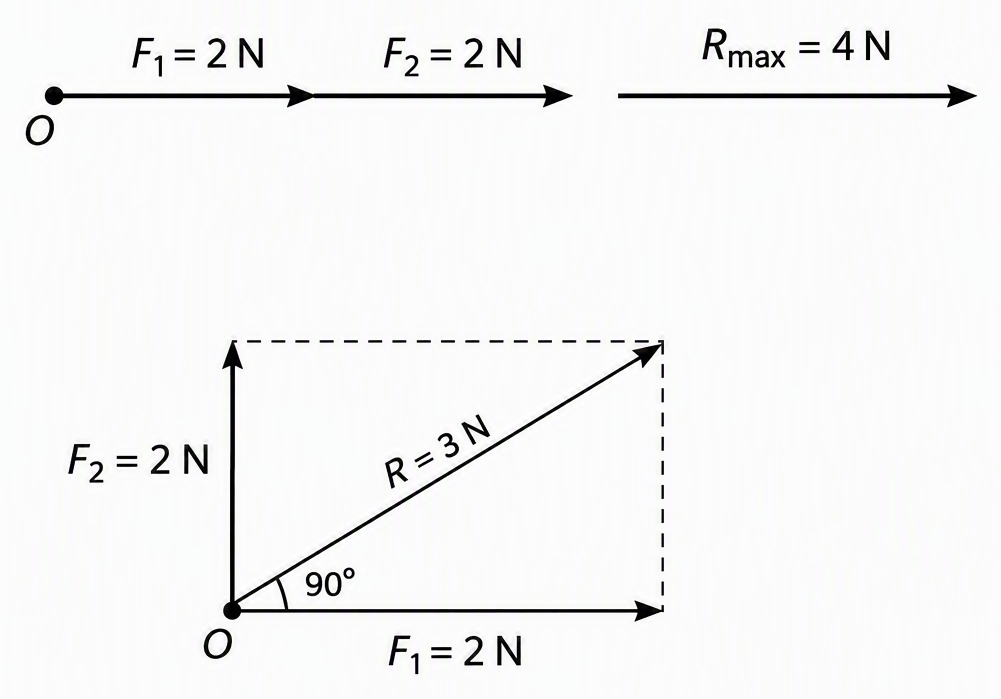
Here, “maximum effect” means maximum resultant magnitude. It does not ask for maximum work or acceleration.
How do the two arrangements become equations?
The aligned arrangement gives the sum of the magnitudes; the perpendicular arrangement gives their sum of squares. These are two simultaneous constraints on the same pair, not two separate force pairs.
Let the following symbols denote the numerical values of the positive force magnitudes in newtons:
Units are restored when stating the answer. The greatest resultant occurs when both forces act along the same line in the same direction, so their magnitudes add directly:
When the forces are perpendicular, the resultant is the diagonal of their vector-addition rectangle. Pythagoras gives its numerical magnitude:
Substitute the given perpendicular resultant:
Squaring both sides gives:
Both sides of the square-root equation are non-negative, so this step is valid. Neither condition alone determines both forces.
How do you find the product and solve the quadratic?
The product is seven-halves, and the known sum and product determine a quadratic whose roots are the two magnitudes. The official method extracts the product first, then solves for the forces.
Start with the square-of-a-sum identity:
The known sum is 4, while the known sum of squares is 9. Substituting both values gives:
Therefore:
Now form a polynomial with the two force magnitudes as its roots. Either magnitude makes one factor zero:
Expanding explains why the coefficient of the linear term is the negative sum and the constant term is the product:
Insert the values just obtained:
Apply the quadratic formula without dropping the denominator during simplification:
Restoring units, the force magnitudes are:
The two roots give one unordered pair, not two competing answers. This pair matches option 3 in the supplied official answer.
How can you check the answer against both resultants?
The pair passes both tests: its sum is 4 N, and its perpendicular resultant is 3 N. Checking only the maximum resultant is not enough, because many positive force pairs share the same sum.
First, check the numerical sum:
For the perpendicular check, set:
Then:
Hence:
Both magnitudes are positive. Swapping their labels changes neither their sum nor their sum of squares, so either ordering is valid.
Why does assuming equal forces give the wrong answer?
Maximum resultant fixes the relative direction, not equality of magnitudes. Assuming equal forces adds a condition that the question never supplies.
The unjustified step is:
Combining it with the known sum gives:
But the perpendicular resultant of two 2 N forces is:
The error is treating an angle change as a magnitude condition. The magnitudes remain fixed; aligning the forces in the same direction maximizes their resultant.
The supplied option texts are absent, so 2 N and 2 N is only a demonstrably wrong result, not an identified distractor. Use both conditions before solving for either force.
What related vector-addition questions should you practise?
Practise opposite directions, a specified intermediate angle, and a new maximum-and-perpendicular pair. The following are original related practice questions from vector addition within Kinematics, not additional verified PYQs.
What is the minimum resultant of the force pair just found?
The minimum is the difference of the magnitudes, obtained when the forces act in opposite directions. Their contributions then subtract, and the resultant magnitude must remain non-negative:
What is the resultant when the same forces make a 60-degree angle?
The resultant magnitude is:
Use the general resultant formula and reuse the sum of squares and product already found. There is no need to square both radical expressions again:
Taking the positive square root gives the answer above. It exceeds the perpendicular resultant but remains below the maximum, consistent with an acute angle.
What forces give a 10 N maximum and a perpendicular resultant of square root 58 newtons?
The magnitudes are 7 N and 3 N. To derive them, repeat the same sum–product–quadratic method, using numerical magnitudes in newtons:
Square the sum and isolate the product:
Build and factor the quadratic:
Therefore:
Cover the worked answers and solve these three again. Before accepting each result, check it against every condition in its question.
Next step: the past-paper archive on JEEnius and search every JEE Main paper from 2002 and every Advanced paper from 2007, by year, subject or chapter, each with a worked solution (free).
Related on JEEnius: Limit, Continuity and Differentiability JEE 2010: Integral PYQ.
Frequently asked questions
How do you solve the vector addition JEE 2004 question?
Using numerical force magnitudes in newtons, the two conditions give F₁ + F₂ = 4 and F₁² + F₂² = 9. These imply F₁F₂ = 7/2, so either magnitude satisfies x² − 4x + 7/2 = 0. The forces are (2 + √2/2) N and (2 − √2/2) N, matching option 3 in the supplied official answer.
Does maximum resultant mean the two forces are equal?
No. For fixed magnitudes, the maximum resultant occurs when both forces point in the same direction; their magnitudes need not be equal. Two forces of 2 N each would give a 4 N maximum but a perpendicular resultant of 2√2 N, not the required 3 N.
What is the minimum resultant of the forces in the JEE 2004 question?
The minimum resultant is √2 N and occurs when the forces point in opposite directions. Subtracting the smaller magnitude, (2 − √2/2) N, from the larger, (2 + √2/2) N, gives √2 N.
What is the resultant when these two forces act at 60 degrees?
For the force pair with a 4 N maximum and a 3 N perpendicular resultant, the resultant at 60 degrees is 5/√2 N. Using numerical magnitudes in newtons, R² = F₁² + F₂² + 2F₁F₂ cos 60° = 9 + 7/2 = 25/2. This lies between the perpendicular resultant of 3 N and the maximum of 4 N.