
What is the chemical kinetics JEE 2019 pressure-data question?
The correct numerical entry for this chemical kinetics JEE 2019 problem is 4.6, not 2.30. It comes from JEE Advanced 2019, Paper 2, Chemistry, and is a numerical-answer question, not an MCQ. Total pressure gives the amount of reactant remaining; the first-order law then gives the time.
Initially pure N₂O₅ decomposes in a sealed, rigid cylinder held at constant temperature. Assume ideal gas behaviour, with temperature and volume constant throughout decomposition.
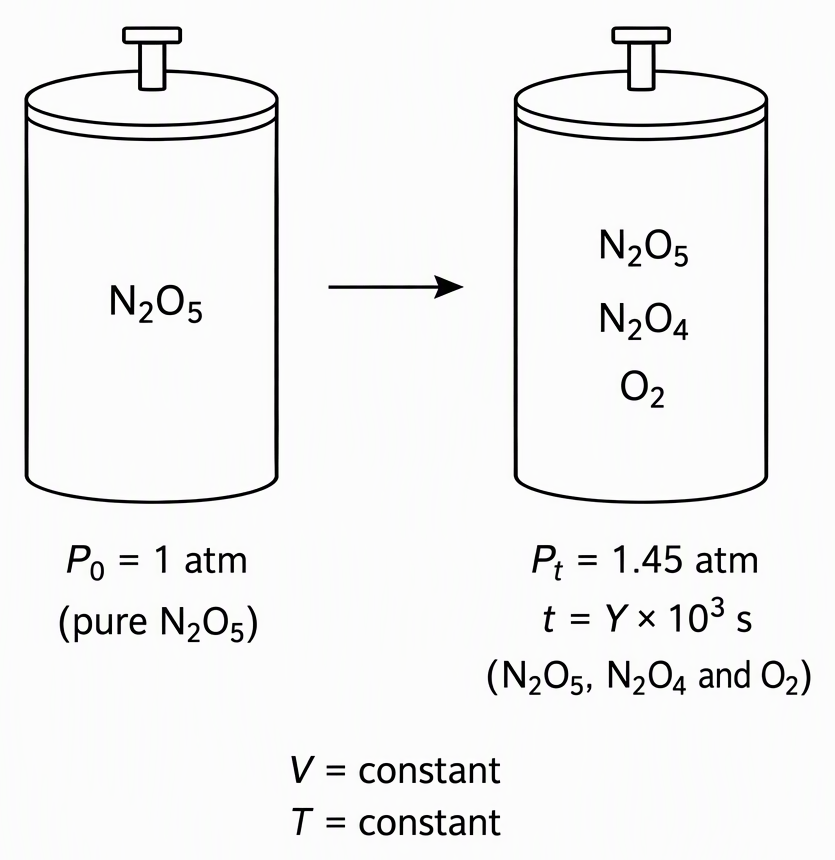
The supplied reaction and measurements are:
Find the dimensionless multiplier:
The question bank classifies this as medium, with an expected solving time of 180 seconds. That is a practice benchmark, not an official exam allowance.
How does the pressure increase reveal how much N₂O₅ remains?
10% of the initial N₂O₅ remains. Start with the ideal gas law: at constant temperature and volume, the pressure ratio equals the ratio of total gas moles. Account for every gas present, not just the reactant.
Define the initial moles of N₂O₅ and the reaction extent, measured in moles, respectively as:
Each mole of reaction extent consumes two moles of N₂O₅ and produces two moles of N₂O₄ and one mole of oxygen. The bookkeeping below lists initial, change, final amounts in that order:
- N₂O₅:
- N₂O₄:
- O₂:
Sum the final amounts, then substitute the pressure data:
The remaining reactant is:
Thus, 90% has decomposed and 10% remains. The extent is not the amount of N₂O₅ consumed; the coefficient two converts extent into reactant consumption.
Total pressure rises because the number of gas moles increases. The measured 1.45 atm is not the partial pressure of the remaining reactant. Using it as reactant pressure would give the wrong concentration ratio in the rate law.
How do you apply the first-order law to calculate Y?
Use the supplied constant directly in the N₂O₅ disappearance-rate law, as the official solution does. At constant volume, the concentration ratio is ten. This gives about 4605 seconds, but the requested entry is the dimensionless multiplier of one thousand seconds.
Writing the reactant temporarily as A, separate variables and integrate from the initial state to the measurement time:
Use the natural logarithm and substitute the given constant:
The supplied final answer is:
Do not enter 4605. The elapsed time carries seconds; the requested numerical entry does not.
As a pressure check, the partial pressures of remaining N₂O₅, N₂O₄ and oxygen are, respectively:
Why does an extra factor of two give the wrong answer, 2.30?
The extra factor changes the definition of the supplied rate constant. Since this question has a numerical entry, 2.30 is an incorrect result to diagnose, not a listed option. This error comes from replacing the disappearance-rate law with a different rate definition while keeping the same numerical constant.
The incorrect substitution for this supplied constant is:
This doubles the effective disappearance constant and halves the calculated time:
Stoichiometrically normalised reaction rates are valid definitions. But the same numerical rate constant cannot be transferred unchanged between that definition and the disappearance-rate law used in the official solution. For the same concentration decay, the normalised-rate constant would be half the disappearance constant.
The coefficient two belongs in the extent bookkeeping. It does not independently justify doubling the given first-order disappearance constant. Use the rate constant with the rate definition to which it belongs.
How to Study Chemical Kinetics JEE: Laws and Practice
How do you solve two related pressure questions using this method?
Find the reaction extent first, then calculate total pressure and use the first-order law if time is needed. These are original follow-up practice based on the solved question, not additional verified PYQs. Both retain the same reaction, initially pure N₂O₅ at 1 atm, constant temperature and volume, ideal gas behaviour, and supplied rate constant.
Question 1: Find the total pressure and elapsed time when half the initial N₂O₅ remains.
Half remaining fixes the extent. Use it to calculate pressure, then apply the first-order half-life:
Question 2: Find the limiting total pressure as decomposition approaches completion. Is that limit reached at a finite time?
Pressure approaches 1.50 atm but never reaches it at finite time in this model. The limiting extent gives:
The remaining concentration stays positive at every finite time:
Exact completion is an asymptotic limit. Before accepting a pressure calculation for this setup, check that it satisfies this range at finite, non-negative times:
Next step: the past-paper archive on JEEnius and search every JEE Main paper from 2002 and every Advanced paper from 2007, by year, subject or chapter, each with a worked solution (free).
Frequently asked questions
What is the answer to the chemical kinetics JEE 2019 pressure question?
The numerical entry is Y = 4.6 for the JEE Advanced 2019 Paper 2 N₂O₅ decomposition question. The elapsed time is approximately 4605 seconds, but the question asks for Y in t = Y × 10³ seconds.
How do you find the N₂O₅ remaining from total pressure?
At constant temperature and volume, total pressure is proportional to total gas moles. For 2N₂O₅ → 2N₂O₄ + O₂, the pressure increase from 1 atm to 1.45 atm gives a reaction extent of 0.45 times the initial N₂O₅ moles. Twice that amount is consumed, so 10% of the initial N₂O₅ remains.
Why is 2.30 wrong in the JEE 2019 kinetics question?
The result 2.30 comes from inserting an extra factor of two into the disappearance-rate law while retaining the supplied numerical rate constant. Here, use −d[N₂O₅]/dt = k[N₂O₅] with k = 5 × 10⁻⁴ s⁻¹. A stoichiometrically normalised rate is valid, but its rate constant must be adjusted consistently.
What is the maximum total pressure in this N₂O₅ decomposition?
For initially pure N₂O₅ at 1 atm, the total pressure approaches 1.50 atm at constant temperature and volume. It does not reach that limit at any finite time under the first-order model, because some N₂O₅ always remains.