
What is the Laws of Motion JEE 2025 elevator weighing question?
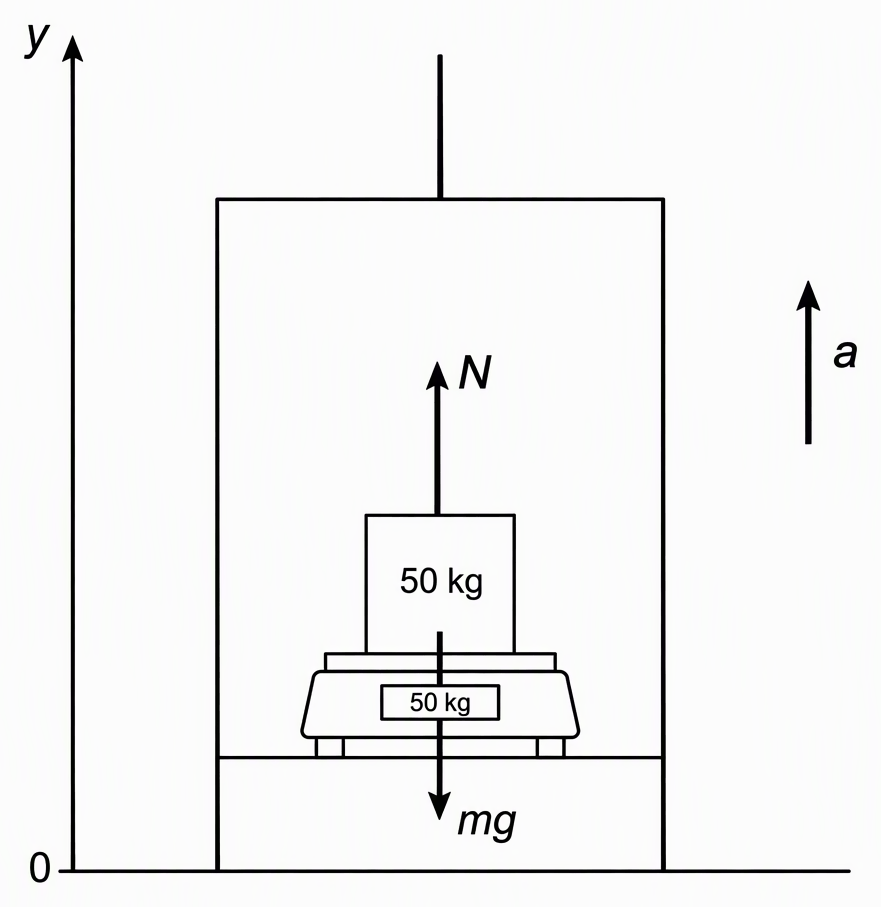
In this laws of motion jee 2025 question, the greatest and least scale readings differ by 2.00 N, not 1 N. An observer inside a vertically moving elevator uses a weighing machine to measure the apparent weight of a 50 kg object as the elevator’s height changes periodically.
The elevator’s height above the ground is:
Find the difference between the greatest and least apparent weights recorded during the motion, in newtons. The machine measures the normal force on the object, not gravity itself.
The source is JEE Advanced 2025, Paper 1, Physics. This is a numerical-answer question, with no answer options. The question bank labels it medium on its own difficulty scale, not an official exam classification, and gives an expected solving time of 90 seconds.
How do you differentiate the height to find elevator acceleration?
Differentiate the height twice to obtain acceleration. Its maximum magnitude is one-fiftieth of a metre per second squared, with equal upward and downward extremes. Keep the angular-frequency factor in both derivatives: dropping either factor changes the numerical answer.
First, define the angular frequency:
Rewrite the height, then differentiate once for velocity:
Differentiate again for acceleration:
The constant height offset has zero derivative. Each differentiation of the trigonometric term introduces a factor of angular frequency through the chain rule; the second differentiation also introduces the minus sign.
Since sine stays between minus one and plus one:
Here, the subscript “max” means maximum magnitude, not a permanently upward acceleration. With upward taken as positive, the signed acceleration ranges over:
How does elevator acceleration change the scale reading?
Upward acceleration raises the reading; downward acceleration lowers it. The weighing machine measures the normal reaction on the object, while gravitational force stays unchanged. The contact force changes so that the object shares the elevator’s acceleration.
Using the forces shown in the figure, with upward positive, Newton’s second law gives:
Maximum upward acceleration produces the greatest reading. Maximum downward acceleration produces the least reading:
The ordinary gravitational weight is:
Substitute the two acceleration extremes:
Moving upward is not the same as accelerating upward. A rising elevator that is slowing down has downward acceleration, so its scale reading is below ordinary weight. Choose the sign from acceleration, not from the cabin’s direction of travel.
How do you calculate the maximum variation in apparent weight?
Subtract the least reading from the greatest reading. The requested variation is the full maximum-to-minimum difference, not just the change from ordinary weight.
Expanding the official calculation shows why both acceleration terms add:
Cross-check using the readings already calculated:
The final numerical answer is 2.00 N. Gravity sets the 500 N baseline, but that same baseline appears in both extremes and cancels when they are subtracted.
Why is 1 N wrong if the weight changes by 1 N?
1 N is a wrong numerical result for the requested full variation, although it is the correct greatest departure from ordinary weight. The incomplete calculation stops at the amplitude of the change instead of finding the complete range.
That calculation measures the distance from the 500 N baseline to either extreme. It does not measure the distance between the extremes:
- 500 to 501 N: a 1 N increase from the baseline.
- 499 to 501 N: a 2 N change from minimum to maximum.
Whenever a question asks for the full variation, write both extreme readings before subtracting. Use the baseline only if the question asks for the greatest departure from ordinary weight.
What does the scale read at the highest position and at 8 m?
The scale reads 499 N at the highest position and 500 N at both crossings of 8 m. The following are original follow-up practice questions based on the supplied setup, not additional JEE 2025 PYQs. Both use the same elevator and the force diagram above.
What does the scale read at the elevator’s highest position?
The reading is 499 N because acceleration is downward at the highest position. Substitute the sine value at maximum height into the acceleration expression:
The elevator’s instantaneous velocity is zero at this turning point. Zero velocity does not imply zero acceleration: the cabin accelerates downward as it reverses its upward motion.
Does the reading differ at 8 m while moving upward and downward?
The reading is 500 N at both crossings because acceleration is zero there. Substituting the height gives:
The velocity directions are opposite, but the scale readings are identical. For your next elevator problem, mark the acceleration direction first, then write Newton’s second law.
Next step: photograph a doubt on JEEnius and photograph any question you are stuck on and get a step-by-step solution, with a free-body diagram when the question needs one (20 free).
Keep going with How to Study Chemical Kinetics JEE: Laws and Practice.
Frequently asked questions
What is the answer to the JEE Advanced 2025 elevator weighing question?
The difference between the greatest and least apparent weights is 2.00 N. For the 50 kg object, the maximum acceleration magnitude is 1/50 m/s², giving scale readings of 501 N and 499 N.
Why is the apparent weight variation 2 N and not 1 N?
The 1 N value is the greatest departure from the ordinary weight of 500 N. The question asks for the full maximum-to-minimum difference, which is 501 − 499 = 2 N.
Does a weighing machine read more when an elevator moves upward?
The reading depends on acceleration, not the direction of motion. With upward positive, the normal force is N = m(g + a). An elevator moving upward while slowing down has downward acceleration, so the reading is below the ordinary weight.
What does the scale read at the elevator's highest point?
In the article's elevator setup, the scale reads 499 N at the highest point because acceleration is downward at 1/50 m/s². The instantaneous velocity is zero there, but the acceleration is not.