
What is the answer to the Wave Optics JEE 2025 single-slit question?
The absolute error is 75.6 μm in this Wave Optics JEE 2025 numerical from JEE Advanced 2025, Paper 1, Physics. It is a numerical-answer question, not an MCQ. The question bank tags it medium difficulty and supplies a practice-time benchmark of 180 seconds, neither an official difficulty classification nor an exam time limit.
A single-slit diffraction experiment determines the slit width using a selected diffraction maximum. The slit faces a parallel screen, with the slit-to-screen distance measured perpendicular to it. The selected maximum lies away from the central maximum along the screen.
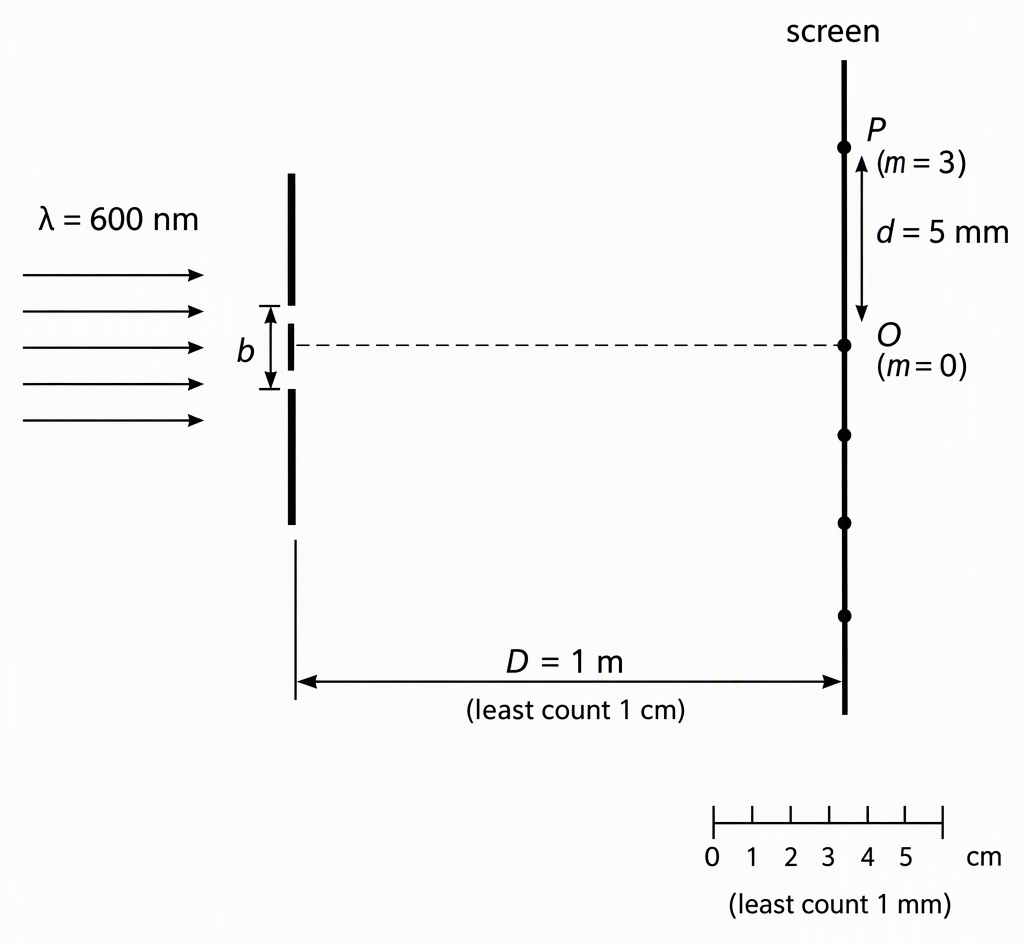
The question supplies the following relation. The order and wavelength are known precisely.
The measured distances and respective scale least counts are given below. Find the absolute error in the estimated slit width, in μm.
How do you calculate the slit width before finding its error?
The nominal slit width is 360 μm. Calculate it separately from the uncertainty: the measured distances determine the nominal width, while their least counts determine its uncertainty.
Use the relation supplied in the question. Rearrange it to isolate the slit width:
Do not replace it with another diffraction-extremum formula. This supplied relation is the model for this numerical, not a universal exact condition for secondary maxima.
Convert the wavelength and screen displacement into metres. Then substitute the nominal values, without including the least counts:
Convert metres to micrometres using:
This is the slit width, not its absolute error. The next step finds the fractional uncertainty to multiply it by.
Why do the relative errors add for a quotient?
The first-order maximum relative error is 21%, because the two fractional uncertainty magnitudes add. Follow the official solution’s convention: take each measurement error equal to its scale’s stated least count, without halving it. The order and wavelength contribute no uncertainty because the question specifies that they are precise.
For the supplied dependence, use the first-order maximum-error rule below. Here, the uncertainties represent magnitudes, not signed changes.
A signed first-order change does contain a minus sign. But an increase in the numerator and a decrease in the denominator both increase the width, so maximum error adds magnitudes.
The slit-to-screen distance contributes 1%. The displacement along the screen contributes 20%.
Add these fractional errors. Use the prescribed first-order maximum-error method, not root-sum-square propagation or exact endpoint bounds.
How does the absolute error become 75.6 μm?
Multiply the nominal slit width by the fractional error, not by the percentage number 21. Since the width is in micrometres, the absolute error is also in micrometres.
Keep the three quantities distinct:
- Slit width: 360 μm.
- Relative error: 21%.
- Absolute error: 75.6 μm.
The slit-to-screen measurement contributes 3.6 μm; the screen-displacement measurement contributes 72 μm. Their sum checks the result:
The screen displacement dominates because its relative uncertainty is twenty times larger, despite its smaller absolute least count. Enter 75.6 when the answer field already supplies μm.
Why is subtracting the errors to get 68.4 μm wrong?
68.4 μm is wrong because uncertainty bounds are not known signed changes. The supplied question is numerical-answer and has no listed options, so this is an incorrect calculation, not an official distractor.
The faulty reasoning subtracts the fractional errors because the screen displacement is in the denominator. It then multiplies the resulting magnitude by the nominal width:
That calculation assigns both measurements positive changes. Yet the least counts give the sizes of the uncertainties, not their signs.
For the adverse-sign case, let the slit-to-screen distance increase fractionally by 0.01 while the screen displacement decreases fractionally by 0.20. The signed first-order change becomes:
Both changes push the inferred width upwards. For the prescribed first-order maximum-error calculation in a product or quotient, add the magnitudes of the relevant fractional errors.
Can you solve two related Wave Optics checks using the same method?
The two absolute errors are 10.8 μm and 39.6 μm, respectively. These are original checks built from the Wave Optics JEE 2025 setup, not additional verified PYQs. Both retain the supplied relation and the same first-order error convention.
Question 1: Keep all nominal values and the slit-to-screen measuring scale unchanged, but hypothetically improve the screen-displacement scale’s least count to 0.1 mm. Find the new absolute error in slit width.
The nominal width remains unchanged because none of the measured values changes. Only the fractional uncertainty from the screen displacement decreases:
Question 2: Keep the slit width, slit-to-screen distance and order fixed. Hypothetically double the precisely known wavelength from 600 nm to 1200 nm, and find the new screen displacement and inferred absolute error using the original least counts.
Under the supplied relation, the displacement doubles from 5 mm to 10 mm. The nominal slit width remains unchanged:
Question 1 tests that better precision changes uncertainty, not nominal width. Question 2 tests that a larger screen displacement reduces fractional uncertainty when the least count stays unchanged. Before calculating either check, identify what changes: the nominal value, the least count, or both.
Next step: the past-paper archive on JEEnius and search every JEE Main paper from 2002 and every Advanced paper from 2007, by year, subject or chapter, each with a worked solution (free).
Keep going with How to Study Chemical Bonding JEE: A Step-by-Step Plan.
Frequently asked questions
What is the answer to the Wave Optics JEE 2025 single-slit question?
The absolute error in the slit width is 75.6 μm. The nominal width is 360 μm, and the first-order maximum relative error is 21%, giving 360 × 0.21 = 75.6 μm. Enter 75.6 when the numerical-answer field already supplies μm.
How do you calculate the slit width in the JEE Advanced 2025 question?
Use the supplied relation bd/D = mλ, which gives b = mλD/d. Substituting m = 3, λ = 600 × 10⁻⁹ m, D = 1 m and d = 5 × 10⁻³ m gives b = 360 μm. This is the nominal slit width, not its absolute error.
Why do relative errors add when slit width depends on D/d?
The prescribed first-order maximum-error method adds uncertainty magnitudes: Δb/b = ΔD/D + Δd/d. An increase in D and a decrease in d both increase the inferred width, so their effects reinforce each other. Here, 1% + 20% gives 21%; subtracting them to obtain an absolute error of 68.4 μm is incorrect.
Should I use the least count or half the least count in this question?
For this numerical, follow the official solution’s convention and take each measurement error equal to the stated least count, without halving it. Use ΔD = 1 cm and Δd = 1 mm. The order and wavelength contribute no uncertainty because the question specifies that they are known precisely.