
What is the correct option for coordinate geometry JEE 2008?
Option D is correct: the three points are not collinear. This coordinate geometry JEE 2008 question is from Paper 2, Mathematics. The question bank classifies it as hard and lists an expected solve time of 180 seconds. That is the bank’s target, not a measured student average.
The task gives three points through trigonometric coordinates, with each angle subject to the strict bounds below. Decide whether one point belongs to the segment joining the other two, or whether no single line contains all three.
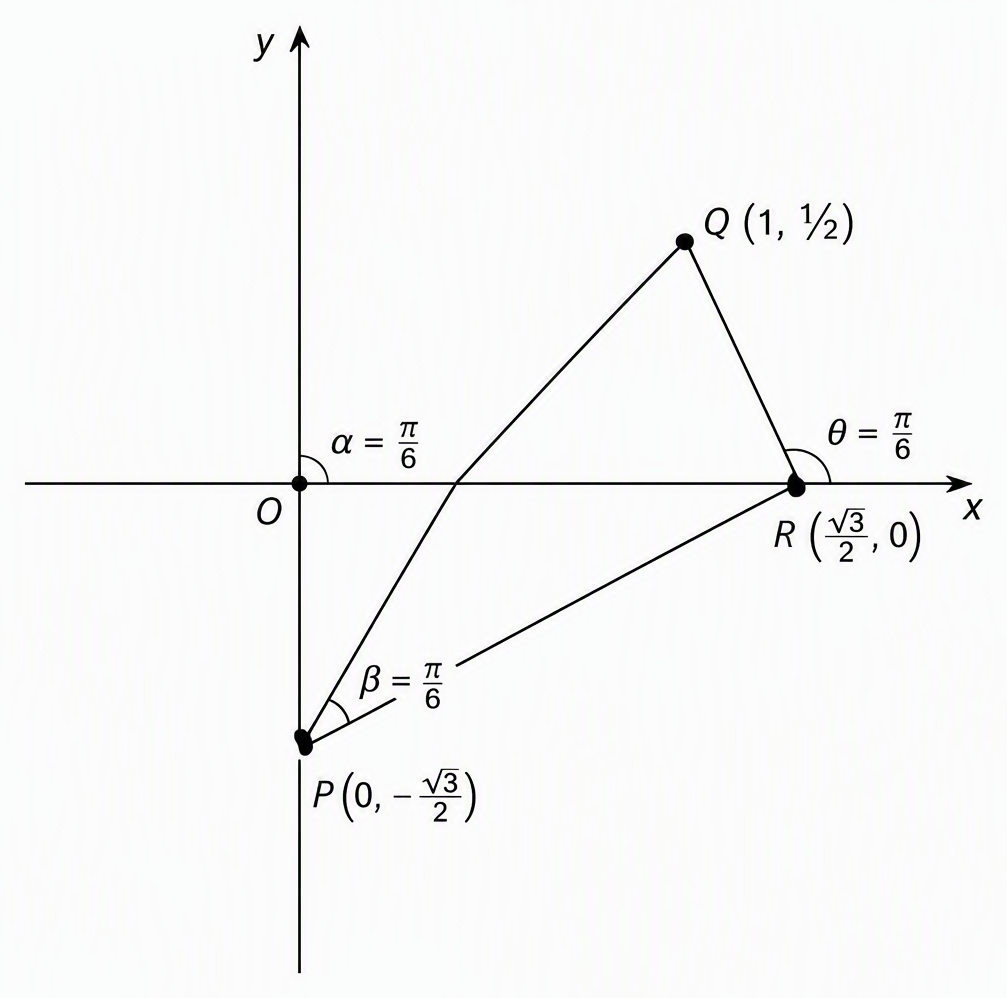
Options A, B and C require collinearity first. Ordering points along a segment matters only after that condition holds. Coordinate bounds alone cannot establish segment membership.
How do we compare slopes without dividing by zero?
Both horizontal differences are positive throughout the permitted domain, so comparing slopes is legitimate. Shorten the repeated angle difference, establish the denominators’ signs, then compare cross-products:
The rewritten points and their four coordinate differences are:
The first denominator is positive because its shifted angle lies where cosine is positive:
For the second, split by the sign of the angle difference. Do not assume it is positive.
- Nonnegative case: Both summands are nonnegative, and the cosine is strictly positive:
- Negative case: The following bounds make their sum strictly positive:
Thus both slopes exist. Write them as:
Define the cross-product difference:
The slope difference is this expression divided by the two positive horizontal differences:
This is also the determinant test, with its sign reversed. Either sign gives the same zero test:
Which trigonometric terms cancel in the worked solution?
The first pair reduces by product-to-sum; the remaining pair loses its mixed sine terms. Keep these groups separate so that every cancellation stays visible.
Expanding gives:
For the first pair:
The matching second sine terms cancel. The sine-difference identity then gives:
For the remaining terms, use:
Substitution exposes the cancellation in their combined contribution:
Factoring what remains:
Combining both groups produces:
Why are both factors positive, making D correct?
The angle restrictions make both factors strictly positive, not merely nonnegative. This proves unequal slopes for every permitted choice of angles, which a single numerical example cannot establish.
First, use the separate restrictions on the first two angles:
Adding yields:
For the second factor:
The sine-plus-cosine sum is positive, so its square exceeding one means:
Therefore:
The points are non-collinear. The final answer is option D. No segment-ordering calculation is needed: failure of collinearity eliminates A, B and C together.
Why do coordinate bounds not prove option C?
Checking each coordinate separately only places a point inside a rectangle, not necessarily on its diagonal segment PQ. The faulty inference is that if R’s coordinates each fall between the corresponding coordinates of P and Q, then R must lie on segment PQ.
Use the admissible values already illustrated:
Substitution gives:
Both coordinate-bound checks pass:
Yet the slopes are unequal:
So R is not on segment PQ. Establish collinearity first, then test betweenness. Equivalently, segment membership requires one shared parameter in both coordinates, which separate coordinate bounds do not enforce:
Which three practice questions check these exact skills?
These are original practice questions, not verified past-year questions. They check the cross-product calculation, the rectangle-versus-segment distinction and the role of a strict angle restriction. Attempt each before reading its worked check.
- Find the unknown coordinate for collinearity.
The horizontal and vertical differences from U give:
- Does W belong to the segment joining U and V?
Both coordinates lie between the endpoint coordinates, but the cross-product expression is nonzero:
The answer is no: W is not even on the line through U and V.
- What changes if the third angle may equal zero?
Keep the original restrictions on the other two angles. At the newly allowed boundary:
The strict non-collinearity conclusion fails because two points coincide. When a proof uses strict positivity, check the excluded boundary before extending its conclusion.
Next step: photograph a doubt on JEEnius and photograph any question you are stuck on and get a step-by-step solution, with a free-body diagram when the question needs one (20 free).
Related on JEEnius: D- and f-block Elements JEE 2025: Magnetic Moments.
Frequently asked questions
What is the correct option for the coordinate geometry JEE 2008 question?
Option D is correct: no line contains all three points. Under the given restrictions 0 < α, β, θ < π/4, the proof establishes m_PQ > m_PR. This rules out collinearity and eliminates all three segment-membership options.
Why do coordinate bounds not prove that R lies on segment PQ?
Separate coordinate bounds place R inside the rectangle determined by P and Q, not necessarily on segment PQ. For α = β = θ = π/6, both coordinate bounds hold, but m_PQ = (1 + √3)/2 while m_PR = 1. Segment membership requires collinearity first, followed by a betweenness check.
How can we compare slopes without dividing by zero?
Set A = β − α and check the horizontal differences before dividing. In this problem, both cos A + sin A and cos(A + θ) + sin A are strictly positive throughout the allowed angle range. Both slopes therefore exist, and their difference has the same sign as the cross-product expression E.
What happens if θ equals zero in this question?
If θ = 0 is allowed while the original restrictions on α and β remain, R coincides with Q and the cross-product expression E becomes zero. The strict non-collinearity conclusion then fails. This is why the excluded boundary cannot be added to the proof's domain.