
What is the answer to the JEE Advanced 2025 manganese magnetic-moment question?
The required sum is 7.73 B.M.: both complexes contain manganese(III), but their unpaired-electron counts differ. This d- and f-block elements JEE 2025 question appeared in JEE Advanced 2025, Paper 2, Chemistry. It is a numerical-answer question, not an MCQ.
Calculate the combined spin-only magnetic moments, expressed in Bohr magnetons, of these two complexes. Calculate each moment separately, then add:
The question bank tags it medium difficulty. Use 120 seconds as a practice benchmark, not an observed solving time.
How do you find manganese’s oxidation state and d-electron count?
Both complexes contain manganese in the +3 oxidation state, leaving four d electrons on the metal ion. Establish that count before deciding whether the ligand causes pairing. Ligand strength controls orbital occupancy, not the oxidation-state calculation.
For the bromide complex, each bromide ion contributes one negative charge. Charge balance gives:
Neutral manganese has the configuration:
To form manganese(III), remove the two 4s electrons first, then one 3d electron:
Coordination number and oxidation state are different quantities. Six ligands give a coordination number of six; they do not make manganese a +6 ion.
Why does the bromide complex have four unpaired electrons?
Bromide is a weak-field ligand, so this octahedral complex is high spin. The fourth d electron enters an upper orbital instead of pairing in a lower one. All four electrons remain unpaired, giving a spin-only magnetic moment of 4.90 B.M.
Octahedral splitting produces a lower set of three orbitals and an upper set of two. Fill these orbitals to count unpaired electrons.
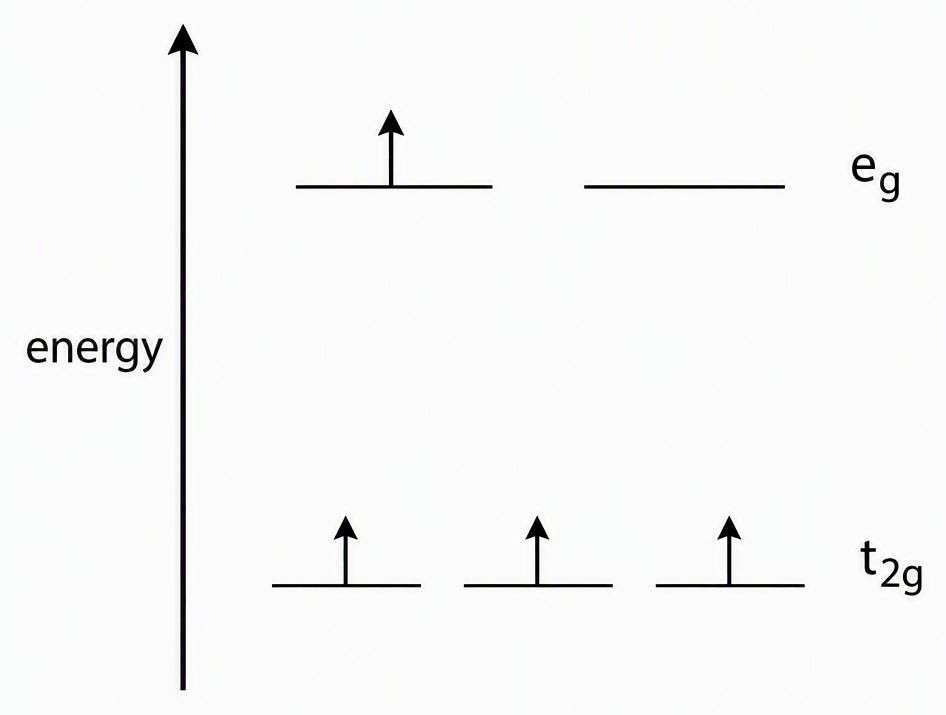
The high-spin filling is:
In the spin-only formula, count unpaired electrons, not total d electrons. Use:
Using the official solution’s rounding:
Why does the cyanide complex still have two unpaired electrons?
Cyanide is a strong-field ligand, so its octahedral complex is low spin. The fourth electron pairs within the lower set rather than entering the upper set. That leaves two unpaired electrons, not zero, so the complex remains paramagnetic.
First repeat charge balance. Each cyanide ion contributes one negative charge:
The metal is again manganese(III):
Changing the ligand has changed neither the oxidation state nor the d-electron count. The three lower orbitals receive one electron each before the fourth electron pairs:
One pair and two single electrons give:
How do the two magnetic moments give 7.73 B.M.?
The question asks for the arithmetic sum of two separately calculated moments. Add the rounded values used in the official solution. Do not add the unpaired-electron counts and substitute that combined count into the formula.
- Bromide: weak field, high spin, four d electrons, four unpaired electrons, 4.90 B.M.
- Cyanide: strong field, low spin, four d electrons, two unpaired electrons, 2.83 B.M.
Final numerical answer: 7.73.
Why is 4.90 B.M. an incorrect result for the sum?
That result comes from incorrectly treating the cyanide complex as diamagnetic and dropping its contribution. This is a low-spin versus diamagnetism error, not an arithmetic error. The supplied question has no answer choices, so this is an incorrect numerical result, not an official distractor.
The faulty reasoning is:
The orbital mistake is placing four electrons like this:
The three lower orbitals are degenerate, meaning equal in energy. Creating a second pair while one equal-energy orbital remains empty violates Hund’s rule for ground-state filling.
The correct arrangement is:
Strong-field pairing avoids the higher set; it does not cancel Hund’s rule within the lower set. Write orbital occupancy before counting unpaired electrons.
Which two practice questions check this method?
Use a free-ion calculation to check electron removal and a difference calculation to check how you combine moments. These are original practice questions, not additional verified PYQs. Attempt each before reading its worked check.
- For a free manganese(II) ion, find the d-electron count, number of unpaired electrons and spin-only magnetic moment.
Remove only the two 4s electrons from neutral manganese. The resulting five d electrons occupy the five d orbitals singly.
- How much larger is the bromide complex’s spin-only magnetic moment than the cyanide complex’s?
Use the established unpaired counts of four and two. Subtract the moments, not the electron counts.
For your next question, write this sequence before substituting any values:
Next step: the past-paper archive on JEEnius and search every JEE Main paper from 2002 and every Advanced paper from 2007, by year, subject or chapter, each with a worked solution (free).
Keep going with Photoelectric Effect JEE 2021: Why the Answer Is 6 eV.
Frequently asked questions
What is the answer to the JEE Advanced 2025 manganese magnetic-moment question?
The required sum is 7.73 B.M., using the official solution’s rounded values. The bromide complex contributes 4.90 B.M. and the cyanide complex contributes 2.83 B.M. Calculate the two spin-only moments separately, then add them.
How do I find the oxidation state and d-electron count in these manganese complexes?
In both [Mn(Br)6]3− and [Mn(CN)6]3−, the six ligands contribute a total charge of −6, so x − 6 = −3 gives manganese an oxidation state of +3. Neutral manganese is [Ar] 3d5 4s2; removing the two 4s electrons and one 3d electron gives Mn(III) a d4 configuration.
Why does [Mn(CN)6]3− have two unpaired electrons despite cyanide being a strong-field ligand?
The complex is low-spin d4, with all four d electrons in the three lower t2g orbitals. Hund’s rule gives one paired orbital and two singly occupied orbitals, leaving two unpaired electrons. Strong-field pairing therefore does not make this complex diamagnetic.
Can I add the unpaired electrons before calculating the total magnetic moment?
No: this question asks for the arithmetic sum of two separately calculated spin-only moments. Use μ = √[n(n+2)] B.M. with n = 4 for the bromide complex and n = 2 for the cyanide complex. Add the resulting moments, not the electron counts.