
What are the correct options in the JEE Advanced 2021 fission question?
A, C and D are correct; B has the wrong mass in its numerator. This nuclear fission and Q-value JEE 2021 problem is a multiple-correct question from JEE Advanced 2021, Paper 2, Physics, Atoms and Nuclei.
A stationary parent nucleus N splits into exactly two daughter nuclei, P and Q. Compare their kinetic energies and speeds using their masses and the mass defect.
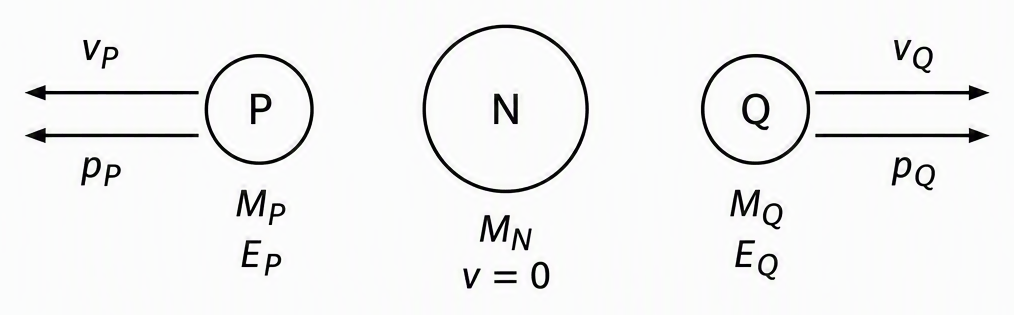
The mass defect, daughter kinetic energies and daughter speeds are denoted by:
The mass subscripts identify the nuclei. The speed-of-light symbol is:
Evaluate these four claims independently:
- A:
- B:
- C:
- D: Both fragments have momentum magnitude
Use one common momentum magnitude, not one common speed. Reduced mass follows from adding the kinetic energies.
Correct options: A, C and D
How does the mass defect give the total kinetic energy?
The released rest energy becomes the two fragments’ total kinetic energy, so A is correct. The parent starts with zero kinetic energy and zero momentum. To distinguish the daughter named Q from the reaction’s Q-value, denote the released energy by:
Energy conservation gives:
Rearranging,
The specified two-fragment reaction puts the released energy into those fragments’ kinetic energies. The recoil calculations below use non-relativistic fragment mechanics, as in the supplied official solution. Mass–energy equivalence does not require treating the fragment speeds as relativistic.
How do equal momenta lead to the reduced-mass expression?
Momentum conservation gives equal momentum magnitudes in opposite directions. Adding the corresponding kinetic energies produces the reduced-mass expression in D. Reduced mass is useful notation here, not a separate conservation law.
Since the initial momentum is zero,
The individual kinetic energies are:
Add them and factor out the common momentum term:
Define reduced mass and take its reciprocal:
Substituting into the total kinetic energy gives:
Therefore,
Take the non-negative root because momentum magnitude cannot be negative. Thus, D is correct.
For a dimensional check, reduced mass and mass defect both have mass units. Their product’s square root has mass units, so multiplying by the speed of light gives momentum units:
How do we verify C and calculate the correct energy shares?
The speeds are inversely proportional to the masses, confirming C. The kinetic energies are also inversely proportional to the masses because the momentum magnitudes are equal.
Equal momentum magnitudes give:
Dividing gives:
Hence, C is correct. Now return to the kinetic energy of P:
Substitution gives:
Expand reduced mass explicitly:
The companion result is:
The fractions add to one, as energy conservation requires:
B puts the mass of P in the numerator for the energy of P. The correct numerator belongs to the other fragment, so B is not a valid general relation.
A correct, B incorrect, C correct, D correct.
Why does assuming equal speeds produce option B?
Equal speeds would make energy proportional to mass, reproducing B. But unequal fragments cannot have both equal speeds and equal momentum magnitudes. The faulty assumption is:
It produces:
Momentum conservation instead requires:
At fixed momentum,
The lighter fragment moves faster and receives more kinetic energy. For a numerical check, take an illustrative mass ratio and total energy in arbitrary units, not measured nuclear data:
B would wrongly assign P just one energy unit. Equal fragment masses make both energy-share expressions coincide, so checking only equal masses cannot expose the error.
How do I apply this method to two related nuclear-recoil questions?
Start with equal recoil momenta, then add the kinetic energies. These original related practice questions are not additional verified PYQs.
Question 1: A stationary nucleus splits into two equal-mass fragments with positive mass defect, specified below. Find each fragment’s kinetic energy, momentum magnitude and speed using non-relativistic mechanics.
The reduced mass and equal energy shares are:
Thus,
Question 2: A stationary nucleus emits an alpha particle and leaves one daughter, with no other products. Their respective masses and the released energy are:
Find both kinetic-energy shares and the alpha-to-daughter speed ratio non-relativistically. Equal recoil momenta give:
Adding and solving,
Substitute back:
Finally,
The numerator in each energy share belongs to the other product because kinetic energy at fixed momentum is inversely proportional to mass. Check that numerator before accepting either expression.
Next step: photograph a doubt on JEEnius and photograph any question you are stuck on and get a step-by-step solution, with a free-body diagram when the question needs one (20 free).
If that step was the hard part, work through JEE Chemistry Preparation: Study Plan for All Three Branches.
Frequently asked questions
What are the correct options in the JEE Advanced 2021 fission question?
A, C and D are correct in the Paper 2 fission question. Option B is incorrect because the kinetic energy of fragment P is E_P = [M_Q/(M_P + M_Q)]δc², with the other fragment’s mass in the numerator.
How do you calculate the Q-value from mass defect?
For the specified reaction, the mass defect is δ = M_N − M_P − M_Q, and the released energy is Q_fission = δc². Since the stationary parent splits into exactly two fragments, this released energy equals their total kinetic energy: E_P + E_Q = δc².
Why does the lighter fission fragment get more kinetic energy?
A stationary parent has zero momentum, so its two fragments have equal momentum magnitudes in opposite directions. In non-relativistic mechanics, E = p²/(2M), so the lighter fragment receives more kinetic energy. It also moves faster because v = p/M.
How is reduced mass used to find fission fragment momentum?
Define the reduced mass as μ = M_PM_Q/(M_P + M_Q). Adding the non-relativistic kinetic energies gives E_P + E_Q = p²/(2μ) = δc². Each fragment therefore has momentum magnitude p = c√(2μδ).