What is the answer to the p-block elements JEE 2018 galena question?
The answer is 6.47 kg of lead per kilogram of oxygen consumed. This p-block elements JEE 2018 problem is JEE Advanced 2018, Paper 2, Chemistry, Q.8. It is a numerical-answer question, not an MCQ. Count lead from both the oxide and the remaining sulphide.
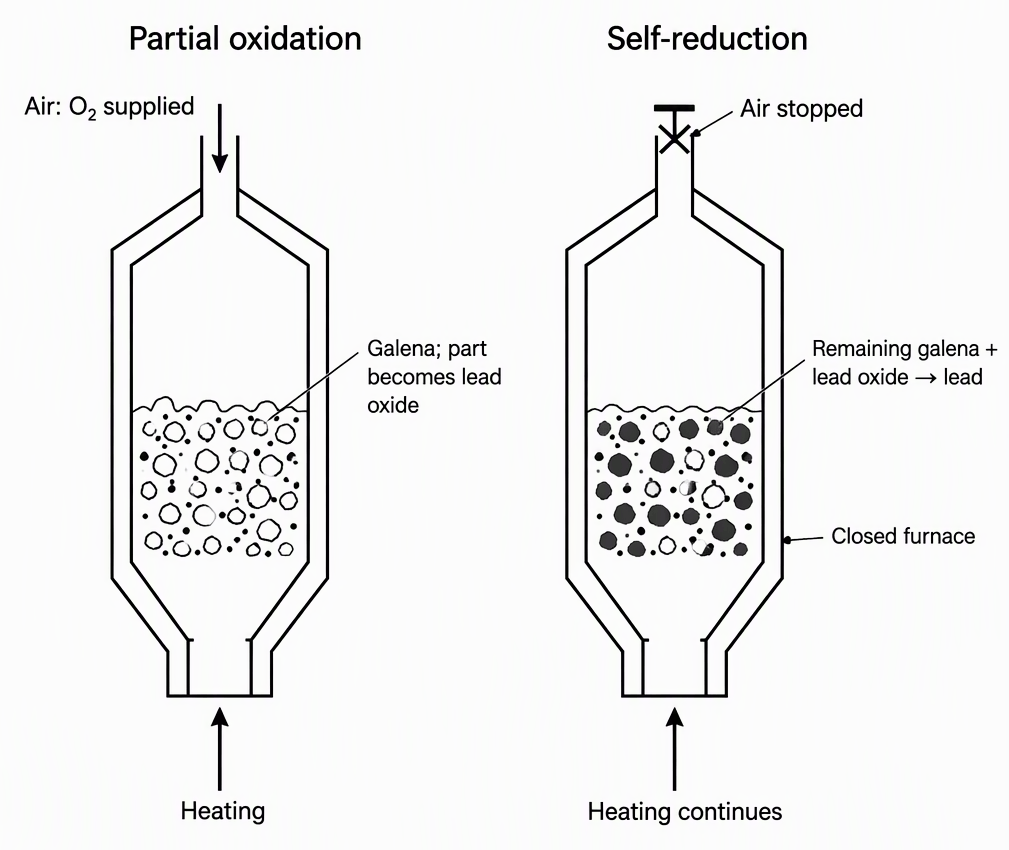
Galena is heated with air until only part of the ore has oxidised. The air supply is then stopped, but heating continues in a closed furnace, where the remaining contents undergo self-reduction.
Find the kilograms of Pb formed per kilogram of O₂ consumed. The supplied atomic masses are:
How does partial oxidation convert galena into lead oxide?
Galena is lead sulphide, PbS. During the first stage, oxygen converts only a portion of it into lead oxide, PbO, while sulphur dioxide forms. Some PbS must remain because it is a reactant in the next stage, not merely unused ore.
The official oxidation step is:
The balance is exact: 2 Pb atoms, 2 S atoms and 6 O atoms on each side. On the right, lead oxide contains two oxygen atoms and sulphur dioxide contains four.
This equation describes the portion reacting with air, not the complete initial charge. For the reaction batch used in the official solution, 2 mol of PbS are oxidised and another 1 mol of PbS is retained for self-reduction.
Why does self-reduction produce three moles of lead?
The second stage produces 3 mol of metallic lead because both reactants supply lead atoms: 2 mol come from 2 mol of PbO and 1 mol comes from the remaining 1 mol of PbS. Self-reduction means that the remaining sulphide reacts with the oxide to yield metal without a separately added reducing agent.
The official reaction is:
Add the oxidation and self-reduction equations without cancelling anything first:
Cancel 2 mol of PbO from both sides, then collect the sulphide and sulphur dioxide terms:
Oxygen is supplied during the first stage. The second stage uses the oxide already formed and does not require another supply of O₂.
This net equation summarises two stages. It does not propose a one-step mechanism in place of partial oxidation followed by self-reduction.
How does 1 kg of oxygen give 6.47 kg of lead?
The net equation gives 3 mol of Pb for every 3 mol of O₂ consumed. Use the molar mass of an oxygen molecule, not an oxygen atom:
The corresponding masses are:
The lead-to-oxygen mass ratio is:
A mass ratio has the same numerical value in g/g and kg/kg. Thus, 1 kg of oxygen corresponds to 6.46875 kg of lead. Round only at the end:
The numerical entry is 6.47. The product can outweigh the oxygen consumed because the lead comes from the ore, not from oxygen.
Why is counting only the lead in PbO incorrect?
Counting only the lead in PbO gives 4.31 kg per kilogram of oxygen, an incorrect result because it omits lead supplied by residual PbS. The source question has no answer options. This is an illustrative wrong calculation, not an official distractor.
The faulty reasoning starts correctly: 3 mol of O₂ form 2 mol of PbO. It then incorrectly counts only 2 mol of final Pb:
The method error is using an intermediate yield as the final metal yield. Self-reduction consumes another mole of PbS, whose lead must also be counted.
Add and cancel the two balanced equations before forming the ratio. That preserves all 3 mol of final Pb.
What two practice questions check the same chemistry?
The required oxidation fraction is two-thirds; 446 g of PbO needs 239 g of PbS and produces 621 g of lead. Both questions below are original practice based on this PYQ, not additional verified past-paper questions.
Question 1: In the ideal two-stage route, what fraction of the initial PbS must become PbO so that self-reduction consumes all the oxide and remaining sulphide?
Let the initial and oxidised amounts be:
The amounts left for self-reduction are:
The required oxide-to-sulphide mole ratio gives:
Thus, two-thirds must be oxidised and one-third retained as sulphide.
Question 2: If 446 g of PbO reacts completely with the required PbS, what mass of PbS is needed and how much Pb forms? Use the supplied atomic masses.
The self-reduction equation requires 1 mol of PbS and produces 3 mol of Pb:
The sulphide supplies lead as well as enabling reduction. Before calculating any mass ratio, check that every lead atom entering self-reduction appears in your final metal count.
Next step: the past-paper archive on JEEnius and search every JEE Main paper from 2002 and every Advanced paper from 2007, by year, subject or chapter, each with a worked solution (free).
Keep going with Gravitation JEE 2019: Gaseous Cloud Number Density.
Frequently asked questions
What is the answer to the JEE Advanced 2018 galena question?
The numerical answer is 6.47, meaning 6.47 kg of lead forms per kilogram of oxygen consumed. The net reaction gives equal moles of Pb and O₂, so the mass ratio is 207/32 = 6.46875, rounded to 6.47.
What is the self-reduction reaction of galena?
The reaction is 2PbO + PbS → 3Pb + SO₂. The remaining sulphide reacts with the oxide to produce lead without a separately added reducing agent or another supply of oxygen.
Why is 4.31 wrong in the JEE 2018 galena question?
The value 4.31 counts only the two moles of lead supplied by PbO and misses the additional mole supplied by residual PbS. Self-reduction produces three moles of lead, giving a mass ratio of 621/96 = 6.46875 rather than 414/96.
What fraction of galena must be oxidised before self-reduction?
Two-thirds of the initial PbS must be oxidised to PbO, leaving one-third as PbS. This gives the 2:1 oxide-to-sulphide mole ratio required for complete consumption in the ideal self-reduction step.